Govan Mbeki and the Modest Revolution
Govan Mbeki, who spent more than two decades in prison for his role in the struggle against apartheid, creatively applied Marxist ideas to South African society.
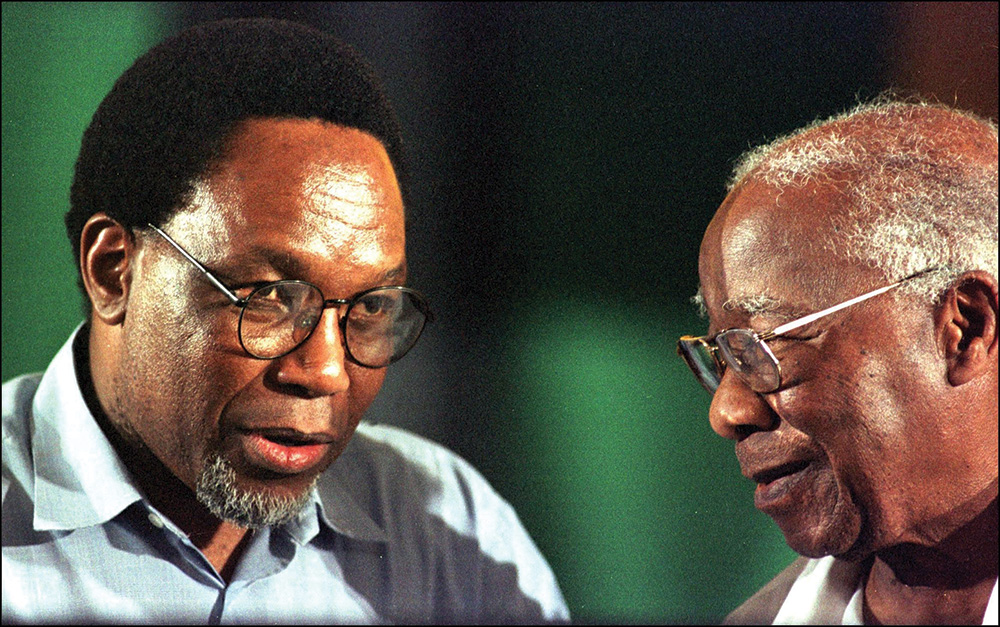
Mbeki, right, shown here in conversation with ANC secretary-general Kgalema Motlanthe in 1997, remained politically active into the final years of his life. (Walter Dhladhla / AFP / Getty Images)
Govan Mbeki’s life merged theory and practice. He was an intellectual who wrote about South African economics and politics for sixty years, a dedicated teacher who cheerfully acknowledged his schoolmasterly ways, and a journalist, researcher, and analyst.
Most prominently, he was a political activist, a member of the African National Congress (ANC) from the 1930s and subsequently of the South African Communist Party (SACP), and he emerged as a leader in both organizations by the late 1950s. When the ANC decided to struggle militarily against the apartheid regime, he became part of its armed wing, uMkhonto weSizwe (MK), overseeing a program of underground mobilization in Port Elizabeth before heading a sabotage unit in the same city.
In July 1963, Mbeki was captured at a farm in Rivonia, a suburb of Johannesburg. He was one of those prosecuted at the famous Rivonia Trial the following year, and he served twenty-four years as a political prisoner before his 1987 release.