The New Cold War Is Exposing Europe’s Fault Lines
Faced with the return of great power rivalry between the US and China and its own economic stagnation, the European Union seems as divided as ever.
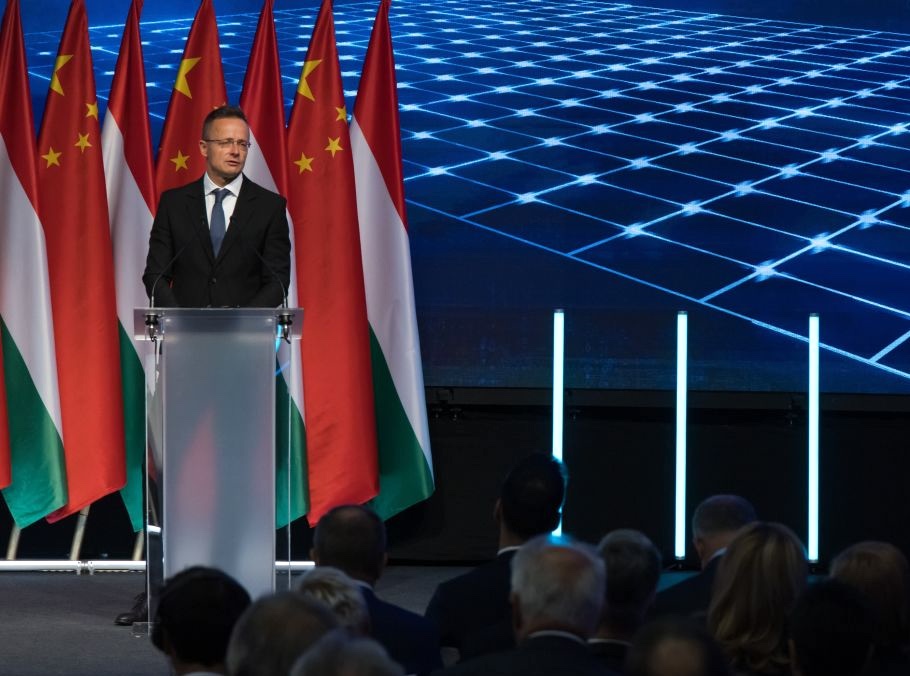
Hungarian minister of foreign affairs and trade Péter Szijjártó speaks in Debrecen, Hungary, on September 5, 2022, on the occasion of Chinese battery producer CATL’s launch of a plant in the city. (Attila Volgyi / Xinhua via Getty Images)
Something is stirring on the European Union’s eastern flank. Hungary is increasingly throwing its lot in with China and receiving billions in investment in return. Slovakia under Prime Minister Robert Fico keeps breaking with Brussels on Ukraine and edging closer to Moscow. Even in countries still aligned with Brussels — like Poland and Romania — illiberal contenders with Euroskeptic platforms are within striking distance of power. Across Central and Eastern Europe, it is becoming clear that Brussels is no longer the only game in town.
Beneath the political noise lies a rational calculus. The global economy is fragmenting thanks to increasingly unstable supply chains, disruptive new technologies, and mounting geopolitical rivalries. In response, Brussels is pivoting toward domestic capacities and strategic sectors. Smaller Central and Eastern European states are ill-equipped to adapt and benefit from that shift, as they remain dependent on external demand and foreign capital. Faced with a strategic agenda focused on industrial sovereignty, green investment, and reduced dependencies on China, which they are poorly positioned to join, some of these states are hedging by seeking external capital and partnerships that keep their old model alive. The result is a slow erosion of Europe’s internal coherence.
Europe Reacts to a Changing World
These regional dynamics are part of a much bigger story. The globalization of the 1990s now seems like a thing of the past. Call it “de-globalization,” “geoeconomic fragmentation,” or something else, but protectionism and geopolitical interference in global trade are on the rise. The global geopolitical order is increasingly bifurcating as China rises, while digitalization and the green transition challenge preexisting industrial status quos. “Disruptor” events further intensify the pressure: Donald Trump’s tariff escalations, the war in Ukraine, and the COVID-19 pandemic have each strained the flow of strategic commodities and technologies such as semiconductors, critical raw materials, and fossil fuels. The effect of these disruptions has been felt across global supply chains.