Migrant Rescue Operations Navigate a Mediterranean Bloodbath
The Seabird is a plane that monitors violence along the world’s deadliest migration route. Piloted by a German NGO, it is showing how European authorities collaborate with militias to harass people crossing the Mediterranean.
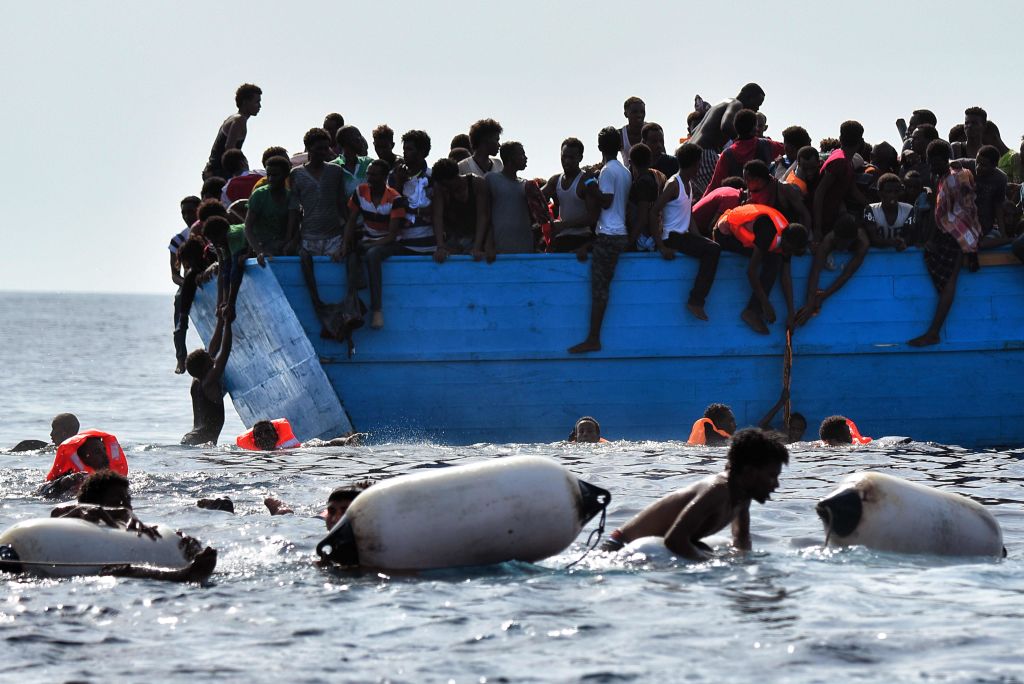
The central Mediterranean is among the world’s most surveilled stretches of water, in the search for weapons, migrants, or drugs. This makes Europe’s collective failure to prevent record deaths more striking. (Aris Messinis / AFP via Getty Images)
Beneath the water, the African landmass spears north, pushing into the Eurasian plate where Sicily meets the Italian mainland.
Atop the bedrock, the African plate’s undersea Pelagian platform raises islands into the central Mediterranean. Over the ages, prehistoric marine life sank into porous rock below its grabens, forming a 1.5 trillion-cubic-foot gas reserve.
Several million years later, British Gas sank the Miskar gas field platform into the seafloor. Its gas is pumped to a Shell-run station in coastal Tunisia that exploits weak regulation in order to flare gas, poisoning local olive groves.
We fly over Miskar as the Mediterranean changes from clear to choppy. Looking over the six-seater aircraft Seabird’s crimson wingtip, you could mistake the white wave caps for small boats. Around a thousand people have died in these waters in such fragile crafts this year; many in so-called invisible shipwrecks. Seabird is looking out for similar emergencies.

The pilot skirts Tunisia’s new militarized zone, in which monitoring flights were banned in 2024. This was a year after Tunis inked a (now-beleaguered) cash-for-border-control deal with the European Union, as its forces abducted people at sea and left them for dead in deserts. Sometimes, people crossing seek refuge on Miskar. In March this year, 116 people were recovered by charity rescue ship Ocean Viking after four nights trapped on its scaffold.
Miskar, often reached by people fleeing Libya, is a legal gray zone, abutting the Maltese and Tunisian maritime rescue areas. States exploit this ambiguity to deny responsibility for assisting stranded people. Last year a United Nations body had to order Malta to conduct a rescue following deaths on Miskar.
When we fly over Miskar’s flare stack, it is calm. I remove my headset briefly and twin engines ring like hornets. The sea seems infinite. We bank around Nadir, a sailboat with waves crashing over her bow. She is carrying seventy-two rescue survivors, among whom is a four-year-old girl offering the crew frank opinions on the quality of their biscuits and tattoos.
Seabird is an airborne eye for vessels like Nadir. Standing watch, it flies south into the tumult that Europe has nurtured at its border for decades; a lawless order that is continually expanding.
Island
Seabird is operated by German NGO Sea-Watch to monitor violence on the world’s deadliest migration route alongside its rescue vessels.
It flies from Lampedusa’s tiny airport, a fifteen-minute walk from the town center. This diminutive island, an Italian possession on the African plate, laces worlds together. There is a rural community of a few thousand in barren backcountry. There is the resort swarming with pleasure crafts and tourists, leaving barely a free inch on TripAdvisor’s “world’s best beach” award–winning Rabbit Beach. There are the refugees landing and humanitarians assisting them. And there’s the former Cold War US spy stations and air force bases, girded with new border infrastructure.

Lampedusa rises and falls with empires. After the Romans left, traces of its habitation declined until the emergence of European imperialism. Today, its energy grid depends on imported diesel, which also powers the desalination plant producing salty tap water. Drinking water comes by ferry. Fresh water trickles in a cave in the Sanctuary of the Madonna, where legends say a hermit once sheltered both Christian and Muslim refugees. Lampedusa is unique but reflects the outside world shaping it.
Even in early summer, harsh gusts whip the coast. Stiff winds bend the remaining trees, but the hardy flora mostly hug the ground. Crosswinds rattle my flight to the island as it drops sharply inward. Lampedusa is thought to have been deforested by prisoners shipped from mainland Italy before the Risorgimento. Today a carceral migration economy still frames it.
Before we land, we glimpse the Porta d’Europa, a memorial sculpture to those dead at Europe’s gateway. It is ethereal; appearing less a doorway between continents and more one to whatever lurks beyond this life. The wider island is a mausoleum for border tragedies.
Above the port, the Garden of the Just honors rescuers; in a mural above it, a local woman embraces another life-jacket-clad woman. In the archaeological museum, Roman pottery fragments sit below paintings inspired by shipwrecks. On the coast, a migrant boat trapped on a cliff has become a monument due to the impossibility of removing it.
Beside the Porta d’Europa lies a rabbit warren of crumbling old military fortifications. The door is guarded.
Exception
A day before I arrive on Lampedusa, fifty people are rescued by Italy’s Guardia di Finanza (GdF), a militarized police unit. Italy’s coast guard and the GdF carry out most rescues, but unlike seagoing NGOs, they generally operate closer to home.
They bring ashore a one-month-old baby girl from the Ivory Coast, dead of hypothermia on arrival. Charity Mediterranean Hope organizes a vigil for her, departing the steps of a church whose crucifix was donated by the late Pope Francis following an infamous 2013 shipwreck. The new Pope, Leo XIV, has now also visited. The parade pauses at the town library, where a young Palestinian woman and her friend sing an Arabic lullaby in elegy, before dispersing on the harborside promenade at sunset.

Afterward we descend to a bar carved into cliffs, hosting a concert with a brew of Mediterranean influences, slow and haunting at first, rising to foot-stamping crescendos. The tragedy is on everyone’s minds, but the mood is convivial. Despite mutual mistrust, activists and law enforcement personnel are both present and agreeing on the urgency of rescue. One older GdF agent plays “Bella Ciao” on the guitar.
Outside sits the crew of Nadir, fresh from a rescue during which Libya’s Coast Guard (LCG) — in reality, a bundle of militias — harassed and threatened them. For a decade, this force has been developed and funded by the European Union and Italy to prevent migration. Libyan forces’ extreme violence and tendency to profit from smuggling have not stemmed European funding.
Within hours of the Nadir incident, rescue vessel Sea-Watch 5 was approached in international waters by a Libyan patrol boat that opened fire with automatic weapons without warning. Boats pursued the crew and ninety rescue survivors for hours. Italy subsequently ordered the ship on a needless four-day journey to safety. Instead of holding the attackers accountable, Italy opened a criminal investigation into the captain; the latest in a string of similar cases that have all collapsed in court.

Sea-Watch has now documented seventy-seven violent incidents involving the LCG. Things reached a head in August 2025, when rescue ship Ocean Viking was fired at for twenty minutes by a European-provided Libyan vessel. The international crew (from across four continents) petitioned their respective governments to little avail. When British crewmembers asked their government to respond, a minister replied with a curt “no.”
Despite attempted murder cases lodged in France and Italy over the Viking incident, Europe doubled down. New boats were transferred to Libya in December 2025. The unrecognized Eastern Libyan government was brought into the fold, with both rival governments present on a junket to Brussels.
As the Sea-Watch 5 was attacked, Council of Europe ministers adopted the Chișinău Declaration, a bid to dilute international refugee law led by Britain’s Keir Starmer and Denmark’s Mette Frederiksen. Their position was that protecting citizens from perceived threats justified suspending rules. This hardly squares with the border machine’s outcome at sea: permitting a foreign military to attack European citizens in Europe’s backyard.
The European Commission insists its Libya financing is improving the situation. But there’s scant evidence of this, and plenty of proof that EU policy incentivizes violence. One Italian military official I spoke to privately agreed that cooperation with Libya was indefensible. But evidence of the harm being done, and even the strategy’s ineffectiveness on its own terms, goes ignored.
Shortly following the attack, humanitarians on the Gaza flotilla were abducted in international waters by Israeli forces. Minister Itamar Ben-Gvir’s revelry in violence against them produced condemnation from European leaders — which has not been forthcoming in multiple previous incidents.
Abuses beget abuses. The erosion of international law in Europe’s borderlands preceded EU institutions’ permissiveness toward genocide in Gaza, which in turn further normalized extreme violence globally. Criminalization and deportation of anti-genocide activists has stitched together authoritarian domestic and foreign policy. Immigration and Customs Enforcement raids, drownings at European borders, and great-power aggression from the United States in Iran to Russia in Ukraine heralds a politics defined by unrestrained force.
Adaptation
Last November, a doctor on board Ocean Viking during the 2025 shooting gave a presentation to rescuers on Mediterranean climate change.
The setting, a chilly hall on the Welsh coast, felt hardly right. But the numbers spoke clearly; warming sea and air is generating more intense and frequent storm systems. Climate may necessitate practical adaptation in rescue; to vessel standards, doctrine, and training. Political factors amplify problems; there is some evidence that people launch boats in dangerous weather to lower their risk of abduction to hellish Libyan detention centers.
Three months later, Cyclone Harry, the season’s eighth high-impact storm, and one unambiguously precipitated by climate change, exploded. NGOs estimated that one thousand people may have been killed in ensuing shipwrecks. Ocean Viking, finally back at sea after repairing firearms damage, recovered the body of a woman floating alone after the storm.
On Lampedusa, Cyclone Harry shattered cliffs with biblical force. Both damaging a boat belonging to EU border agency Frontex and tearing apart the gate guarding the pier where rescued people disembark, the storm did not discriminate.
Elsewhere, it compounded inequalities. It caused a deadly train derailment in Spain and a landslide in Sicily. Sicilian coastal roads, water, and power were decimated, and the paucity of government and media response provided evidence of Italian elites’ ongoing contempt for the South.
The Mediterranean is seeing another summer of record heat. As states pour public money into migration enforcement and rearmament to “protect European borders,” catastrophic threats to these borderlands go ignored. Instead, European policy further immiserates those who have left home amid escalating environmental collapse.
Oil
As the Earth heats, the United States has embarked on a military takeover of fossil fuel networks to buttress its declining power; air strikes in Nigeria, kidnapping Venezuela’s president, threats to Greenland, and a firestorm against Iran. While capitalism’s fossil fuel dependence primarily threatens planetary health through climate change, the wars it provokes are now perhaps a more immediate threat.
In the Mediterranean and Africa, the US strategy merges migration control, military power, and resource access, cutting dozens of opaque deals to dispatch deportees to African states, a policy echoed in new EU deportation legislation. Libya has been both earmarked for exploitation by Chevron, and for a US deportation camp.
As the Hormuz crisis unfolded (in turn spiking fuel costs for both humanitarian and enforcement operations on Lampedusa), Russian tanker Arctic Metagaz was attacked crossing the central Mediterranean. The raid risked environmental catastrophe. The worst was prevented, but Ukrainian and Libyan forces’ growing entanglement raised questions, especially when another explosives-laden sea drone was found drifting in the Mediterranean in May. Russia is also competing for influence in both Libyan states.
Simultaneously, Italian ships began constructing new Libya gas infrastructure. As Gulf supplies become unreliable, Mediterranean deals will become more essential to Europe, adding new incentives to disregard human rights or environmental concerns. While Italy proclaims its North Africa strategy as transcending colonial history through cooperation, its model is anchored in fossil fuel extraction, arms, and violence — as Italy revives the pledge of a naval blockade against migration.
We view the consequences from Seabird’s windows as construction below begins, and an empty stretch of sea is suddenly crowded. Amid these waters marked by the deaths of people crossing, we can also glimpse an epochal scale of death; dying seagrasses, new marine parasites, fires and storms spreading.

Neeske Beckmann has been Seabird’s tactical coordinator for the best part of a decade. Alongside crimes against humanity, she has seen what else people hide in the sea; illegal gas flaring, a dead cow dumped from a livestock carrier, and arms shipments flouting the ban on weapons to Libya, which states from Turkey to Italy stand accused of violating. Rome has bet big on its military-industrial complex, with little apparent regard for human consequences.
“We’re seeing more guns on [Libyan] boats recently”, Beckmann adds. She recalls seeing a patrol boat they were observing carrying a rocket launcher. Seabird immediately climbed clear; LCG crews have threatened to shoot down monitoring aircraft.
Crews subsequently raised the minimum operational altitude for future flights. Such is the logic of operating in war zones, but this is a stretch of water that most Europeans associate with bucolic holidays. Profiteers from across the globe are cashing in, while the Mediterranean becomes more dangerous for all.
“I don’t want to express too much empathy for [Libyan forces], because their violence is horrendous”, says Beckmann. “But I’d like them to be able to see the bigger picture; that they’re being used too; that European powers benefit from their continued destabilization.”
Above
Two days after we overfly the oil platforms, Seabird spots a Libyan boat driving south with seventeen people it has intercepted. It’s the Ras Jadir, an EU-provided vessel involved in the attack on Sea-Watch 5. Nearby, five people wait trapped on the abandoned Didon oil platform.
“It’s an assumption,” says Beckmann, “but we believe that Frontex coordinated the interception.” Their aircraft was on scene long before issuing a general distress call, she says, and Libyan patrols arrived suspiciously quickly. A 2022 Human Rights Watch report found that Frontex systematically referred people crossing to Libyan forces.
The central Mediterranean is, in fact, among the world’s most surveilled stretches of water, in the search for weapons, migrants, or drugs. This makes Europe’s collective failure to prevent record deaths more striking.

Surveillance forms many states’ vision of how a chaotic world can be made more secure and predictable, a vision that the ballooning AI-powered tech industry is keen to reinforce. All patterns, it says, can be spotted and managed. Crime can be prevented and even predicted. War can be mechanized through drones and AI targeting.
Frontex’s ambitious Mediterranean surveillance programs, comprising multinational data harvesting, drones, and satellites are an example; ostensibly about technocratic management, in practice tied to chaotically violent regimes. The violence is concealed by mechanization and distance; an airborne deus ex machina metastasizing information high above.

Airpower is inextricable from imperial logic; the development of military aviation after World War I is inseparable from surveillance and terror against colonies. A flailing US empire’s assertion of its muscle through “ruling the skies” over Iran is the newest articulation. Migration regimes also connect airborne policing and warfare. Libya surveillance is one example. Another is surging deportation flights (often involving torturous conditions and rendition to hidden camps). These are accompanied by far-right propaganda videos espousing airborne “remigration,” retooling consumerist promises of cheap air travel as instruments of race war. These shows of force themselves suck in resources, from the data center usage involved to aviation fuel.
Seabird is a small counterweight, implicitly posing alternative theories of airpower. Monitoring and rescue infrastructure showcases rapid civil evolution to extreme circumstances. But the entry barrier to airborne operations is even higher than at sea. Regulatory frameworks are tight, operations complex and expensive, and the skill sets and technologies involved are mostly the preserve of military and police forces.
Civilians have limited access to surveillance tech. Sea-Watch trains volunteers to spot potential distress cases with binoculars while flying as slow as the airframe will allow. These processes are developed through trial and error. They are transmitted to volunteers that live on the island for weeks at a time in a shared house, receiving training, orange jumpsuits, and advice to wear a diaper and take motion-sickness pills on one’s first flight. There are high risks of trauma and burnout, perhaps even more so than at sea where crews can at least often directly intervene.
As social, ecological, and technological ruptures deepen, this is one of many environments where emergency response skills are developed alongside political ideas required to apply them.
There’s one more example of the implications of counter-airpower. Last August, I met a Sudanese man who, after fleeing war, was intercepted by Libyan militias at sea. Eventually he was resettled. Rather than moving on, he became involved in advocating for those still suffering and had just returned from flying in Seabird. In the skies, he had reclaimed agency and the ability to assist others.
Our conversation took place in Mérida, Spain, at the end of a scorching summer. Spain was beginning, haltingly, to chart a different path than betting only on higher walls. Madrid recently embarked on migrant regularization, labor law enforcement, a national climate adaptation pact, tech regulation, and standing up against human rights abuses and foreign wars. This is not altruism but self-interest, a pragmatic approach to dangerous times.
The stories that disaster nationalists and fascists tell are simple. It is harder to explain how the mosaic pieces of globalized exploitation fit together. But from the air, you don’t need to: you can look out the window and see storms, pollution, militias, and forced displacement; threads stitching together a tapestry of destruction across the Middle Sea.
After a while, something altogether different emerges. Through distance, the Earth reveals itself unencumbered by transient, shifting borders. We open a window to photograph a rescue vessel below and air rushes in from a bright sea and sky. It becomes easy to imagine different realities.
Back on the ground, tactical coordinator Neeske Beckmann sinks onto a wooden bench among her crew on a rooftop overlooking Lampedusa’s picturesque harbor. After a long flight, she speaks of tiredness and resignation after years of watching nightmares unfold. But just a moment later, she looks at the sky and her shoulders straighten.
“I don’t want to live in a world like this,” she says, more firmly.
“And I refuse to accept it.”