Cory Doctorow on the Right — and Wrong — Way to Criticize AI

Cory Doctorow

Worrying about whether AI can do your job is a blind alley, Cory Doctorow argues. The real danger is AI’s bubble: a speculative fantasy built on convincing bosses to replace workers with systems that can’t actually do what their salesmen promise.
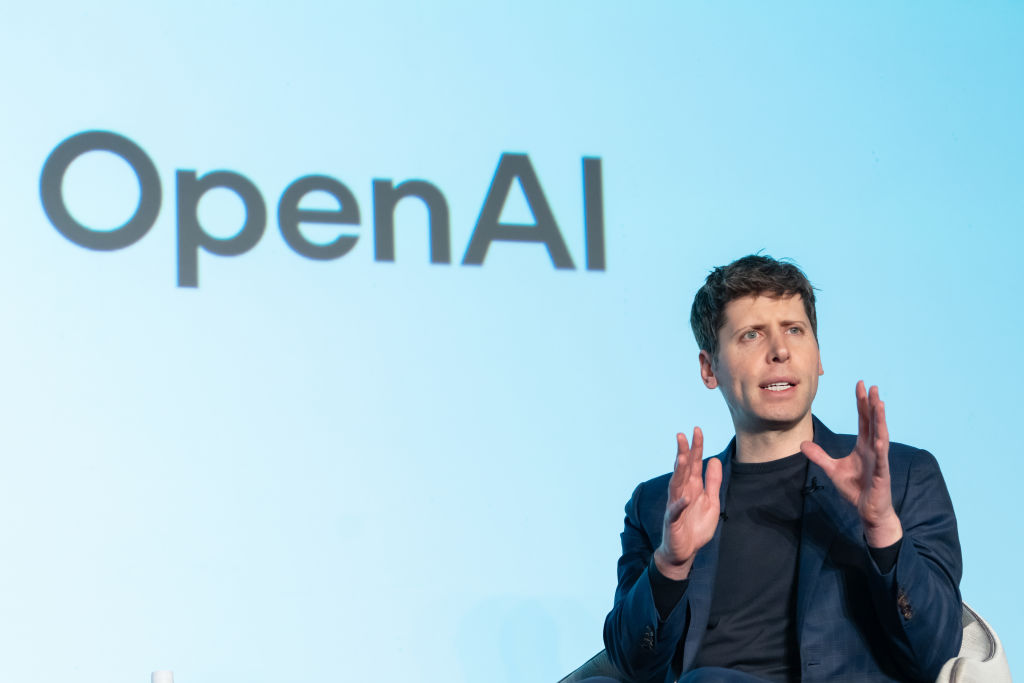
OpenAI CEO Sam Altman speaks during a talk session with SoftBank Group CEO Masayoshi Son at an event titled "Transforming Business through AI" in Tokyo, Japan, on February 3, 2025.

Cory Doctorow on the politics of AI: “As a science fiction writer, the one thing I know to be very true is that what a machine does is way less important than who the machine does it for and who the machine does it to.” (Tomohiro Ohsumi / Getty Images)


Interview by
Angela Frances Hui

As artificial intelligence continues its inexorable march through human institutions, its popularity appears to be reaching an early nadir. So far, the sector’s behavior almost seems tailor-made to provoke a negative response. In San Francisco, billboards and bus stop ads exhort employers to STOP HIRING HUMANS. Workers across the country brace for layoffs blamed on AI, and AI companies spend hundreds of billions of dollars on environmentally destructive data centers. You can’t talk to a customer service rep anymore, only a chatbot that tells you lies. AI slop is filling up social media feeds, Spotify playlists, and even academic journals and newspapers.

What is to be done?

Author and digital rights activist Cory Doctorow sets out to answer this question in his new bookThe Reverse Centaur’s Guide to Life After AI. The author of more than twenty books, including the 2025 hit Enshittification, Doctorow is well known for his perceptive and irreverent writing on Big Tech. Jacobin spoke with Doctorow about what’s driving the AI craze, how to be a good AI critic, and what we can do to protect ourselves in the age of AI.


Angela Frances Hui

I want to start off by asking about your book’s title. What is a reverse centaur, and why is it a useful concept when it comes to understanding AI?

Cory Doctorow

In automation theory, a centaur is someone who is assisted by a tool. Whenever you use a spellchecker, or ride a bicycle, you are a centaur. A reverse centaur is someone who’s recruited to assist a machine. The example everyone knows is Lucille Ball working in the chocolate factory — she and Ethel have to pluck chocolates off the assembly line and put them in the chocolate box. The owner of a machine will want to utilize the machine to its maximum throughput, because that’s how they make their money back. The human, the reverse centaur, is going to be the slowest part of the system. So, you crank up the machine to run at the very outer limit of the human being’s endurance and capability, which means that you’re not just using a person, you’re using a person up.

When you talk to people about AI, you get people who are skilled workers and historically reliable narrators of their own experience, and they tell you that using AI helps them in all kinds of ways and makes their work better. And then you meet people who, again, are skilled workers and reliable narrators of their experience, and they tell you that that very same AI tool is making them miserable, and they can’t believe how poor the quality of the work they’re producing is. My proposal here is that the answer to this conundrum is that the first group are centaurs, and the second group are reverse centaurs.

As a science fiction writer, the one thing I know to be very true is that what a machine does is way less important than who the machine does it for and who the machine does it to. That’s the dispositive question we should be trying to answer when we talk about labor and automation, whether or not we’re talking about AI.

Effective AI Criticism

Angela Frances Hui

Your book is about how to be an effective AI critic. Can you tell us more about what effective AI criticism entails and, conversely, what it means to be an ineffective AI critic?

Cory Doctorow

If you believe, as I do, that the toxic thing about AI is the bubble, then you have to attack the material basis of the bubble.

You have these very large tech firms that have saturated their markets by attaining monopolies, and they want to convince Wall Street that they can still grow, because companies that are growing have a much higher valuation than companies that are mature.

There’s this idea that capitalism has the ideology of a tumor, in that it wants to grow forever. I think that’s overstated, because it implies that capitalists want to maintain growth forever on some ideological basis. But it’s a material basis. Firms that cease growing often don’t survive the transition to becoming a mature company. They get swallowed up or destroyed. And particularly since the 1950s, we’ve had this growing trend toward compensating senior executives, and even the entire management layer, in shares. If the share price goes off a cliff, the individuals making these decisions become personally much poorer.

That’s why they are pumping the AI bubble, and why they pump bubble after bubble, to tell a growth story. And the basis of this bubble is particularly toxic: it’s convincing other firms to fire their workers and replace them with chatbots, both because it will cut their wage bills and because the prospect of having your job given to a chatbot is a powerful disciplining force on labor.

The bubble will also have a catastrophic effect on the overall economy and on workers’ fortunes. It’s not the irrational exuberance of fund managers that gives us bubbles; it’s the calculated bet that, whether or not the bubble pays off, you can transfer your overvalued assets to normie investors who will lose everything. When the AI sector crashes, we’re going to see the vaporization of about a third of the stock market, which will lead to crushing austerity.

To be an effective AI critic, you have to focus on the material conditions that amass capital for these firms. Instead of running around and saying, “AI can do my job,” you should say, “AI salesmen can convince my boss that the AI that can’t do my job will do my job.” You have to point out that invoking AI is a way of getting consumers to accept lower quality while blaming workers for that lower quality and letting bosses pocket the difference.

You also need to understand the difference between an AI demo that is morally reprehensible and disgusting and an AI demo that is materially consequential in and of itself. When they say, “We’re going to replace commercial illustrators with a pixel-guessing machine,” they’re not saying that is the source of the profits that are driving the bubble.

The total wages of all the commercial illustrators working today don’t even amount to the kombucha budget for a single training run of Midjourney. What they’re doing is just a spectacular demo, getting people in the door so they can talk about all the radiologists they’re going to fire. We can be disgusted and angry about this, but we also have to focus on what its material nature and origin is, rather than helping them sell this story about mass AI unemployment driven by replacement of workers — as opposed to mass AI unemployment driven by the destruction of the economy and the tricking of bosses.

When the Bubble Bursts

Angela Frances Hui

If, as you say, the problem with AI is the bubble and not the technology itself, what do you see as the future of AI once the bubble collapses?

Cory Doctorow

Having lived through a bunch of bubbles, I’ve come to understand that while every bubble is a sin and a crime, some bubbles leave behind something useful. WorldCom was a bubble, and the CEO can rot in hell. But at my place in Los Angeles, I have 2 gigabit symmetrical fiber that AT&T runs over old WorldCom lines it bought at pennies on the dollar. That doesn’t mean it was good that WorldCom stole all that money. It just means that out of that wreckage we have some salvage.

The AI bubble will leave behind a bunch of stuff that will be useful. If you wait long enough, you’ll be able to buy graphic processing units (GPUs) at 10 cents on the dollar, hire as many applied statisticians as you want, and run open-source models in ways that would beggar the imagination of people today who compare them to these so-called frontier models. And the genuinely useful things that AI can do, it will keep doing. Under those circumstances, we can arrange something that looks much more centaur-like, that isn’t overwhelmed by these absurd overstatements about AI’s capabilities.

Angela Frances Hui

You mention, in your book, the idea that AI is “normal technology.”

Cory Doctorow

If it weren’t for the bubble, we would call AI a plug-in. We get plug-ins for our tools all the time, and sometimes they’re useful, and sometimes they’re not. We don’t decide to reorganize the entire economy around them. We don’t decide to fire everyone and use the last seven drops of potable water left to see how far we can push them.

What we want to be aware of is characterizing AI as exceptional, even if we characterize it as exceptionally evil. Because there are a ton of investors whose heuristic is that things that are exceptionally evil are probably exceptionally profitable. And we don’t want to drive that investment story.

Angela Frances Hui

Once the AI bubble collapses, and, as you predict, these very resource-intensive foundation models stop being available, which of the social ills currently associated with AI do you think will persist, and which will cease to exist?

Cory Doctorow

We’ll probably still have AI psychosis — the AI psychosis everyone talks about, not the AI psychosis that makes your boss fire you and replace you with a shitty chatbot, which is the most materially consequential AI psychosis we have. But the one where you talk to a super pliable chatbot that convinces you to kill yourself or the people you love, I think that will still be around, because you can configure a local chatbot to do it.

We’ll still have bosses who are trying to replace their workers with automation, but there’s going to be a lot less push for it, and there won’t be all of this capital for it. Certainly, you’re not going to see governments that are proposing to reorganize their whole economies around AI the way they are today. In Canada, we have this bizarre phenomenon where our prime minister has hired a minister of AI who thinks that the way that we’re going to grow Canada’s economy is by spending billions of dollars on data centers and then firing as many workers as possible. I don’t think that will survive the calamity, because I think it’s also going to cost the industry a lot of social capital, and people will be less interested in it than they are now.

Don’t Side With the Boss

Angela Frances Hui

I’m curious about the role of cheaper and more efficient Chinese AI models in all this. Your book mentions that DeepSeek’s release made Nvidia’s valuation fall by two-thirds of a trillion dollars in one day. At the same time, some US companies, like Airbnb, have started using Chinese models, like Qwen. Do you think these Chinese models will hasten the collapse of the AI bubble or prop it up?

Cory Doctorow

I went to the Consumer Electronics Show (CES) in Las Vegas this year with Ed Zitron. He brought some of his favorite tech critics to go and make fun of it for his podcast. Everything at CES this year was just a chatbot integrated into a thing: a chatbot in a toy, a chatbot in an appliance, a chatbot in a brick wall. Our question for all of them was what they’ll do if OpenAI goes under, or if OpenAI starts charging a hundred times what they do now for tokens. And they all said they’d switch to Chinese models — which, so long as you never ask your robot companion about Tiananmen Square, may or may not work.

But the point is that if you can use a Chinese model, you can use a local model. The heart of AI mania is not just a bet that you can use automation to replace a worker but also that automation can be proprietary to the firm you’re investing in. If you can use automation to replace a worker, but the firm that generates that automation cannot capture the value of that displaced worker’s salary, then that’s important economically — and it’s important for the workers certainly — but I don’t really understand what the investment story is there. If that was your investor pitch, I don’t know where you’d get the $2 or 3 trillion that Sam Altman says that you’d need to spend in order to make the industry actually do what it claims it can do.

Angela Frances Hui

Book publishersrecord labels, and other media companies have been suing tech companies for copyright infringement, arguing that training AI models on copyrighted work is not fair use. A lot of writers and artists I know have been cheering on these lawsuits, but your book argues that legal battles like these will not ultimately benefit creatives. Can you tell us more about this?

Cory Doctorow

The argument goes that AI companies that take works to train on are breaking copyright law as it stands, and I think many people do not understand how weak and contentious a legal argument that is.

You can break AI training into three steps, all of which I think are arguably legal under copyright, and all of which are used for legitimate activities that I think most of us are very happy exist in the world.

The first step is scraping the internet and making transient copies of words. If you can only scrape the web with explicit permission from the copyright holders to the works you’re scraping, then Google is the last search engine we’ll ever get, because no one else will have the capital and the reputation to get those permissions. We would also lose our archives. Making copies of, say, a corporate website before and after the Trump administration comes in and seeing everything they’ve changed about DEI and labor policy and fairness — that’s a socially useful activity that you only get if you’re allowed to scrape the web.

Step two is performing a mathematical analysis on a work. In the case of a large language model, it’s counting words, how far apart those words are, and how often one appears near another — within one word, within two words, and so on. You don’t need a copyright holder’s permission to derive facts from a creative work. You can count all the adjectives in the lyrics on a CD or make a dictionary citing where each word was first used, and all of that would be extinguished if we created a new regime where those activities require permission.

And then, the final piece of making a model is publishing the facts. Software is a literary work; that’s why it’s covered by copyright. A model is a literary work full of facts about other literary works. It’s basically the proximity of words in some abstruse vector space that is populated by counting all the words in everything we could find. And again, publishing compendia of facts about copyrighted works is not a thing that you need copyright permission for.

Some people may disagree with me, and even people who agree with my legal analysis might wonder if we can solve our problems by wordsmithing a law that would preserve all of these beneficial activities and still prohibit the creation of AI models. And my answer to that is no.

We have been expanding copyright for forty years. Copyright covers more kinds of works — it covers more uses of those works — and statutory damages are higher and easier to secure. The media industry that pushed for those copyrights is larger and more profitable than it’s ever been, and the share of income going to creative workers is lower than it’s ever been.

The answer to this seeming riddle is that giving more bargainable rights to creative workers in a market dominated by five publishers, four studios, three labels, two companies that control all the apps, and one company that controls all the e-books and audiobooks is like giving your bullied kid more lunch money. There is no amount of lunch money you can give that kid that will get them lunch, because the bullies will take it away.

The media industry is somewhat explicit about this. When Midjourney was sued by Disney and Universal, I got a press release from the CEO of the Recording Industry Association of America that basically said, “We’re really disappointed that Midjourney took all these creative works from media companies rather than licensing them, because we could have just done a partnership.” It’s not that media companies don’t want to use AI to replace creative workers; it’s that they want to get paid for the training data and, presumably, to have some guardrails on the model that gets produced.

Really, any time you’re pushing for legislative action that your boss likes, you should ask yourself if you’re on the right side.

Plus Ça Change

Angela Frances Hui

What do you think is a more effective way for workers to protect themselves from AI?

Cory Doctorow

We’ve already got a ready-made solution for creative workers’ rights, which is that the US Copyright Office has repeatedly stated, and litigated, and gone all the way up to a certiorari petition at the Supreme Court to say that works generated by AI are not entitled to a copyright. This is the thing that creative workers should be shouting from the rooftops. If your investors get wind of the fact that you just fired all your workers, spent billions of dollars on chatbots, and you’re not going to be able to stop people from selling or giving away everything you produce from now on, they’re going to be really angry.

There’s also a group of workers who stopped AI in their tracks, and that’s the Hollywood screenwriters. And the reason they were able to do that is because they were grandfathered in for sectoral bargaining, where you get to bargain against all the employers in one sector, when the Taft– Hartley Act was passed in 1947. The Writers Guild of America and other guilds have been able to secure and expand a set of labor rights that workers in the rest of the economy, who don’t have sectoral bargaining, have lost. So, if we’re going to fantasize about passing a new law or mobilize to pass a new law, let’s make it a sectoral bargaining law. It would help every worker in America, and your boss would hate it.

Angela Frances Hui

Where else do you see opportunities for labor unions to create more of these protections?

Cory Doctorow

Anyone who cares about the future of labor in America thinks that unions need to organize more workers, and they need to have more power for the workers that they organize. And they understand that that power is going to come legislatively at the end of a nonlegislative fight. Labor rights didn’t arise because we got labor law. Labor rights arose because we asserted the rights, and then the law followed. The courts and the laws will not protect us until we unite and protect ourselves. And that’s an issue that AI is going to help precipitate, because AI is such a direct assault on workers’ power, but the answer is not any different in the age of AI than it was before AI came along.

Angela Frances Hui

Do you think that tech workers, in particular, have more power here to organize and stop some of the problems associated with AI?

Cory Doctorow

Certainly, in the sense that it’s very hard to make AI without tech workers, although tech bosses fantasize that they’ll be able to do that. I think tech workers have a great deal of urgency in this matter.

Tech workers were, for a long time, the princes of labor, because they were incredibly scarce and very, very valuable. That’s why tech bosses were so generous: there were ten other bosses at the factory gates who’d give you a job if you quit that day. We had this period in which tech workers had a lot of power, and they mistook the source of their power. They thought that they really weren’t workers at all, that they were temporarily embarrassed founders, or entrepreneurs in waiting.

They didn’t unionize when they had that scarcity-driven power, and then scarcity went away. Supply caught up with demand. We saw half a million tech layoffs in Silicon Valley over the last three and a half years, and now there aren’t ten bosses at the factory gates — there are ten other workers who’ll take your job. And we know how tech bosses treat the workers they’re not afraid of. There is nothing about programming a computer that says that you can’t be made to pee in a bottle or work until you are critically injured. There is an enormous urgency right now for tech workers to demand those rights that were always very fragile and that they mistakenly thought were eternal.