Paul Robeson Defended Jewish Anti-Fascists From Stalinism
In 1949, Paul Robeson performed the “Song of the Jewish Partisans” in Moscow, in the Yiddish original. At a time of rising Stalinist antisemitism, Robeson’s act of solidarity made clear his stand against any form of racism.
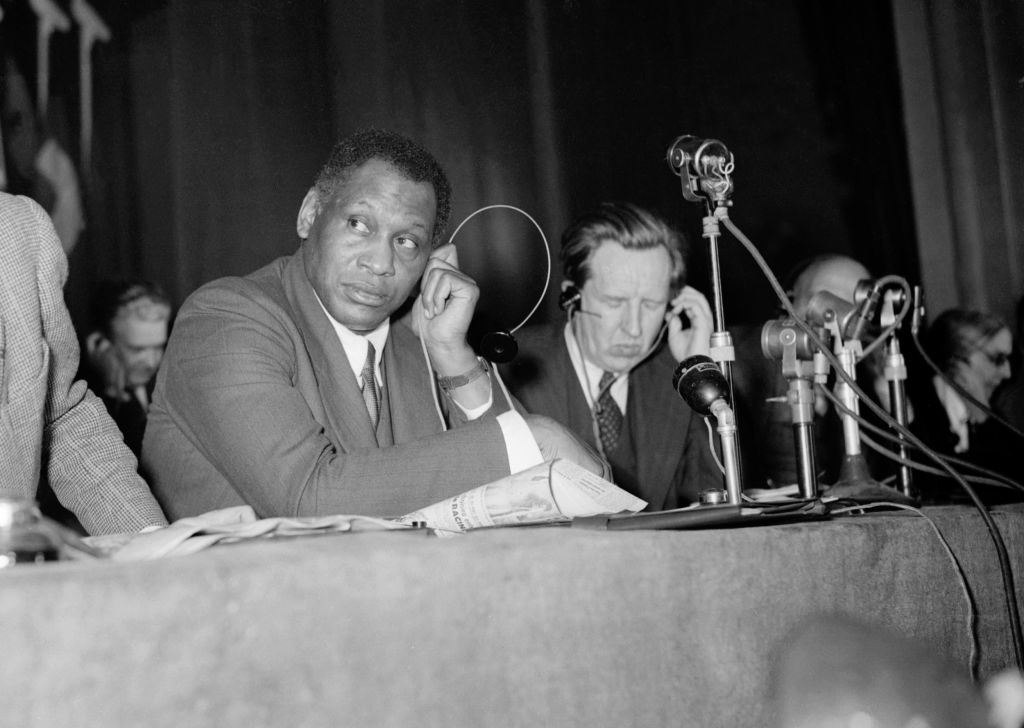
Paul Robeson listens to a speech during the Peace Partisans World Congress in Moscow on April 20, 1949. (AFP via Getty Images)
In 1949, the African American singer Paul Robeson, known for his anti-racist stand, performed the “Song of the Jewish Partisans” (“Zog nit keyn mol”) in its original version, in Yiddish, at a concert in Moscow. It was an expression of support for his friends in the Jewish Anti-Fascist Committee, at the time being repressed in the antisemitic Stalinist “campaign against cosmopolitanism.”
Fifty years after the singer’s death, the artist and activist Alexey Markin revisited this story in an exhibition in Hamburg called Entangled Voices. He also invited the Russian protest ensemble Arkadiy Kots to participate, which recorded a new version of the “Song of the Jewish Partisans” in seven languages, including Arabic and Ukrainian. In this conversation between those involved, the participants discussed the historical importance of the project and its meaning for today.
- Maria Markina
During the preparation of the recording, our song kept growing with new participants and languages, and its meaning for each of us simultaneously became more complex and more precise. In a way, for me this is also a reference to Paul Robeson himself, who according to some sources spoke more than twenty languages. For him, knowledge of language was not purely academic: he saw it as a tool for resisting oppression and strengthening human unity.
The song begins with a poetic tribute to Robeson written by the remarkable Nigerian poet David Odiase. He reads it in English and Yoruba, and then performs a verse of the song in his own translation into Pidgin English (a language that, like Yiddish, is characterized by its flexibility and its ability to absorb elements of many cultures, reinterpreting them in a new context). He is joined by performers in Yiddish, Ukrainian, Arabic, Russian, and German.
- Kirill Medvedev
In 2000, we released “Zog nit keyn mol” as part of the Transeuropean Partizan Jam — then during COVID-19, we began remotely, together with musician friends from different countries, to record Russian versions of partisan songs from various European countries. The idea is that the anti-fascist legacy unites Russia and Europe, and it is more than just an archive, more than a subculture; and this legacy must not be handed over to governments — including the authorities of the Russian Federation, who today use it to justify the war against Ukraine.
The “Song of the Jewish Partisans” was written in Yiddish in the Vilnius ghetto, by the poet Hirsh Glick, to a melody by the Pokrass brothers from a Soviet film, which in turn goes back to very ancient Jewish folk themes, possibly even from the era of the Maccabean Revolt (second century BCE). Jews who escaped from the ghetto often joined Russian and Belarusian partisans; it was in this environment that such songs were born and sung. Later, Jewish partisans together with the Red Army and the Polish Home Army liberated Vilnius. Thus, the history of Resistance is, for us, a shared European history — of partisans, the Red Army, and the armies of allied countries. This is a contradictory history that does not fit into the rhythm of a triumphant march, uncomfortable for several mainstream discourses today. We remember the forced incorporation of Lithuania into the USSR, as well as the participation of Lithuanian police formations in the extermination of Jews and the history of Soviet antisemitism.
Vilnius, incidentally, was one of the centers of the Jewish diaspora in Eastern Europe. Dozens of Yiddish newspapers were published here; the Jewish socialist Bund party emerged and operated here with its ideas of national-cultural autonomy for Jews, opposing both Zionist concepts and European nationalist and imperial models. In political and cultural terms, this was a special part of Europe and, in a sense, an alternative project of Europe.
- Inge Mandos
I first heard this song in the 1960s, during the student movement in Germany. Our parents’ generation tabooed everything connected to Jewishness as a result of an unresolved Nazi past. In relation to Jewish culture and the tradition of Yiddish songs, a black hole emerged.
We were interested in what had existed “back then,” meaning before the Nazi era — what exactly had existed and what had been suppressed. In addition, German folk songs had been used by the Nazis for propaganda purposes, so for us, who loved singing and were interested in folk music, they became unacceptable.
Therefore, after 1968 many musicians began researching what folk songs had actually existed in the German-speaking world and came across a vast repertoire of Yiddish songs. Such musicians included the groups Zupfgeigenhansel (1979) and Espe (founded in 1976), as well as Hai and Topsy Frankl in 1981. In the former German Democratic Republic, the group Aufwind had been working with this repertoire since 1984, and Lin Jaldati since 1966.
Both the silence of our parents’ generation and the unwillingness of politicians to deal with the crimes of the Nazi era triggered youth resistance. In this context, the partisan song “Zog nit keyn mol” was often performed at demonstrations and commemorative events, for example on November 9 [the anniversary of the Kristallnacht pogrom]. Particularly well known were the performances by Auschwitz survivor Esther Bejarano here in Hamburg, where the song was always performed at the end. In this way it acquired a contemporary meaning as an anti-fascist anthem with the message “Never Again!”
- Maria Markina
There is one aspect of the creation of this song that has particularly interested me.
Hirsh Glick borrowed the melody from a popular song by Jewish Ukrainian composers, the Pokrass brothers. The first performer of this song in 1937 was another Jewish Ukrainian star singer, Leonid Utesov. His performance is very spirited, exuberant, almost mischievous (he sings it accompanied by his jazz orchestra), with very free tempo and intonation (just consider the glissandi on almost every word in the final verse).
The song itself — “Terskaya March” — is dedicated to Cossacks. Given the complex and often tragic history of relations between Jews and Cossacks, one inevitably asks: How is this performance perceived in such a historical context? What exactly is Utesov singing about here, a man who may still have remembered the pogroms in Odessa?
This performance makes me think of an act of symbolic appropriation: a subject who has experienced violence, by reproducing the image of the one who carried out that violence, does not simply imitate it but redefines its meaning. In this way, symbolic authority is subverted: the image is removed from its original context and becomes an object of interpretation (an ironic one, in fact) and control.
Why did Glick choose precisely this melody for his anthem? It seems this choice is not accidental, and in it one can see an act of secondary subversion, where appropriation becomes a tool for deconstructing violence and, in a sense, symbolically appropriating its power.
- Kirill Medvedev
Yes, the “Song of the Jewish Partisans” is, in a sense, a fragment of another world with its complex connections, not always transparent to us today. In Robeson’s 1949 performance, I hear this song as a memorial hymn to the world of the Jewish working class and socialist Yiddish culture — a world that was effectively destroyed by the Nazis. Then came the campaign against cosmopolitanism, against which Robeson, within his means, spoke out. And it became a huge trauma for Soviet Jews — I know this from my own family stories. Most of them considered Soviet power their own, participated in the revolution, built socialism, fought Nazism, and then they literally felt betrayed by it. Historically, this became a powerful argument in favor of the need for a Jewish state and eventually led a large part of the Jewish intelligentsia in the USSR to develop skepticism not only toward Soviet rhetoric about the “friendship of peoples” but also toward the left project as such.
And when we see today’s global anti-universalist trend, set in motion in part by Russia and Israel — a trend in which any supranational narratives, programs, or values appear increasingly hostile — and when we see that a large part of the far-right pro-Israel community consists of people from the post-Soviet space, we are inevitably reminded of those events of the 1940s. And we sing “Zog nit keyn mol” for everyone — in Russia and Ukraine, in Israel and Palestine, in Nigeria, in Germany, and on all continents — for whom the words “peace to the peoples” still have meaning.
- Leonid Kharlamov
For me, this is primarily a work about how to remain human in a situation that can dehumanize us. An important component of a humanistic approach, in my view, is the ability to resist even in seemingly impossible conditions. First of all, one must overcome fear within oneself. Despite the dangers of protest struggle, a person is capable of suppressing instincts and, against biological logic, taking risks for the sake of justice.
Today we are witnessing processes of suppression of freedoms all over the world. Perhaps this is a crisis of capitalism but also an expression of political positions that treat people as material.
At the same time, I see youth, at least in Germany, who are ready to resist this. Even schoolchildren are organizing themselves to prevent the older generation from turning them into a gray mass.
Therefore, ideas of resistance are especially relevant now. Everyone must decide which values they are ready to defend. For this, a certain inner spirit is necessary — and such songs can reflect it.
- Ziad Nehme
When I was very young and my grandmother (who had abandoned Haifa in 1948 with three children to seek refuge in Lebanon) was still alive, I used to hear a lot about keys — Palestinians who held on to the keys of their homes and held on to the hope of returning to them some day. I remember my mother saying that her mother still had her keys in a box in her room in Tripoli.
I left home when I was twenty-three to start a new life in Europe. Nobody forced me out. I was not in immediate danger. It was my choice. And I still have a copy of my parents’ old apartment in Lebanon. It is useless now, but I will still be able to come back if I choose.
The line in my text “We left the cities, and we left the keys behind” could have easily been “We left the cities, but we held on to the keys.” It would have been more hopeful maybe, or more heroic. But I am not hopeful. And I am not heroic. My grandmother never returned to her first home. I will not go back to my first home. Many people across the world will never return to their first homes. They will make new ones. Holding on to the keys feels each day less like hope and more like a trap of nostalgia and delusion.
- Maria Markina
When you discuss this story, everyone has a very clear idea — what is right and what is wrong, how one should have acted in his place. But in reality, the longer you look at it, the harder it becomes to decide what exactly Robeson should have done. And why do we tend to project onto someone the role of a savior and expect action and responsibility from another person rather than from ourselves? Perhaps it is precisely this ambivalence that gives the project its main strength for me — the acceptance of a complex picture of the world. Like Robeson, we make our own choices, and behind each choice there is a reverse side that we should remember.
At the preview of the exhibition, we were asked a question: What does a partisan song mean to you? And I thought, really, who is a partisan here for whom? And are we even in the same unit?
I cannot give a definitive answer. This is an important aspect of the multiplicity of languages in the song — none of us understands them all. At some point, everyone loses control and finds themselves in a vulnerable position, where they must make an effort to understand the other. One would like to believe that we are singing about the same struggle, but that is partly a utopia. And yet the very fact that we gathered and performed this song together shows: utopia is possible when we are ready to hear the other, to see the world in its complexity, and to support each other despite differences.
- Alexey Markin
Robeson was able, despite all the complexities involved, to remain faithful to his internationalist convictions and to the American tradition of black-Jewish alliance — the mutual support of black and Jewish communities in the struggle for equal rights. It seems to me that the moment for forming political alliances between different oppressed groups has arrived in contemporary Russian history as well. In simple terms, we need to unite in order to reclaim our civil rights in Russia — rights that the current political regime systematically violates: through the absence of free elections, the suppression of dissent, military censorship, forced conscription, and ultimately through discrimination against citizens on the basis of nationality and religion, as well as sexual orientation and gender identity. And of course, all these problems concern many countries or may concern them in the near future. In this sense, Paul Robeson and the history of the American civil rights movement can become a source of inspiration and practical lessons.
Paul Robeson is one of the most legendary figures of the black civil rights movement in the Soviet context, alongside W. E. B. Du Bois and Angela Davis. In the USSR, he was an extremely popular singer, known and loved by generations. Robeson first came to the Soviet Union in 1934 at the invitation of Sergei Eisenstein, and after that he visited the country six more times; his last visit took place in 1961, when he came for medical treatment — precisely during the period of Yuri Gagarin’s flight into space.
In my doctoral dissertation, I examine the representation of African Americans, including Robeson, in Soviet art, while in the artistic project his role as a political activist in Soviet history comes to the forefront — a role that, in my view, needs to be rethought. On the one hand, Robeson rightly belongs in the pantheon of black civil rights fighters in the United States. On the other hand, he never developed a consistent critical position toward Stalinist repression, although he had both the necessary knowledge and personal connections with repressed Soviet citizens. Some of these people died literally in front of his eyes, and he was unable to help them, despite certain privileges and connections within the Soviet establishment.
Yet he accomplished something virtually impossible by Soviet standards — to make a unique gesture of political solidarity with the victims of the antisemitic campaign against “rootless cosmopolitans.” In 1949, at Moscow’s Tchaikovsky Hall, he performed the Jewish partisan song “Zog nit keyn mol” as an encore. Robeson dedicated this performance to the actor and chairman of the Jewish Anti-Fascist Committee, Solomon Mikhoels, who had been murdered by Soviet security services. All of this took place in public space and moreover was broadcast on the radio across the entire Soviet Union.
This political statement, unimaginable for Soviet citizens, became a gesture of defiance and a symbolic subversion of official Soviet policy.
The exhibition includes two films: one is a new music video for the “Song of the Jewish Partisans,” and the other is an interview with the project participants. Even before the start of our collaboration, during the preparation for the project, I came across a video recording of the performance of the Jewish partisan song by the group Arkadiy Kots. I was struck by the way it completely reinterprets the musical tradition of performing this song — not as a martial march but as a work connected to a deeply tragic moment in history. It then occurred to me that within our project we could create another version of this song — but based on a collective agreement about how it might sound today: in the specific historical moment of the wars in Ukraine and Gaza, and in a specific place — Hamburg. A city where, on the one hand, the Holocaust took place, the consequences of which have not disappeared, and on the other hand, there exists a very rich tradition of political resistance.