Paul Robeson Spent His Life Fighting Against America’s Extreme Right
Paul Robeson, the socialist actor, musician, and civil rights campaigner, dedicated his life to battling against right-wing red-baiting that has echoes in reactionary crusades against progressive education and “critical race theory” today.
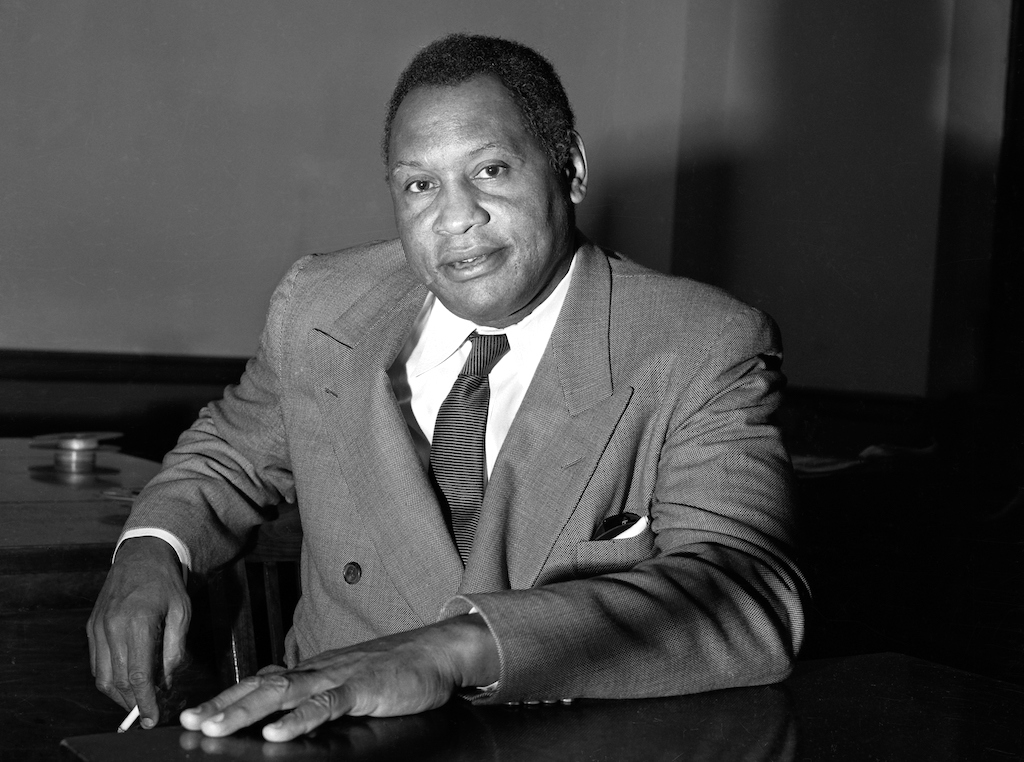
Paul Robeson at a press conference in New York, September 20, 1949. (Bettmann / Getty Images)
An hour north of New York City just past the Hudson Line’s Peekskill station, a golf course sprawls along ponds, sand dunes, and weeping willows. Before this idyllic green was carved from the wooded valley, my friends and I knew it as the defunct Hollowbrook Drive-In. With a giant L-shaped mid-century sign fading above an entrance on the far edge of a traffic circle, I recall during my middle and high school years the skunk weeds and dandelions breaking through asphalt that sprawled beneath a long-neglected screen. I pictured old films playing in black and white. But four decades before, the world-beloved actor, singer, activist, and lawyer Paul Robeson produced a concert here. What that concert spurred made our town infamous, associated forever with the phrase “Peekskill riots.”
It was late August when Robeson arrived. The concert was a fundraiser for the Civil Rights Congress, one of the many progressive organizations that fell victim to a right-liberal backlash against the social and economic policies of the Franklin D. Roosevelt (FDR) era. The start of the Cold War gave succor to conservatives eager to put brakes on a civil rights movement, whose most forceful advocates were radicals and socialists.
The day of the riots, Robeson and his entourage saw a burning cross on the hill above; racists pelted and flipped over some of the singer and his crew’s cars; rioters effectively blocked the concert to supporters; and mobs slinging racial epithets against blacks, leftists, and Jews injured a dozen. A week and a day later, the concert proceeded. But damage was done: the Ku Klux Klan (KKK) gloated and plastered Peekskill with posters adorned with phrases lifted from fascist rioters during Kristallnacht.