Trump’s Deportations of Palestine Activist Students Aren't Over

After successfully challenging deportation orders in court last year, Palestinian student activists Mahmoud Khalil and Mohsen Mahdawi are facing renewed attacks from the Trump administration. Their persecution is meant to chill political speech broadly.
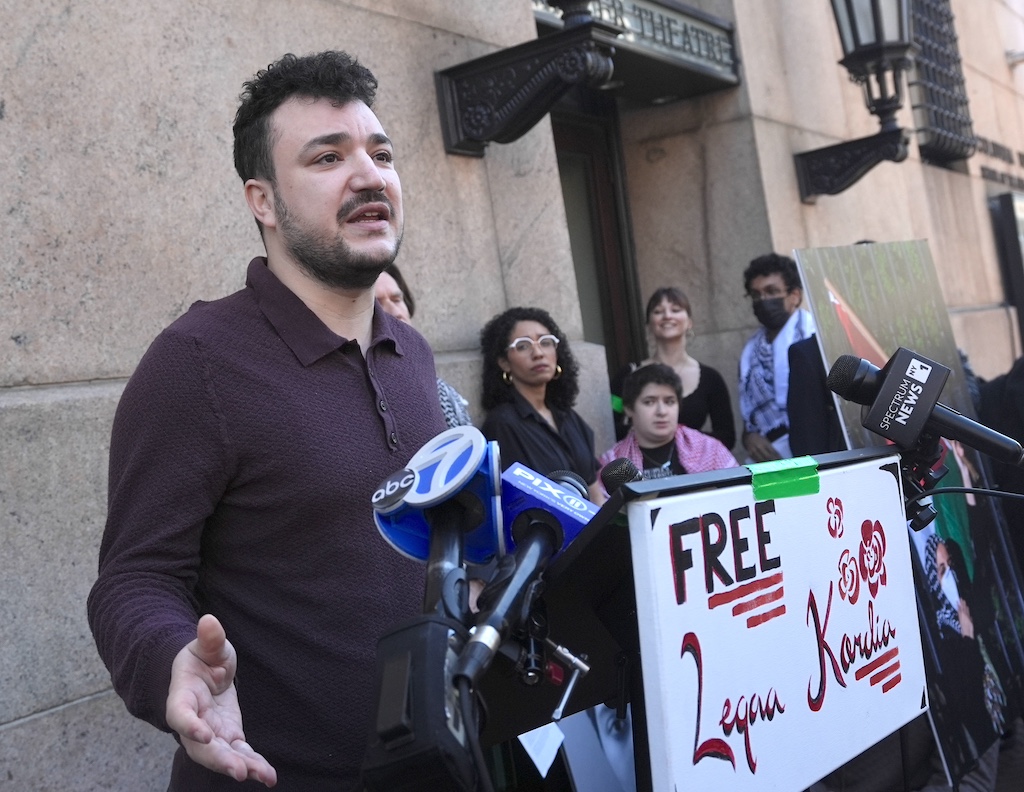
Mahmoud Khalil speaking at a podium with a sign that reads "FREE Leqaa Kordia."

Columbia University has been shamefully silent about the US government’s continuing attacks on the rights of Columbia alumnus Mahmoud Khalil and current student Mohsen Madahwi. (Selcuk Acar / Anadolu via Getty Images)


On March 8, 2025, Immigration and Customs Enforcement (ICE) entered a Columbia University dormitory and abducted Palestinian activist Mahmoud Khalil. Mahmoud was a recent graduate of Columbia, a legal permanent resident, a husband, a soon-to-be father, and, ultimately, a detainee. In his 104 days in custody, he missed the birth and first two months of his son’s life.

Weeks after Mahmoud’s detention, Mohsen Mahdawi, another Palestinian Columbia student activist, traveled to a scheduled immigration appointment, a final step in his green card process, only to find ICE waiting for him. Mahmoud and Mohsen successfully challenged their deportations in federal court, but now, more than a year after their initial detentions, both activists face a renewed effort by the Trump administration to force their deportations.

The government has not alleged that Mahmoud or Mohsen committed crimes, violated the terms of their visas, or posed any actual security threat. It has, in its filings and public statements, cited their political activity in the form of their speech, their affiliations, and their presence at demonstrations against Israel’s genocide in Gaza. Visa revocation and deportation proceedings operate largely outside the scope of the procedural protections that constrain criminal prosecution. No legitimate due process is afforded in these instances; the state does not need to prove that an individual did something wrong, it just needs to show, with considerable latitude, that your presence is contrary to “national interests,” a justification that is deliberately ambiguous enough to label the protest of a genocide as “anti-American.”

This is not a novel development. Political dissidents have long been persecuted through legal mechanisms such as immigration enforcement. The targeting of Mahmoud and Mohsen is simply the latest episode in the US security state’s long history of repressing dissent, including the use of the Espionage Act against socialist organizers during World War I, the Second Red Scare of the McCarthy era, and COINTELPRO’s attacks on black radicals and other New Left activists.

The Trump administration’s vindictive fixation on Mahmoud and Mohsen threatens to set a dangerous precedent. If immigration status can be leveraged against political speech, then the roughly one million international students currently in the United States are politically vulnerable in a way their American peers are not. International students may be able to participate in campus life, but the cost of dissent for them is existential in a way that has no domestic equivalent.

The result is a tiered system of political rights, in which the material consequences of dissent are unbearable for one group even though political speech is not explicitly proscribed. You don’t need to ban a protest, after all, if you can simply deport the organizers. The state has always understood this; the threat of job loss, deportation, or blacklisting has historically done far more to suppress labor and political organizing than outright prohibition.

This chilling effect is not limited to international students. Faculty who advise, support, or publicly defend targeted students assume institutional liability, as department chairs make risk calculations to determine which academics can be thrown under the bus to placate the federal government. Universities, already structurally dependent on federal funding and responsive to donor pressure, are forced to adjust their educational frameworks and intellectual independence in pursuit of “institutional neutrality.” Domestic students watch all of this and naturally reconsider what kinds of organizing are permissible.

Repression of this kind works by making an example of a few individuals. One high-profile deportation does the work of a thousand policy memos, at a fraction of the cost, and with little political accountability because the targets are noncitizens.

The broader stakes are not primarily about the health of American research output or our global competitiveness, though those are real concerns. The deeper issue is about political power and who gets to wield it. Universities have historically been sites where subordinated groups have developed intellectual and organizational tools to combat oppression. That is part of what makes them threatening to a political project like the one being pursued by the current administration, whose agenda involves rolling back the gains of prior social movements and reasserting social hierarchies that past decades have disrupted. Cracking down on Palestinian organizing on campus is not incidental to that project but an instance of it.

Columbia’s Silence

The administration of Columbia, a university that has employed prominent and dissident Palestinian academics like Edward Said and Rashid Khalidi, has largely accommodated the Trump administration’s blatant repression. Operating under intense political pressure and facing the threat of funding cuts, it has responded with meaningless bureaucratic rhetoric and silence on the underlying issue. In refusing to explicitly name Mahmoud and Mohsen in any statements, Columbia is complicit in the state’s attacks on their rights.

This complicity reflects whose interests the institution of the modern American research university actually serves. Columbia has a $14 billion endowment, a board composed largely of financial and corporate elites, and a history of prioritizing institutional stability over faculty governance and student rights. When the federal government and the donor class align against a group of student activists, the administration’s calculus is not difficult to predict.

Days before Mohsen was detained, he wrote to Columbia University administrators, “I am writing to you with a final plea for urgent help. My life is in danger, and Columbia University’s inaction is putting me at further risk.” Columbia remained silent. In a closed-door student government session, former senior university executive vice president Gerald Rosberg reiterated the assertion that Mohsen engaged in “threatening rhetoric and intimidation,” the very same allegation Secretary of State Marco Rubio cited in his memo urging Mohsen’s deportation.

When ICE agents misrepresented themselves to enter a dormitory and abduct Columbia student Ellie Aghayeva this past February, the administration immediately released a statement indicating their support for her release. No such statements have been made on behalf of Mahmoud, Mohsen, Leqaa Kordia, or the dozens of other students harassed, shamed, doxed, and attacked for their positions against the Gaza genocide.

For an institution that regularly boasts of its history of student activism, Columbia today seems all too happy to aid and abet the Trump administration’s campaign of repression. But the renewed attacks on Mahmoud and Mohsen mean university leaders have an opportunity to reset this institution, to redeem it in the eyes of its student body, and to reaffirm Columbia’s commitment to a more just world. As student activists at Columbia and New York University, we are calling on outgoing Columbia University President Claire Shipman to end her tenure with an act of courage by saying their names at this year’s commencement: the names of Mahmoud Khalil, Mohsen Mahdawi, and every Columbia student targeted by the Trump administration for the crime of speaking out against wanton violence.

What is happening at Columbia is not only relevant to one campus. When our universities silence dissent, sit still as our peers are arrested, and choose donors over a commitment to democracy, the rights that are eroded are not just those of students. They are everyone’s.