The Rise and Fall of Puerto Rican Independence

In the 1940s, the gradual unraveling of colonialism offered hope to Puerto Ricans demanding independence. But the archipelago was of military importance to the US — so Washington used economic threats and repression to retain it.
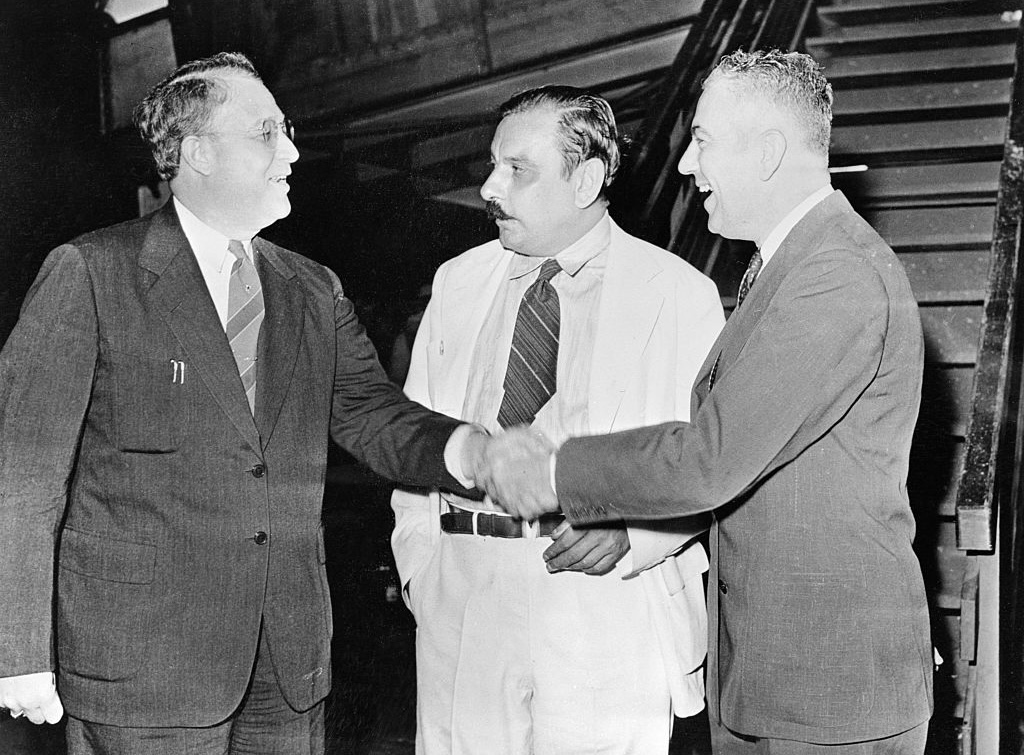
Rexford Tugwell Being Congratulated by Guy J. Swope on Governorship

In the 1940s, Puerto Rican independence seemed like it was a real possibility. But Washington claimed the island’s economy could not survive without the US and deployed the FBI to persecute and covertly disrupt groups fighting for independence. (Bettmann / Getty Images)


When President Franklin Delano Roosevelt and Winston Churchill signed the Atlantic Charter in 1941, committing themselves to “respect the right of all peoples to choose the form of government under which they will live,” it looked as if the era of colonialism was finally coming to an end. In Puerto Rico, many felt that Luis Muñoz Marín, who would become the island’s first democratically elected governor in 1949, would come out strongly for independence.

In August 1943, 1,800 delegates and 15,000 supporters had gathered at the Sixto Escobar Stadium in San Juan, Puerto Rico, to launch the Pro-Independence Congress (CPI). Uniting leading figures in the Popular Democratic Party (PPD) with left-leaning nationalists and communists, it was a single-issue political movement whose ideals, as Muñoz Marín said in a message to the event, “without doubt are those of large numbers of Puerto Ricans.” A year later, Muñoz Marín and the PPD committed themselves to a plebiscite on the island’s status in these terms:

The PPD, opposed as it is to the permanence of the colonial government regime, solemnly undertakes to submit to the direct decision of the people of PR [Puerto Rico], no later than world peace is achieved — not through organizations or intermediaries in any form, but directly to each voter — in a vote entirely apart from elections, the consultation on the final political status that the people want for the full exercise of their rights and the best development of their future.

That promise had allowed Muñoz Marín to go into the elections on November 7, 1944, assured of the support of independentistas while, at the same time, neutralizing the issue by insisting that votes cast for the PPD “will not be interpreted in any way, nor under any circumstances, as votes in favor of any political status.” It worked perfectly: the PPD won 65 percent of the vote and attained a virtual monopoly in both houses.

The contradiction inherent in Muñoz Marín’s position was not, however, lost on the FBI in San Juan. At their weekly meeting with representatives from the Office of Naval Intelligence and the army’s equivalent, G-2, the unanimous view was that “the independentist element within the PPD would soon align themselves against Muñoz Marín and that a split would occur within the ranks of the PPD even before the first legislature met on February 3 [in 1945].” They were only a week off. On February 10, 1945, the PPD leadership banned its members from belonging to the CPI, which, it said, had “become an organization dedicated to attacking the PPD.”

That same week, Rexford Tugwell, the New York–born governor of Puerto Rico, used his annual budget message to nail his colors firmly to the American mast. Puerto Rico, he argued, “could not exist alone” because “unlike Cuba and Santo Domingo, it doesn’t have vast unused lands.” He continued:

With various assistances from the United States, it has achieved a higher level of living than prevails in any neighboring island and one which could not be maintained in isolation. The United States, for its part, needs a secure arrangement for military and naval bases here in the central Caribbean.

Tugwell claimed in his statement that he was “for change” and that Puerto Ricans ought to have “complete separation” if they “freely choose” it. Nevertheless, having said that independence advocates should not impose their view “by force, by chicanery or by demagoguery,” in the next breath he warned that Washington could penalize Puerto Rico financially if it opted to break away and argued for a US veto over the options put to a referendum. In a passage that would cause a furor and set a pattern for decades to come, he wrote:

It would be unfair to propose a plebiscite which had not been authorized by the Congress. To do so would be to ask Puerto Ricans to choose among alternatives which might seem completely unreal. Their choice would naturally, for reasons of self-respect, not be given to one which they knew beforehand they could not attain. Fairness to everyone requires that the Congress offer the choices it is willing to accept rather than to require that Puerto Ricans should petition for status with the risk of rejection.

The kindest interpretation of Tugwell’s inconsistency is that he was being realistic. Yet in arguing that it would be unfair to offer Puerto Ricans a choice that would not be acceptable to Washington, he was also being disingenuous about the benefits of the colonial relationship. His assertion that living standards were higher than in neighboring islands but could not be maintained without “various assistances” from the United States was at odds with what he would write shortly after leaving office about the impact of colonialism on Puerto Rico being “no better” than Britain’s “unforgiveable” treatment of Barbados, Trinidad, and Jamaica. Writing in The Stricken Land that the United States “had taken Puerto Rico by force and, without her consent, had closed her within our tariff system,” he said this had meant “her coffee had lost its market in Europe” while having “forced her to pay perhaps 30 percent more than she would have paid, say, for Burmese rice.” It had, he added, “taken away her livelihood and then had required her to support, out of her impoverishment, the far more prosperous farmers and processors in our States.”

Whatever the contradictions, Tugwell’s annual budget speech suited Muñoz Marín in timing and substance, and he was quick to show appreciation, saying that Tugwell “does us the service of giving us his personal opinions, the fruit of a sincere preoccupation for our future.” His only caveat was that “when the United States Congress submits to our people different solutions that it is willing to implement, we Puerto Ricans will also have the opportunity . . . to reject them if all the solutions proposed were contrary to the judgment of the people about our own destiny.” Given that Muñoz Marín knew there was virtually no support in Congress for either statehood or independence — for which a bill was being proposed at the time by Senator Millard Tydings — he was in reality saying that Puerto Ricans would only be offered either the status quo or whatever expansion of “self-government” he managed to negotiate with Washington. Muñoz Marín had not yet settled on a name for his own option — though he would soon start using the word “commonwealth” — but Tugwell’s speech and his response had signaled the direction of travel.

The CPI, meanwhile, was furious. Its leader, Gilberto Concepción de Gracia, accused Tugwell of falling into “the demagoguery that he tried to impute to others,” charging:

The governor talks about the Atlantic Charter and declares that its principles should have been applied to Puerto Rico a long time ago, but he immediately speaks out against those who defend the principle of nationality . . . and tries to cast shadows on the supporters of independence. I energetically reject all of your veiled accusations and reaffirm with the greatest emphasis that the Puerto Rican independence movement is a movement of order, absolutely democratic, respectful of the law, which demands the validity in our land of the principles for which Puerto Ricans have fought and died on all fronts of the world.

After four years in Puerto Rico, Tugwell must have known there would be a backlash. He had been, for many Puerto Ricans, the acceptable face of Washington rule, a liberal who wanted to improve the island’s economy and distribute resources more equitably. Enemies of the New Deal dubbed him a socialist and claimed Puerto Rico had “gone completely collectivist” under his stewardship. Yet on the issue of independence, he was no different from most Washington politicians and could not see the double standard in quoting the Atlantic Charter while insisting that US bases had to stay and that “self-determination” should be limited to what was acceptable to the colonial power.

Tugwell would be long gone by the time Muñoz Marín’s hybrid “commonwealth” option had evolved into a deal that, in the words of César Andreu Iglesias, was “nothing more than an amendment” to the legislation under which the United States had been ruling Puerto Rico. To secure its acceptance, Muñoz Marín would be ruthless and the battles would sometimes be bloody. Through it all, he became increasingly reliant on the FBI and its anti-communist rhetoric and repression to defeat those who wanted independence, regardless of the tactics they actually favored in trying to achieve it. Nationalists who used violence were dubbed communists. Communists who opposed their methods were accused of “a conspiracy to overthrow the US government . . . by force and violence.” The paradox of Puerto Rico’s supposed autonomy was that it came with ever more intrusive intervention from Washington’s political police force.

Puerto Rico has remained trapped in the “commonwealth” status that was accepted in a take-it-or-leave-it referendum in 1952. It was sold at the time as offering political freedom with economic benefits but — as even some of its advocates later admitted — it did not end colonialism or allow the island to become more than a source of cheap labor and an avenue for tax breaks.