How Massachusetts Teachers Transformed Their Union

Max Page

Outgoing Massachusetts Teachers Association president Max Page reflects on a decade of rank-and-file reformers turning a cautious, staff-driven union into a militant, member-led force by striking, winning stronger contracts, and pushing to tax the rich.
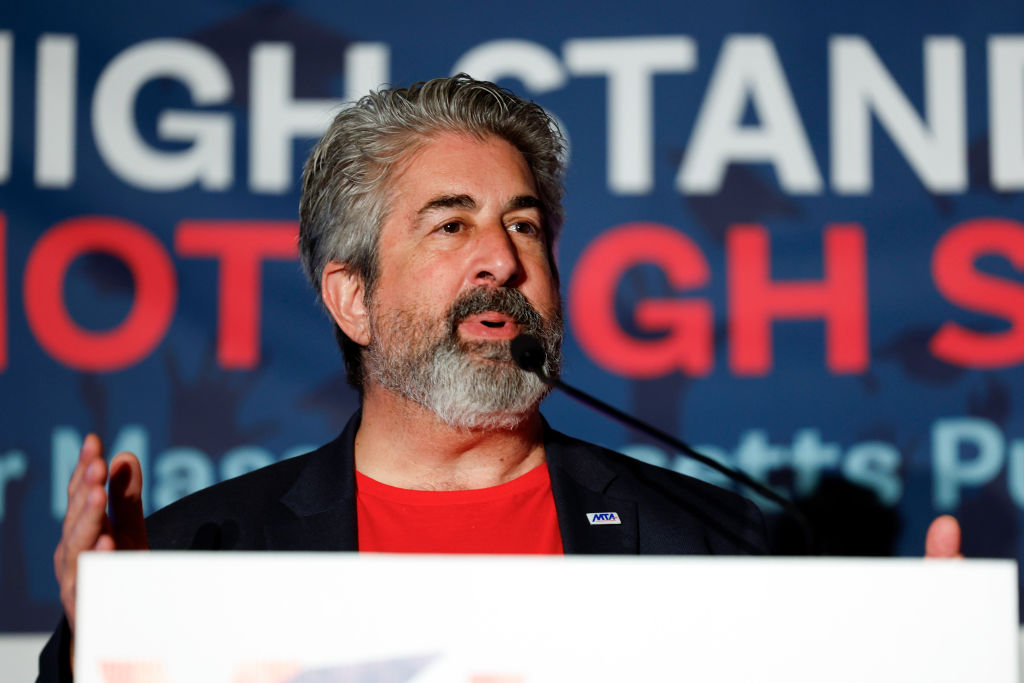
Max Page speaking during an election watch party at the Fairmont Copley Plaza Hotel. (Danielle Parhizkaran / the Boston Globe via Getty Images)


Interview by
Chris Brooks

Max Page is president of the Massachusetts Teachers Association (MTA), one of the largest state affiliates of the National Education Association and the largest union in New England, representing roughly 117,000 education workers from pre-K through higher education. A professor of architecture and history at the University of Massachusetts Amherst, Page is one of the founding members of Educators for a Democratic Union (EDU), a reform caucus that has spent more than a decade reshaping the MTA’s politics, structure, and strategy.

Page is the third consecutive EDU-backed president, following Barbara Madeloni and Merrie Najimy, and is serving the second of his constitutionally limited two terms. The election campaign for his successor is currently underway. Under EDU’s leadership, the MTA has moved from a relatively cautious, staff-driven union, which had too often gone along with destructive education reform policies, toward a more militant, member-driven model centered on democratic bargaining, strike readiness, and large-scale “common good” campaigns like the successful effort to tax millionaires and expand public investment.

Jacobin columnist Chris Brooks spoke with Page about what it takes to successfully drive a reform agenda, how high-participation bargaining changes both outcomes and consciousness, and why taxing the rich has become central to rebuilding working-class power.


Chris Brooks

You are the third EDU candidate to serve as president. What are some of the key lessons from more than a decade of union reform?

Max Page

Barbara Madeloni was put forward by EDU with the goal of democratically influencing the politics and direction of the union, but we didn’t think she would actually win. Then, in a surprise to all of us, she did.

But she didn’t win with a slate. So she had a vice president and a majority of the MTA board who actively opposed EDU. When we won that first election, the view among the incumbents wasn’t that the membership had voted for change. It was that we had invaded their private club. They fought us bitterly.

In the next election, we ran an entire slate. Merrie Najimy was elected president; I was elected vice president. This was important, because we didn’t know if Barbara’s victory was just a flash in the pan. Barbara is very charismatic and ran against a weak candidate. So was that all it was, or were we capable of building a real movement?

The EDU slate’s victory proved we had consolidated support and were growing. That’s what made it possible for me to serve two terms as vice president, and now two terms as president.

We are following through on the ambitious goals we set when we first formed the caucus: we said we were going to tax the rich, end high-stakes testing, implement a program of democratic, high-participation bargaining, and win living wages for all education workers, especially our education support personnel. We have made major progress on all of these goals.

The lesson from the past twelve years is that you need both a caucus and a plan. And that plan needs to be rooted in the core issues of the membership. We were clearly pushing our union from the Left, but we were centering that push on the most widely and deeply felt concerns of our members.

It’s not enough to have principles. You have to have a real program. We talk about EDU as a shared project we’re collectively advancing, with specific goals and actual organizing plans to win them.

Chris Brooks

The MTA played a major role in passing the Fair Share Amendment, a statewide initiative that amended the state’s constitution to impose a 4 percent tax on incomes over $1 million. Had the union been active in organizing the public around progressive initiatives before?

Max Page

No. In the past, the MTA was mainly the bank that helped to fund defensive fights, like when there were efforts to eliminate the state income tax. That started to change when Barbara was elected. The first big decision was to fight a charter school expansion initiative pushed by the Waltons and the Kochs in 2016. If the billionaires could privatize the best public school system in the country, then the rest of the dominoes would fall across the country. We decided, led by Barbara, that we would refuse to cut a deal and would fight it all the way to the ballot, even though the polling looked bad for us. By accessing the public’s deep commitment to public education, we were able to turn a 2-1 defeat into a 2-1 victory.

That victory gave us confidence to go from defensive fights to offensive ones. We became central players in the Raise Up Massachusetts coalition. I give a lot of credit to our SEIU (Service Employees International Union) comrades who helped form the Raise Up coalition — an independent, labor, community, and faith coalition advancing fights via the ballot to win advances for economic justice. We joined their campaign for sick leave and then became core members for the fight for a $15 minimum wage and paid family medical leave, and then the Fair Share Amendment, taxing the rich to fund public education and transportation. This is a core belief in the EDU caucus, which was ultimately embraced by the whole union: that if we care about what happens inside public schools and colleges, then we better care about the lives of students and families outside of them.

In the past, the MTA narrowly focused on curriculum, school funding, and contracts. But as great as our educators are — and I think Massachusetts has the best in the country — we cannot overcome the effects of poverty and racism in the classroom alone.

So our union has taken the position that a $15 minimum wage is education reform. Paid medical leave is education reform. That is real reform, the kind that will have a very real impact on our students and their ability to learn and be successful.

The trick of corporate education reformers was simple. They demonized educators and our unions, said we only cared about ourselves. It’s true that the educator is the most important factor in a student’s success in the classroom, but what they didn’t want to talk about was the impact of the other sixteen hours in the day on those students. How the conditions of their lives, such as their family’s income, the impacts of racism, safe and secure housing, access to reliable transportation, has probably an even greater impact.

That shift connected our union to broader working-class struggles. We were capable of winning those statewide campaigns, and I think it’s safe to say that winning those statewide campaigns wouldn’t have been possible without MTA being so centrally involved. The combination of our sheer numbers, the fact that our members are in every single city and town and are some of the most respected people in their communities, combined with the new MTA’s willingness to budget for and then spend substantial sums to win, were absolutely central to those victories. It was daunting and anxiety-producing to decide to take on these big and risky campaigns — it was very possible we could have lost on charters or on the Fair Share Amendment. But we also felt like we had a responsibility to demand more and, if the legislature wouldn’t act, we would, through a citizen’s ballot initiative.

So our approach at MTA is now to integrate the fight for more funding for public schools with larger common-good fights to create more security for working families. And to do that we have to really engage our 117,000 members, which means building strong, well-organized, democratic and militant locals. We can only win these kinds of fights at the ballot box and in the legislature if our union is powerful at the local level.

Chris Brooks

So that’s why the fight for democratic, high-participation contract campaigns is so important. There’s a direct connection there between militancy in negotiations, the ability to engage everyone in high-participation fights at the local level, and the ability to mobilize at scale for bigger fights across the state.

Max Page

Exactly. Strong, well-organized, democratic, and militant locals are how we build power for broader fights.

I can proudly say that open bargaining has become the norm in our union. That doesn’t mean that it happens in every local, or is happening as extensively or deeply as I would like, but the principle that members should be involved in determining what bargaining teams fight for and win at the negotiating table has really sunk in.

Contract action teams (CATs) have been a kind of revolution for us. It’s the idea that members should be organized to strengthen the union in negotiations by engaging in escalating collective actions outside the bargaining room.

One of our innovations is what we call “silent representatives.” We invite members to silently attend bargaining sessions. They pack the room, observe negotiations, and then actively participate during caucuses, helping to decide what direction the core bargaining team takes.

School districts hate it. They want to cut the bargaining team off from their membership, knowing that if they can isolate the negotiators, that will be easier. There was even a big legal case around this, where one of the school districts sued us to try and shut down public bargaining. But you know what? The judge agreed with us: the boss can’t tell us who our bargaining team is. Sometimes the entire membership is the bargaining team.

A group of people sitting in chairs and standing at a library.
Gloucester teachers packing out the bargaining session. (Courtesy of Max Page)

In Haverhill, another urban local, the school district lawyer proposed in a pique of anger that they open up bargaining to the entire public! Our local jumped at the chance, and soon bargaining was being live streamed. These aren’t just our contracts, they’re the community’s contracts. Our working conditions are the students’ learning conditions, so we welcome community involvement.

Chris Brooks

For many members, seeing bargaining firsthand can be pretty transformative.

Max Page

It really is. In the past, locals would agree to ground rules that barred them from even telling members what was happening. It was crazy. Now members watch live. They see the back and forth. They see management’s arguments, the disdain, the dismissiveness for themselves. At the same time, they gain greater respect for the member leaders skillfully fighting for the union’s priorities.

They might be silent observers, but that doesn’t mean they don’t communicate. They’re texting coworkers and sharing updates from their firsthand experience. In the past, when members heard secondhand about something the superintendent said, they might wonder if people were exaggerating. But when you are actually in the room, you see it for yourself. In some militant campaigns, hundreds of members have served as silent reps over the course of just a few bargaining sessions.

This has been a powerful organizing tool. It builds anger, it builds solidarity, and it gets people ready to act. And because it makes the union stronger, our locals end up winning stronger contracts.

Chris Brooks

Can you give me an example?

Max Page

One of our large urban locals, Fall River, was led for a long time by an impressive president — progressive, committed, politically skilled. But the union came to be embodied by her. Members admired her so much they largely left advocacy to her, alone. She was succeeded by someone apparently less polished. But the new president quickly came to understand — in part with the support of a new field staff we hired over the past decade, who were hired precisely because of their organizing approach — that to win, he had to open the union up, to embrace the democratic, high-participation model of negotiations, and let the contract action team push hard from the outside, in every school. Fall River educators ended up winning the best contract in that local’s history.

We have developed a bargaining certificate program to train locals in this approach. The importance of rejecting management’s ground rules, how to build a strong CAT, how to get members to show up inside the bargaining room, escalate actions, how to even go door-to-door in the community. This training program has been a gateway drug to militancy. And as a result, our union now has a new motto: “Every local eeds to be strike ready.” That should always be our goal.

Chris Brooks

That’s a major shift, especially since teacher strikes are illegal in Massachusetts.

Max Page

It is, but there’s a clear pattern. There were a lot of strikes in the ’70s and ’80s, a handful in the ’90s and early 2000s, and then nothing after 2007 — until 2019, when EDU’s program really took hold. Since then, locals have chosen to go on strike across the state — Dedham, Brookline, Andover, Woburn, Marblehead, and many more. Massachusetts political leaders (almost all Democrats, by the way) have refused to change the law prohibiting public sector workers from striking. But members decided that they were never going to win living wages for educational support professionals (ESPs) or paid parental leave — municipal workers were left out of the state’s otherwise outstanding paid family and medical leave law MTA helped win, without being ready to withhold their labor. Most of these strikes, or near-strikes, were led by EDU activists.

A man speaking to media with people surrounding him with picket signs.
Max Page speaking on the picket line with striking teachers. (Courtesy of Jonathan Ng / Massachusetts Teachers Association)

Chris Brooks

What we saw in the UAW was that once employers saw how serious we were about fighting, they would sometimes start capitulating easier at the table. They didn’t want to deal with the more militant union leadership.

Max Page

That’s exactly what has happened with us. I would estimate that for every local who had to go on strike to win a better contract, ten other locals got better contracts because school districts didn’t want to face down the same kind of fight.

But that only works because locals are actually building credible strike threats. They’re organizing, publicly escalating and preparing, all the way up to a public-strike authorization vote. This is important, the decision on whether to strike is a completely local decision made by the members. MTA doesn’t lead these strikes in any way.

Locals that go on strike face the threat of big fines. So there is some risk, but members know and debate these issues as they move forward.

All of that is discussed among the membership and culminates in a public vote at a local membership meeting, where, in a number of instances, everyone is given a green and red card. They take the vote publicly — you hold up the green card if you vote yes to authorize a strike and red if you vote no.

Every time I see a picture of one of these votes, I get chills. It’s always an ocean of green cards. All being held primarily by women, by educators who a year before would never, ever have thought they would be willing to go on strike. But that’s what this process does. It transforms people. The vote itself is such a powerful expression of solidarity. It’s incredible.

An image in black and white of a crowd of people holding up cards that are in color, green.
Woburn teachers strike vote, January 2023. (Courtesy of Jonathan Ng / Massachusetts Teachers Association)

Chris Brooks

Another significant shift is prioritizing the demands of education support professionals (ESPs), such as classroom aides, secretaries, cafeteria workers, maintenance staff, and others.

Max Page

Yes, historically our union was dominated by classroom teachers. In many locals, ESP contracts were treated almost as an afterthought. It should be fundamental to every union that our top priority is to take care of the lowest-paid members, but that had not previously been the case in the MTA, as in too many other unions. We have flipped that.

We launched an ESP bill of rights, and a majority of locals have endorsed it. That commitment has translated directly into our approach to bargaining. In each of the strikes, one of the central issues was a living wage and paid family leave for our ESPs. All across the state, ESP wages are jumping dramatically. In Andover, they went on strike in part to win their ESPs a $40,000 a year starting salary. And they did! And in a friendly competition, now Somerville has vaulted ahead and raised the bar — winning $25,000 starting salary two bargaining cycles ago; then $35,000 in the last round; and just recently $50,000. We are finally reaching something we can call a living wage. It’s not nearly what these members deserve, but it is life-changing.

And it’s even led to changes in the structures of our locals. In many school districts, the ESPs have one local and the teachers have another. After bargaining together, some of the locals went on to merge. The members made the decision that being separate locals was just another way for the boss to divide them. So now these locals are wall-to-wall and are organizing unified actions. In one local — Gloucester — the two locals decided to merge during their strike!

Chris Brooks

Let’s talk about the millionaire’s tax. You are very passionate about taxing the rich. What has been the real-world impact in Massachusetts?

Max Page

Taxing the rich is near and dear to my heart. The Fair Share Amendment — which asked the very richest 25,000 families in a state of seven million to pay a small additional income tax — has generated about $3 billion a year, all for public education and transportation. We can now provide universal school meals, free community college, free four-year public higher education for working-class students, and funding for early ed and childcare, higher ed and vocational school construction projects, and more. And that’s only looking at the education investments made by the state from this revenue. There have also been major investments in transportation, including free regional buses and upgrading the subway system in Boston.

The millionaire’s tax has been a huge success and is now a model that activists are pushing for in other states, like in Washington, Illinois, and Maine. What’s politically happening in Maine is especially important. Maine Governor Janet Mills vetoed a millionaire’s tax a few years ago and is now publicly championing the legislation, because she realizes that the politics in support of taxing the rich has shifted. That’s what we want: movements that are big and strong enough that politicians see it as a benefit to be on the side of taxing the rich.

A projection on a building that reads,
Projectionists from the Illuminator, an arts activist group, displayed messages in favor of the Fair Share Amendment. (Courtesy of Max Page)

One campaign I’m watching very closely is UHW-SEIU’s (United Healthcare Workers–SEIU) statewide initiative to tax the wealth of billionaires in California. That’s important because a lot of these billionaires don’t have income. They just take out loans against their stock investments, never pay any income tax for their entire lives, and then when they die their family inherits all of it tax free. Taxing wealth — all the stocks and bonds and mansions and private islands the uber rich own — is the next arena for winning back more for working people. I hope a wealth tax is the next tax campaign we take on in Massachusetts.

Chris Brooks

Right-wing politicians and their mouthpieces in the media are endlessly claiming that taxing the rich is self-defeating because they will flee the state and then there will be less revenue. Has that been your experience?

Max Page

It’s absolute bullshit. It’s a fairy tale. It’s a lie. The millionaires pay these right-wing nonprofits to spin this message and either fund the campaigns of legislators or make them so afraid of backlash from the business community that they repeat it. They never actually have any evidence to point to. They just make this claim as an article of faith.

Here’s what we’ve seen. Despite all the propaganda about how millionaires and billionaires were going to leave the state and that tax revenue would plummet, we are now collecting over $3 billion a year from about 25,000 households. The amount we have collected has gone up every year, not down. I expect we will find that we brought in even more than $3 billion this year. And those households, on average, are even richer today than they were before the millionaire tax was passed. We barely made a dent. Any complaint that somehow they’re worse off is completely ridiculous. I was happy to see New York City Mayor Zohran Mamdani pointing out that our state’s millionaire tax has been a complete success for working people. If we did it successfully in Massachusetts, they can do it successfully in New York.

Chris Brooks

[Donald] Trump’s so-called “Big Beautiful Bill” is austerity in its rawest form — tax cuts for the rich paid for by gutting Medicaid, food assistance, public schools, and other social programs. With working people set to bear the costs nationwide, it seems like the moment for unions to scale-up “Tax the Rich” campaigns. I understand the National Education Association is coordinating such an effort across state affiliates for the first time. Can you speak to that?

Max Page

NEA president Becky Pringle has been a strong support of the May Day Strong movement and has embraced my and other NEA state leaders’ efforts to encourage tax the rich campaigns in states across the company. NEA gets it — if we don’t demand revenue from those who have the most, our public schools and colleges are going to be gutted by ongoing Trump cuts and especially the Medicaid cuts hitting next year. We have nineteen NEA state affiliates eager to develop revenue campaigns; we are pushing close to half of all NEA affiliates. Nothing like this has ever happened before. I applaud all of this, but I still don’t think it’s enough to meet the moment, which is why I’m publicly pushing for NEA members at our Representative Assembly in July to increase our dues so that the NEA has more resources to support revenue campaigns nationally.

Chris Brooks

It’s really incredible to think that in just twelve years EDU has grown to be the dominant influence in the largest local union in New England, has led a whole culture shift around high-participation contract campaigns and democratic bargaining, revived teacher strikes, and successfully led a statewide campaign to tax millionaires that is now a model that the NEA is trying to emulate in state affiliates across the country. I can’t help but think of that André 3000 quote that great things start in little rooms. It must be pretty incredible to look back at the founding of EDU and see how far you have come.

Max Page

It started with just a few of us organizing — some who found each other in the eastern part of the state, and others in our faculty union at University of Massachusetts. We built from the local level up to the state level. We’ve accomplished a lot, but we’re not done yet. Thankfully, there is a cadre of really sharp, young leaders who are in EDU and have stepped up in big ways to lead their own locals.

The EDU candidate for MTA president is Matt Bach, the president of the Andover local. He guided a local that had been drained of its resources and its member engagement, it seems by design. Matt was elected and immediately he started involving more members and helping them raise their expectations. Within just a couple of years they had a strike and won what at the time was the best contract in the state, making big gains on a number of issues from ESP pay to twelve weeks of paid parental leave to prep time to protecting recess for all students.

Our candidate for vice president, Deb Gesualdo, has the same story. She was president of the local in Malden that went out on strike and won an incredible contract. The northeast — which has the legacy of the Lynn and Lowell strikes — has been a hotbed of great organizing. The election is May 9, and I feel hopeful that our members will support EDU and continue all the great work of the past decade.

So the growing militancy at the local level has produced a whole new layer of battle-tested EDU leaders who are not stepping up to take on statewide leadership. I think they’re going to do a great job continuing building on the great work that we started twelve years ago.