Congress Must Investigate War Profiteers Once Again

Ninety years after the original Nye Committee exposed the arms industry’s corruption, the Pentagon and its contractors are bigger, richer, and more unaccountable than ever.
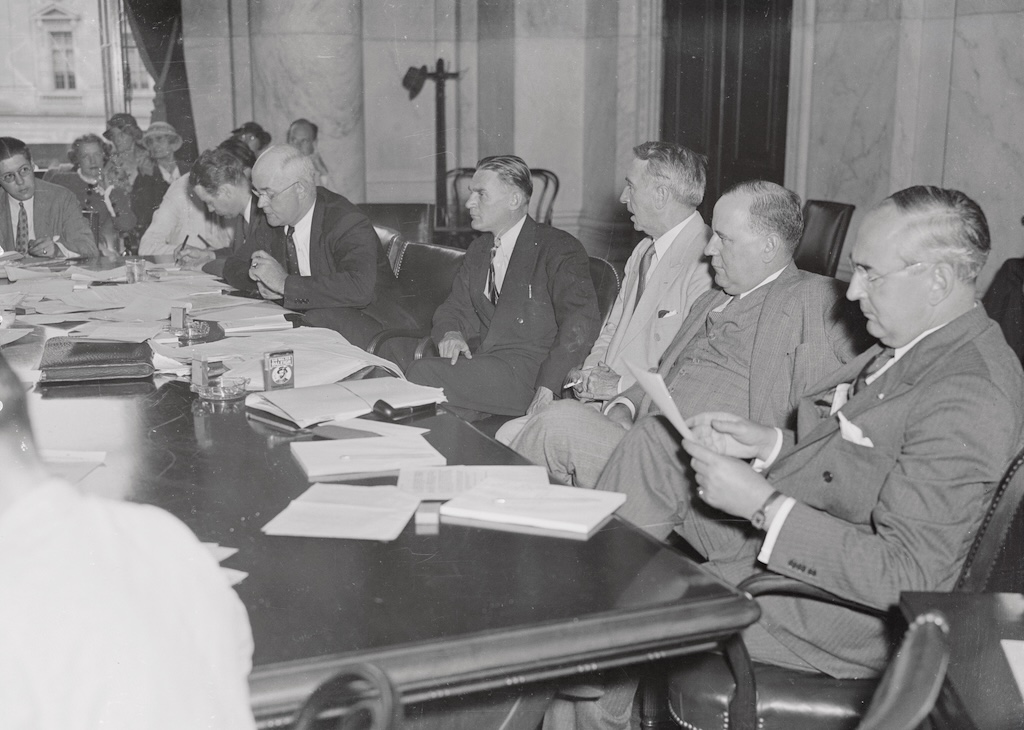
A session of the Senate Munitions Investigating Committee takes place in Washington, DC.

The members of the Special Committee on Investigation of the Munitions Industry appear during a session of their inquiry into deals among international munitions manufacturers. They are, left to right, Senators James Rope of Idaho, Gerald Nye of North Dakota, Walter F. George of Georgia, Bennett "Champ" Clark of Missouri, and Arthur H. Vandenberg of Michigan. (Getty Images)


In April, President Donald Trump requested a $445 billion dollar increase to the defense budget, meaning the United States will be spending around $1.5 trillion on the military. Much of the largesse will benefit the “big five” war contractors: Boeing, General Dynamics, Lockheed Martin, Northrop Grumman, and RTX (formerly Raytheon). These are the companies behind such budget-shredding boondoggles as the F-35 and the littoral combat ships.

If the promises of these weapons salesmen are to be believed, the US war with Iran should already be over. The enormity of the Pentagon’s budget, on paper, means that any conflict the United States enters should be a decidedly short and lopsided affair. Yet Iran has not crumbled against an onslaught that one analyst calculated has cost the United States $72 billion and counting. What has all this spending accomplished?

A US Patriot interceptor missile costs $4 million; a THAAD (Terminal High Altitude Area Defense) interceptor runs around $12 million. America has fired plenty of both in the war with Iran. Contrast that with the Iranian attack drones these systems are meant to shoot down, which run anywhere from $20,000 to $50,000 apiece. These swarms of cheap drones are able to effectively counter US aircraft carriers whose price tags run into the billions. (That is, when laundry room fires don’t do the job.) The United States has fired off so much ordinance that talk has turned to a possible missile shortage.

All this weaponry comes at a steep price for the average American back home. Last month, a report from the Institute for Policy Studies found that the average taxpayer spends approximately $4,000 per year on war and weaponry. What is all this money going toward? Who has really benefited from over a trillion dollars a year in annual military spending? In a spirit sorely lacking today, ninety years ago Congress tried to answer these and other questions when it forthrightly challenged the Pentagon and military contractors in its famous Nye Committee of 1934.

The Big, Corrupt Business of Arms Sales

In the wake of the Great Depression, a wave of anti-militarism and anti–weapons manufacturer sentiment swept the United States. Iron, Blood, and Profits by muckraker George Seldes and bestseller Merchants of Death by H. C. Engelbrecht and F. C. Hanighen exposed the workings of the international arms trade. Even Fortune, no hotbed of radicalism then or now, published their own exposé “Men and Arms” that was reprinted to a wider audience in Readers Digest.

A shocked public demanded action. Dorothy Detzer of the Women’s International League for Peace and Freedom approached Nebraska Senator George Norris about launching a Senate investigation into the munitions industry. Norris was a natural choice given he had strongly opposed World War I, arguing the country was “going to war on the command of gold. We are going to run the risk of sacrificing millions of our countrymen’s lives in order that other countrymen may coin their lifeblood into money.” But Norris begged off, citing illness and overwork.

Instead, Norris suggested North Dakota’s Gerald Nye. Although a Republican, he was supported by the left-wing Nonpartisan League. Nye was a firm anti-militarist who condemned Uncle Sam for “helping to crucify” the people of Nicaragua via military interventions to shore up business interests. Nye had already served on two Senate investigations and was picked to chair the two-year inquiry.

The Special Committee on Investigation of the Munitions Industry, commonly referred to as “the Nye Committee,” uncovered some explosive evidence — arms manufacturers frequently bribed officials. Clarence Webster of Curtiss-Wright Export Corporation objected to the “rather harsh” term bribery before admitting that the greasing of palms was employed “strictly speaking.”

Curtiss-Wright played countries against one another for profit, telling one sales representative in Peru during the Colombia–Peru War to “diplomatically inform interested parties that your neighbor to the extreme north [Colombia] is still purchasing large quantities. Do not overlook such items as bombs, ammunition, machine guns equipment, etc.” They were not alone.

A Colt salesman explained to the Bolivian Consul that “it would be advisable for [Bolivia] to act quickly if it wanted to get these guns, intimating that a certain other government might get them if Bolivia did not act quickly.” The Paraguayan government was the other party, then fighting Bolivia in the Chaco War.

Frank Jonas of Remington Arms proclaimed during the war: “The unsettled conditions in South America [have] been a great thing for me as I sold a large order for bombs to Brazil and also a fair cartridge order. I also sold very large bomb orders for Colombia, Peru, Ecuador, Bolivia. . . ”

Arms manufacturers complained of US diplomatic efforts that might put a damper on business. A representative of the Electric Boat Company (today a part of General Dynamics) complained to a counterpart from Vickers (today a part of UK defense contractor Rolls-Royce Holdings plc), “it is too bad the pernicious efforts of our State Department have put the brakes on armament orders.” Peace, it seems, was just too unprofitable.

It even turned out that a commander in the US Navy was moonlighting as an arms salesman. James H. Strong helped peddle the wares of two munitions makers and received a tidy commission for doing so. Nye was shocked to find “governments — especially our own war and navy departments — have been actively promoting the munitions makers for years . . . ”

The Committee also investigated the sky-high profits arms manufacturers had made during World War I. DuPont, headed by one of the oldest and richest families in America, saw a 1,130 percent increase to its profits, totaling $1,245,000,000. Eugene Grace, president of Bethlehem Steel, testified at how “unfortunate” it was that Bonus Marchers had marched on Washington to protest for their WWI bonuses. He then admitted, with no seeming sense of irony, that he had received almost $3 million in bonuses during the war. The situation, he averred, could “leave a bad taste” in veterans’ mouths.

Shocking revelations aside, the Nye Committee produced little substantial legislation. Efforts to nationalize the arms manufacturers failed despite widespread public support, as did a campaign to require a national referendum to declare war. The Neutrality Acts that did result were whittled away as the country moved back on a war footing in the lead-up to the bombing of Pearl Harbor. In his farewell address, Nye said he was “more proud of having” led the Senate inquiry than of anything else in his career.

Under Trump, War Is More Profitable Than Ever

Recent books The Trillion Dollar War Machine by William D. Hartung and Ben Freeman, and The Spoils of War by Andrew Cockburn have followed the trail blazed by Engelbrecht, Hanighen, and Seldes. The authors have documented the revolving door between military contractors, government, and think tanks; the corrosive effects of arms industry and foreign lobbying; and efforts to influence the media. The merchants of death are still on their bad behavior. In January 2025, a citizens tribunal found that American weapons contractors are themselves guilty of crimes against humanity, including genocide. Open bribery — “rather harsh” or not — has not disappeared, as Raytheon’s recent legal troubles have proven.

Conflicts of interest and public officials acting as salesmen for private arms manufacturers are also still with us. Palmer Luckey of Anduril is both a major Trump donor dating back to 2016 and a recipient of Pentagon liberality, with his company receiving a $250 million contract to produce missiles and drones for the military. Luckey has suggested the United States needs “to hyperscale manufacturing” for a potential showdown with China, ideally (and conveniently) with his company’s Arsenal-1 weapons factory in Ohio. Secretary of War Pete Hegseth has pushed for a Pentagon shake-up to better facilitate the overseas arms trade. Even the President’s sons Donald Trump Jr and Eric Trump have positioned themselves for a windfall through their investments in various companies manufacturing military drones. Ninety years later, General Smedley Butler’s war racket continues to make a killing, no matter how unpopular that war, like the one in Iran, might be with the public. It’s a big, well-armed club, and we aren’t in it.

“Investigations serve a most healthy purpose,” Nye said, the year before chairing the committee. “With economics and political influence coming into such concentrated control it is of great importance that legislative bodies be on closest guard against encroachment which further threatens a free government. . . . We should have not less, but more legislative investigations.”

The issues raised by his investigation have only worsened in the intervening years. After the boondoggles of Iraq, Afghanistan, and now Iran, the time has come for a twenty-first century Nye committee. If we don’t act, those wars — no matter how unpopular — will grind on. There’s simply too much money to be made.