Mamdani Can Empower Workers Themselves to Enforce Labor Law

Zohran Mamdani can take labor law enforcement beyond traditional mechanisms by empowering workers themselves to enforce the law on the job, building peer education and empowering shop-floor workplace rights monitors.
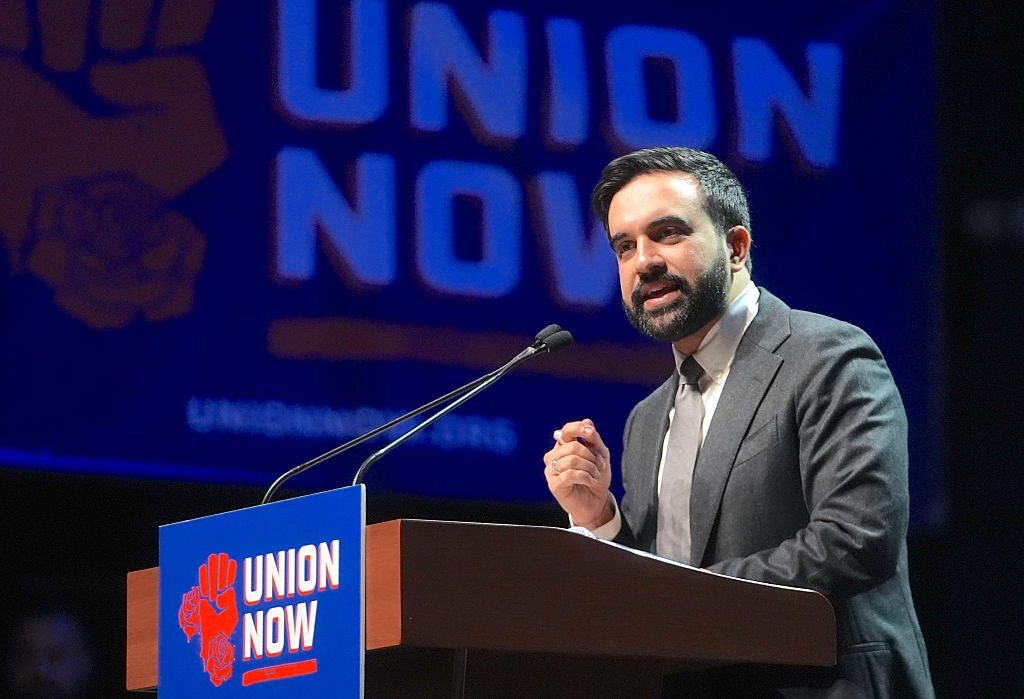
Zohran Mamdani speaking at a podium that reads, "Union Now."

Zohran Mamdani can use the power of city government to uphold and advance workers’ rights by training and empowering workers themselves to enforce labor law on the job. (Selcuk Acar / Anadolu via Getty Images)


Since Zohran Mamdani took office in New York City at the start of the year, an important question has hung over his administration: Will the new mayor be able to use the power of city government to uphold and advance workers’ rights? Mamdani was elected after taking strongly pro-labor stances, vowing, in the words of his campaign platform, to defend “the right to collective bargaining” while “requiring high-road labor standards” for all workers doing business with the city. At the same time, with state and federal governments possessing most jurisdiction over labor and employment issues, the city’s mandate is limited.

Budgetary constraints are likely the biggest obstacle to the mayor expanding labor law enforcement. During his campaign, Mamdani promised to double the Department of Consumer and Worker Protection’s budget to roughly $135 million. While that vow was at least temporarily walked back due to budget woes, it appears the administration is still trying to follow through on its initial commitment. But regardless of what progress Mamdani makes on that front, his ability to navigate budget limitations should not be his only standard of success.

Alex Jacquez, chief of policy and advocacy at Groundwork Collaborative, a progressive economic policy think tank, acknowledged that the mayor’s hands are “somewhat tied” by restrictions on how he can raise revenue, but he added that the administration could create “more visibility, more awareness from the business community, from employers, that the mayor is prioritizing [enforcement]” — and that heightened scrutiny alone could have a “deterrence effect” on violators.

As important as steering adequate resources toward labor law enforcement will be the mayor’s ability to break new ground in pursuing initiatives that bring working people themselves into the process of defending their rights on the job. Indeed, if Mamdani is to become a champion of workers’ rights, this should be a second standard by which he is judged. The idea that workers should have a formal role in shaping and upholding the laws designed to protect them is known as “co-enforcement,” and this represents an expanding field within progressive policymaking, including at the city level.

In recent years, advocates have put forward a variety of suggestions of how New York City could advance on this front and work to establish itself as a laboratory of co-enforcement experiments. Two ideas that Mamdani could pursue are the empowerment of shop-floor workplace monitors and the use of worker leaders as peer educators who uphold labor rights.

Workers as Monitors

In a 2023 article written for the New School’s Center for New York City Affairs entitled “Three Ways New York City Can Prevent Wage Theft,” public policy researcher Nikko Bilitza argued that, while New York State could and should do more to enforce its own labor laws, there was no reason for New York City to wait for the state to act.

One thing the city could do right away, with or without state support, Bilitza wrote, is create a system of workplace monitors composed not only of city labor inspectors but also community allies. Particularly in workplaces not already represented by unions, the involvement of workers’ rights leaders as part of the system would help establish an “on-the-ground presence” to monitor compliance across industries in which violations are rampant.

“If there are workers who are able to stand up and put forward their own solutions and appoint a workplace monitor for themselves,” the city would not necessarily need to pass municipal legislation or spend a great deal of money, Jacquez told me. That may be a sensible route in a place like New York City, he added, “where you already have dense union penetration and some of these more pro-worker organizations and organizers in place.”

Whether monitors operate outside or inside of a particular workplace, he noted, “there’s a lot of different kinds of models this could take, and without legislating a specific one. The biggest obstacle, of course, is the power of employers, and their knee-jerk and reflexive opposition to anything that looks like more scrutiny from their workforce against managers.”

Even in a heavily unionized town like New York City, most workers are not represented by a union. A major advantage of workplace monitors is that they can improve conditions even in nonunion workforces. Lindsay Owens, Groundwork Collaborative’s executive director, argued in a 2021 report that workers should elect monitors who would be trained to identify labor violations, access internal records to check for compliance, and assist workers in identifying and reporting violations.

These monitors would act as a bridge between the relevant labor agency and their specific workplace, freeing up resources for government inspectors, protecting vulnerable workers from retaliation, and leveling the playing field for law-abiding employers. Though Groundwork acknowledges that monitors are no substitute for unions, monitors have the potential to improve working conditions for large groups of workers who currently lack formal representation.

There are successful precedents for workplace monitor programs. In the early 2000s, the New York State attorney general established a Greengrocer Code of Conduct under which employers could secure limited liability for past violations in exchange for submitting to regular third-party monitoring of compliance with labor law. Another example Bilitza cited is that of a construction-sector monitoring system implemented by the city of Austin, Texas, in partnership with the Workers Defense project. Austin developers were offered an expedited building-permit review process in exchange for creating good jobs and submitting to regular monitoring of compliance with applicable labor laws.

Advocates argue that New York City could implement a workplace monitoring system in industries with higher rates of violations, such as construction and the food service sector. The city could require monitors as part of its public contracting or permitting processes, or as a remedial measure to bring high-violation companies and industries into compliance. Monitors trained by workers’ centers could be among those eligible to serve. And empowering workers to elect monitors directly would ensure their independence from management.

Of course, monitoring programs can only be effective if problems are taken seriously once uncovered. Janice Fine, a professor of labor studies who leads the Workplace Justice Lab at Rutgers University, argues that, ideally, worker monitors themselves should be given power to initiate processes that result in immediate remedies. In cases involving just a few workers, Fine recommends that “workers would raise violations directly with their employer supported by a written letter from the trainer or training organization. The letter would state the relevant legal requirements, the alleged violations, and the steps required to come into compliance.” In more severe cases of labor violations that involve many workers, Fine argues that a system should be put in place whereby abuses identified by monitors trigger expedited action by the city’s Office of Labor Policy and Standards for Workers or relevant state agencies.

“We Are the Best People to Render Solutions”

A second idea is to use worker-leaders as peer educators to spread awareness of labor laws and enforce a higher level of compliance. In a February 2026 paper entitled “Mass Worker Education: Governing from the Shopfloor,” Nantina Vgontzas, assistant professor of labor studies at the City University of New York School of Labor and Urban Studies, and sociologist Sanjay Pinto, who studies strategies for building worker power, proposed institutionalizing the role of peer educators in implementing worker protections.

Because peer educators are “uniquely positioned” to share insights about employers’ exploitative practices, Vgontzas and Pinto argued, they could have a distinctive and valuable role to play in lifting labor standards in New York City. In particular, the two authors laid out possibilities for peer education to build training capacity among warehouse workers and parcel delivery drivers. Administered in partnership with unions and community groups, such a program would strengthen the role of people with firsthand knowledge of workplace practices in enforcing new laws that address industry abuses.

As with workplace monitors, the peer-educator proposal addresses the challenges of organizing workplaces in a country with historically low union density. “There are multiple sectors where peer education has been this linchpin,” Vgontzas said.

For example, the peer-educator model has served New York City–based domestic workers well, she argued. The We Rise nanny training program, launched in 2017, uses peer education to heighten awareness of working conditions for New York’s nannies. As Vgontzas and Pinto write, the training has “expanded the program to cover other sectors, training hundreds of nannies, cleaners, and home health aides, as well as day laborers and farmworkers.”

In terms of further workplaces that could be prioritized in New York City, Vgontzas noted that the use of exploitative algorithmic management practices has helped fuel organizing efforts in warehousing and parcel shipping — including among Amazon Labor Union-International Brotherhood of Teamsters Local 1 and Teamsters Local 804 — and that these developments make this industry an apt target for a peer education program. The Warehouse Workers Protection Act, a state law that was passed in 2022 but subsequently weakened, established limited labor protections for workers in certain warehouse distribution centers. Vgontzas believes that formal peer-educator programs in warehouses across New York City could build on these initial steps forward.

Pinto said that his and Vgontzas’s call for peer-educator programs in New York City was partly inspired by the success of a program led by “promotoras” in combatting sexual harassment and violence in California’s janitorial industry. Promotoras were conceived of as a type of peer educator with direct knowledge of workplace conditions.

Indeed, many workers in the program had experienced sexual harassment or assault firsthand. As the Guardian reported in 2019, “Nearly 100 janitors are currently trained as promotoras, ready to start going into workplaces to conduct trainings with fellow workers.” The report quoted worker-leaders who contended that the program was an essential means of making employers take a preventative approach to these issues and argued, “We are the best people to render solutions.”

Vgontzas and Pinto report that they are currently working with the New York City Council to draft legislation to support mass worker education. Pinto contends that expanding peer-educator programs could help spread awareness of the law and “how people can effectively avail themselves of their rights,” adding that it is “not necessarily addressing all aspects of enforcement” but laying important foundations to build “an effective environment for enforcement.”

Rutgers’s Professor Fine argues that the key to strengthening such programs is ensuring that peer education programs explicitly emphasize the importance of organizing and collective action. “If you really want to stop the violations, then any training needs to talk with workers about how they can get together to go to their employer and request a change,” Fine says. Peer education that does not link to organizing efforts being pursued by unions and workers’ centers, she believes, is a huge missed opportunity, given that the rights to organize and collectively bargain for change are key legal protections enshrined in labor law.

Expanding Workers’ Role in Public Policy

Beyond specific enforcement measures, Pinto says he has also been pondering a broader question: “How do you build different kinds of governing models so that actors in civil society feel more empowered to participate in the governing process, and how do you build the infrastructure so that [it’s more durable], so it’s not just dependent on having someone who’s progressive in power?”

He is not the only person considering these questions. Experiments in co-enforcement are part of the wider set of practices known as “co-governance,” through which grassroots and social movement groups are looking to play larger roles in the governing process, rather than just relying on elected champions to act on their behalf. In recent months, Mamdani made the novel move of appointing a director of co-governance to serve in his administration, under his newly founded Office of Mass Engagement. The position is tasked with “transforming relationships with the community moving from engagement to empowering communities to govern with the Administration” and with “establishing formal structures that bring base-building organizations into the inception and implementation of co-governance initiatives.”

Among other personnel choices that suggest that Mamdani is looking to expand grassroots involvement in the protection of workers’ rights is the appointment of Julie Su as his Deputy Mayor for Economic Justice. As labor commissioner for the state of California, Su had endorsed the idea of working together with community groups on enforcement, lending credibility to a number of pioneering initiatives being developed in the state.

In the realm of workers’ rights, labor scholars argue that there is room for substantive involvement of workers themselves at multiple points in the process of upholding labor standards. This is what Fine calls “thick” co-enforcement.

“Some state agencies will give grants to community organizations to do education with workers, to do ‘Know Your Rights’ trainings,” Fine has explained. “That’s all well and good, but it’s not nearly enough. We’re arguing that at every stage of an investigation into workplace abuses, workers’ organizations have a significant role to play.”

This ranges from providing strategic research and on-the-ground reporting about conditions at companies that are violating the law, to helping inspectors access workers who might otherwise be hesitant to talk to government representatives who appear at a workplace, to making sure that remedies for labor law violations are actually carried out after they are ordered.

Amid tight city budgets, it remains to be seen what the Mamdani administration will be able to accomplish in terms of prioritizing workers’ rights. But the extent to which it is able to meaningfully enlist working people and their organizations in the process of labor enforcement will form a critical part of its legacy.