Amy Goodman and Democracy Now! vs. Mainstream Media

Amy Goodman
Tia Lessin

The new documentary Steal This Story, Please! shows how Amy Goodman helped build Democracy Now! into an independent outlet with a mass audience. We spoke to Goodman and director Tia Lessin about the film and challenging corporate media today.
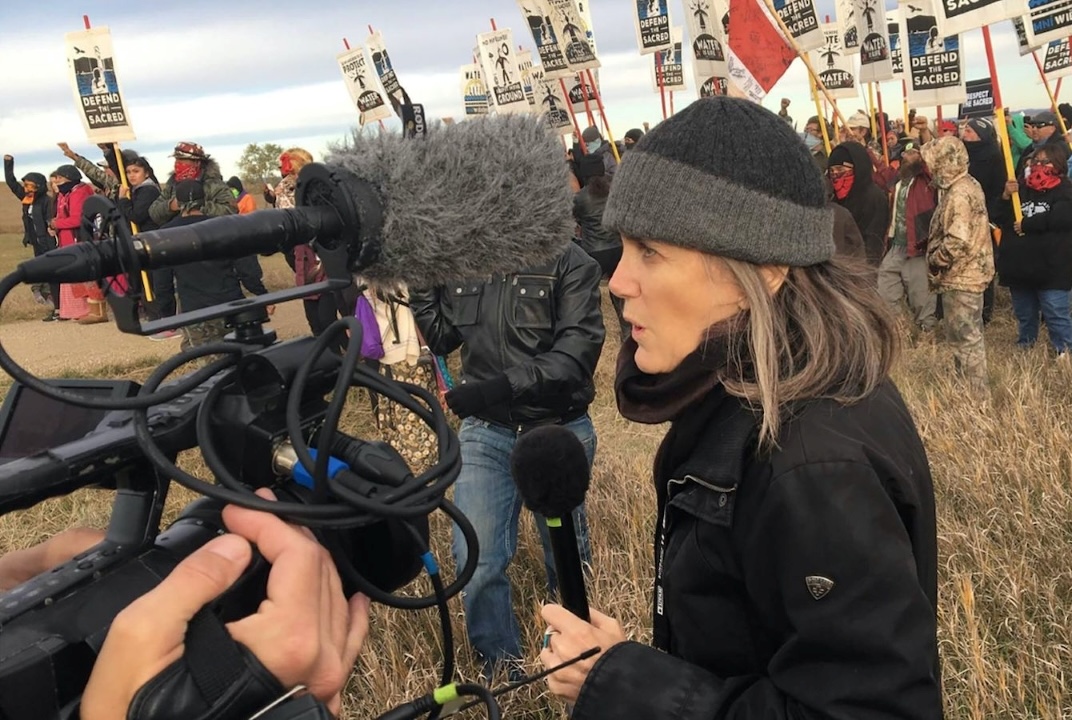
Amy Goodman at the Standing Rock protest in 2016.

Amy Goodman: “Those who care about war and peace, the climate catastrophe, economic and racial inequality . . . are not a fringe minority, not even a silent majority, but the silenced majority, silenced by the corporate media.” (Xceptional Communications)


Interview by
Alex N. Press

At a moment when the American media landscape is consolidating at the top and fragmenting at the edges, a new documentary spotlights one of the most durable experiments in independent journalism in the United States. Steal This Story, Please! traces the career of Amy Goodman and the growth of Democracy Now! from a scrappy radio broadcast carried on a handful of stations into a global news platform broadcast on more than 1,400. The film is directed by Tia Lessin and Carl Deal, longtime collaborators whose work includes Trouble the Water, on Hurricane Katrina survivors, and Citizen Koch, on money and power in American politics.

Lessin and Deal began the project in the wake of Donald Trump’s first presidency, as attacks on the press intensified and corporate consolidation accelerated. At the film’s release, those pressures have only intensified. Drawing on decades of archival footage, from East Timor in the 1990s to Israel’s genocide in Gaza in the present, the documentary situates Goodman’s reporting within a broader argument about journalism’s purpose: scrutinizing the powerful and amplifying those systematically excluded from the stories they tell.

The film’s release has run into some of the same barriers it documents. Despite winning audience awards across the festival circuit, Steal This Story, Please! has struggled to secure traditional distribution, instead building an audience through independent screenings and word of mouth — an echo of the grassroots model that sustained Democracy Now! itself.

Alex N. Press spoke with Goodman and Lessin about the conditions under which political documentaries get made, the gap between what mainstream media claims audiences what and what they actually seek out, and what it means to build a media system that answers to those people rather than to the institutions that prefer their silence.


Alex N. Press

Tia, what made you decide Amy, and by extension Democracy Now!, was the right subject for this moment?

Tia Lessin

It was in the aftermath of Donald Trump declaring the press was the enemy of the people in 2017 and ramping up attacks against journalists and journalism as a whole. And in the context also of the acceleration of the consolidation of the media, it seemed really appropriate to focus on this remarkable journalist, Amy Goodman, and this independent network that she’s created and pioneered, in some ways.

We’ve known Amy for more than thirty years, and we know her to be not only a remarkable journalist, but also just a lovely person — a lovely, warm, compassionate person. It seemed like there would be interest. So we started thinking about this documentary a couple years ago, but we landed in this moment, which is really a crossroads for democracy and has underscored the importance of the free press and holding power to account. It has also underscored the freedom that Amy has in terms of her independent model, where she’s accountable only to her listeners and is not forced to adhere to corporate advertisers’ concerns that would likely object to some of her coverage.

We are seeing, as we show in the end of the film, this capitulation by mainstream media on major issues time and time again. Amy is a journalist that’s never capitulated, so it seems like the right time to tell the story.

Alex N. Press

Tia, you’ve been making politically committed documentaries for a long time, so you’re familiar with the narrowing landscape of funding, all the issues that the film itself is about. So in this moment where independent media is under so much pressure — funding drying up, political attacks at every turn — what does it take to get a film like this made?

Tia Lessin

It is a very fraught time for documentary filmmaking in general, and certainly for political documentary films. But it’s never been that easy to make these kinds of films, even if you’re Michael Moore. He’s always had to fight for funding and for attention, though the fact that his films make money for the very corporations he sometimes criticizes certainly helps. Fahrenheit 9/11 [which Lessin produced] was dropped by Disney in the weeks before it was supposed to be released. This is after it won the Palme d’Or at the Cannes Film Festival; it was wholly political. Disney did not want to lose out on tax breaks that George W. Bush’s brother, Jeb, who was the governor of Florida, was giving to Disney’s amusement park there.

But look, we’ve had our own work censored. My work on Citizen Koch was censored by PBS’s funding arm, because they were concerned about losing donations from Charles and David Koch; David Koch was on the board of their two flagship stations. In the lead-up to the Iraq War, we had a music video suppressed by MTV because of pressure from the army. It just happens.

We know how difficult it is to take on these hard topics, even when you get funding. For example, we made a film about Katrina survivors that was nominated for an Oscar, but we could not get any funder interested. It took years of independent funding, using credit cards and grants, because we were told that broadcasters had Katrina fatigue, and “find a white character and come back to us.”

With this film, we didn’t have any illusions that we would have a commission out of the gate. That was liberating, because we could tell the story without concerns except for what was true and accurate and of consequence. So we made the film entirely using foundation money and individual contributions.

But when it came to distributing the film, we found no takers, even after the Telluride Film Festival, even as we continued to get audience award after audience award. And audience awards are what distributors look at, because that signifies there is going to be an audience. So the fact that even then we were still lacking distribution is of note.

But we’re not alone in that, and we’ve been able to chart our own course. We have a hundred theaters booked. We’re independently distributing this through a nonprofit. And we’ve had really strong openings, which shows there is an appetite for nonfiction storytelling beyond true crime and musician biopics.

Alex N. Press

You use a lot of archival footage, moving between that and present-day reflection. How did you decide on the structure?

Tia Lessin

We worked with hundreds of hours of footage that Amy had collected over the years: all her studio recordings, all her field recordings, outtakes as well.

There’s eyewitness footage of the East Timor massacre, where we can see Amy and her colleague Allan Nairn reporting as the Indonesian army is marching, getting ready to turn their M16s on the civilian protesters. That footage was shot by Max Stahl. There was also footage from pool cameras of Amy at the White House asking hard questions of Mike McCurry, Clinton’s press secretary. Amazingly, they have a reverse shot of Amy. We had footage filmed by other filmmakers as well, and footage I had shot twenty-six years ago at the Republican National Convention in Philadelphia, and more recent footage of Amy reporting on Gaza.

So we had all this footage. We decided it was important to minimize the talking heads. We wanted to see this scrappy little program from 1996 grow into this huge network. We structured it more or less chronologically but also went back and forth between [earlier periods and] the current moment. Even though Donald Trump appears later, his presence looms pretty large throughout the narrative. Amy has been sounding this alarm for thirty years, and it resonates now more than ever.

We came up with a narrative structure and hoped to create not only a portrait of Amy, but a portrait of independent journalism.

Amy Goodman

The fact that they are distributing this independently and have won all these awards is really astounding. To put out this film and for it to win over a dozen audience favorite and grand jury prizes from all these places — from Santa Barbara to Santa Fe, from Woodstock to St Louis to Seattle to Oslo, Norway, at the Human International Documentary Film Festival — it really sends a message, when it’s difficult to get these corporate platforms to stream it or distribute it, that they don’t even care about the audiences.

The theaters have been sold out in New York and Los Angeles. Here in Seattle, where we just arrived, the main showings tonight and tomorrow night are completely sold out, and in Portland, Oregon, it’s the same thing. Everyone’s trying to add a third and a fourth screening.

This really says something, that it goes against even their instinct for making money, because there’s such audience demand. Audience favorite is a special category. It’s what people want to see. But I know this from Democracy Now!: it doesn’t come from management at stations, usually, to put on Democracy Now! It comes from the community demand, and that is the reason it has grown from nine community radio stations thirty years ago to over 1,400 today. It’s this absolute demand, this hunger for independent voices.

Alex N. Press

As you both mentioned, you’re racking up audience awards and demand for showings, and yet still there are problems with distribution. In the film itself, you talk about how when you go on CNN or MSNBC, you’ll ask the host, “Why aren’t you covering these stories?” and they’ll usually blame executives and say, this causes eyes to roll, and we care about eyeballs staying on the screen, that kind of thing.

Yet as the film points out of your coverage of Standing Rock, that is just not true. People do want to see this footage, and we’re seeing it with your film. People do want to see the movie, yet that doesn’t cause executives to change their mind.

Why does this lack of coverage from mainstream media persist? Why do these stories not get the coverage?

Amy Goodman

I call it breaking the sound barrier: sometimes they really have no choice. In the case of the standoff at Standing Rock, I was saying we should have been elbowing our way to the front of this protest to get the best shot, stumbling over other reporters, but we were the only ones there.

Then we post the footage online: fourteen million views over twenty-four hours. At the time, Barack Obama was in Laos on a historic trip; he was holding a democracy forum for a group of young people. One of these young people raises their hand at the end and says, President Obama, what about the standoff at Standing Rock? Can you talk about it? He said he had to go back and investigate what had happened. But then we got word that he saw the video at the White House, and it wasn’t lost on the first African American president what it meant to have dogs sicced on protesters.

So, this kind of trickle-up journalism makes an enormous difference, especially when there is such a hunger for it. Our job is to go to where the silence is. But it’s not usually silent there. It’s raucous. It’s rowdy. People are organizing, as you well know from your work. It just doesn’t hit the corporate media radar screen.

When you have a global platform like Democracy Now!, it really makes a difference. We started this platform thirty years ago out of necessity. We had a fifty-nine-minute radio show we needed to distribute. We didn’t have the money for satellites, so we used the internet before podcasts even existed.

People started transcribing segments. Someone in Mexico would transcribe one; someone in Montana another; someone in South Africa another. We got a transcription coordinator, posted them online, and journalists would take those transcripts to the White House, the Pentagon, the State Department, and ask questions based on real voices. That makes an enormous difference.

Alex N. Press

There’s a really compelling thread about mentorship in the film. Jeremy Scahill talks about how when he worked at the Catholic Worker office in Manhattan, he’d write you letters the way you once wrote Phil Donahue, whose program you were desperate to work on out of college. How do you think about giving people a chance, and what does it mean to reproduce this kind of journalism across generations?

Amy Goodman

Mentorship is so important. Community is what keeps us going. This is community radio and community television. That’s what public media is. Two nights ago, we did a big event in Sacramento. The theater was packed — four hundred people. It was moderated by the head of Access Sacramento, and this week the cable commission is deciding whether to cut their funding. To be able to go city to city not only to show the film but to do what the film is talking about, to shore up independent media, is critical.

Public access is one of these incredible reservoirs of experience where people can get access and learn from those who have been doing this longer. I’ve always been deeply committed to that. When I met Jeremy at the Catholic Worker, he was relentless, he wanted to be a part of this. Sharif [Abdel Kouddous, a longtime Democracy Now! correspondent and producer] came from corporate banking, but he had a hunger.

Amy Goodman, producer and host of Democracy Now!, being restrained by police.
Steal This Story, Please! tells the story of Amy Goodman and her long-running independent journalism show Democracy Now! (Xceptional Communications)

I often think of the great journalist Les Payne, who talked about that fire in people’s eyes. When you see that, you can’t say no. But mentorship doesn’t go one way. The inspiration I get from the people I work with is what keeps me going.

Alex N. Press

Amy, throughout the film, we see that some people object to the idea that you’re a journalist. They say you’re an activist. I’m thinking of Israel’s genocide against the Palestinian people the past few years, but there are plenty off others. At Standing Rock, you have a warrant issued for your arrest by the state of North Dakota. Or the first time I saw you in person, when I was a teenager getting kettled by the New York Police Department at Occupy Wall Street, you were standing two feet from me reporting. I thought, now that’s a real reporter, but I know plenty of other people would say, no, that’s an activist.

This is certainly a tension I’ve experienced myself. How do you navigate that?

Amy Goodman

First of all, Alex, that’s a great story. Was I able to prevent you from getting arrested? Did you get arrested?

Alex N. Press

No, I didn’t get arrested. I imagine your presence didn’t hurt!

Amy Goodman

I used to live in Hell’s Kitchen, and I can’t tell you how many times I was about to have my first bite of food for the day at dinner time, and I’d hear colleagues were getting kettled at Times Square, and I’d race there. I thought, if I run fast enough, before they get put in the police vans, I can make a difference.

But this is just following the basic tenets of good journalism. We all have opinions, and I know no one’s opinions more than the mainstream journalists on television. They reinforce the status quo so often, and we don’t call that an opinion. Those who are expressing a view outside of that, they are the opinionated ones pushing an agenda. But I don’t think that we’re following the tenets of good journalism, to be fair and to be accurate, if we think that way. The mainstream view on television, I actually don’t think it is mainstream or the majority view, because those who care about war and peace, those who care about the climate catastrophe, those who care about economic and racial inequality, those who care about the immigrant crackdown, those who care about the LGBTQ community, are not a fringe minority — not even a silent majority but the silenced majority, silenced by the corporate media, which is why we have to take it back and rebuild a new media.

We don’t know the form of media in the future, but I know we have to have basic principles about fairness, accuracy, going to where the silence is, being the exception to the rulers. That’s our job, holding those in power accountable.

It’s why President Trump is so vilifying the press right now. He is a media creation, and there’s no one who is more of a master manipulator of the media than President Trump. He knows that the media created him and knows the flip side of that is that the media that can take him down, can expose him. So he has gone after one corporate network after another.

We see him suing CBS because of how 60 Minutes edited a Kamala Harris interview. My God. I mean, that type of editing is standard practice. CBS would have won that case, but instead they settled for $16 million. Why? Because that was chump change compared to what their parent company would make — Paramount joining with Skydance in a corporate merger of at least $6 billion. So that $16 million not only was chump change, but it was paying Donald Trump. So they both appease Trump, and then this merger, which has to get the approval of Trump’s Federal Communications Commission, goes through. The same thing happened with ABC.

Tia Lessin

It’s not lost on me that the heads of Paramount Skydance had a dinner for their CBS correspondents celebrating the First Amendment and Donald Trump. I can’t even say the two things in the same sentence, except to say that Donald Trump has taken an ax to the First Amendment.

Talk about activism: Is it activism that a number of broadcast and print journalists from the commercial media signed an open letter calling out the White House Correspondents’ Association, demanding that they confront Donald Trump and force accountability on his attacks on the press? To me, that’s not activism; it’s just doing the job.

We’re all guided by our values. They’re guided by their values and their faith in the First Amendment, and they’re speaking out because of that. I’m guided by my values. It’s one of the reasons why I make the films that I make.

It’s one of the reasons I came together with Carl [Deal] and our executive producers and thousands of other filmmakers to oppose the Paramount Skydance–Warner Bros. Discovery merger. This is not activism. This is living our values and protecting our right to creative expression and the public’s right to hear diverse voices.

Librarians are guided by their values. Lawyers at the Justice Department are resigning because they’re guided by their values. They’re not activists — they’re people who are saying no in this moment. I think it takes quite a lot of principle to make that sacrifice. Amy’s been putting her career and her life on the line for decades. That should be an inspiration. It should compel us all to act out of conscience.

Amy Goodman

Very quickly after the arrest of Sharif, Nicole [Salazar], and me [at the 2008 Republican National Convention] — I was just trying to get them freed, and after hours and tremendous public outcry, we were released — I went back to the convention center, where I had run from to try to get them freed. I was invited to NBC’s skybox to talk about what had happened. I did the interview, and then when they turned the camera off, the reporter came up to me and said, “I don’t get it. Why wasn’t I arrested?”

And I said, “Oh, were you out covering the protests as well?” He said, “No.” I said, “Well, I don’t get arrested in the skybox either.”

We have a job. It’s to be on the convention floor, to talk to the delegates; it’s to get into those corporate suites to see who is paying for these parties, and it’s to get out onto the streets where the uninvited guests are, to see why they’re out there, why they feel so strongly that they’ve come to the city of the convention and are speaking out. It’s at every level, and all of that is just practicing good journalism.

And Alex, what you described about when you were being kettled and you saw me there, I think there is another point in that, which is that it dignifies what people are doing to be heard when the media gets there.

When the media is a little more savvy, sometimes they’ll go out to the protests — you’ll even see a protest on the network cable shows. But the reporter is walking alongside, saying, “Now they’re turning right, now they’re turning left, now they’re going up Sixth Avenue.” You’re not a traffic cop. Why don’t you take the mic and hand it to someone and just ask them? Don’t tell us. Ask them why they are there.

And this goes to a critical point about the role of the media in the twenty-first century. We’re going around and holding fundraisers for these amazing stations like KPFA in Berkeley, founded more than seventy-five years ago, part of the Pacifica network. Pacifica was founded by a war resister when he came out of a detention camp and said there’s got to be a media outlet not run by corporations that profit from war, but run by journalists. It’s KPFA, then KPFK in Los Angeles, WBAI in New York in 1960, WPFW in 1977 in Washington, and KPFT in Houston. That’s the Pacifica five.

When KPFT went on the air in the spring of 1970, they were blown up by the Ku Klux Klan. The Klan strapped dynamite to the base of the transmitter, blew it to smithereens. They get back on their feet, a few weeks later they go back on the air, and the Klan straps fifteen times the dynamite to the base of the transmitter and blows it up again, right in the middle of Arlo Guthrie singing “Alice’s Restaurant.” It then goes off-air for months as they rebuild. In January 1971, Arlo comes back to Houston to finish his song on the air, and KPFT has been on the air ever since.

I can’t remember if it was the exalted cyclops or the grand dragon, because I often confuse their titles, but he said it was his proudest act, because he understood how dangerous Pacifica is, how dangerous independent media is, because when you hear someone speaking from their own experience — be it a trans kid in Texas, a Palestinian child, an Israeli grandmother — it changes you. It breaks down the stereotypes and the caricatures that fuel these hate groups. That’s why they found it so threatening.

And if we hear those different voices, an uncle in Afghanistan or an aunt in Iran, it makes it much less likely that you’ll want to destroy him. The media can be the greatest force for peace on Earth. Instead, all too often, it’s wielded as a weapon of war, and that’s why we have to take it back.

Share this article

Contributors

Amy Goodman is the host of Democracy Now!

Tia Lessin is the director and producer, with Carl Deal, of Trouble the Water, Citizen Koch, and Steal This Story, Please! She also directed The Janes and Behind the Labels and produced several of Michael Moore's films including Fahrenheit 9/11, Where to Invade Next, and Fahrenheit 11/9.

Alex N. Press is a staff writer at Jacobin who covers labor organizing.

Filed Under