Russia’s Antiwar Prisoners Are Outcasts in Their Own Land

Over four years into Russia’s war in Ukraine, some of the Russians imprisoned in its early days are still in jail. Even people with no previous political activism have been landed with long prison sentences in order to crush dissent.
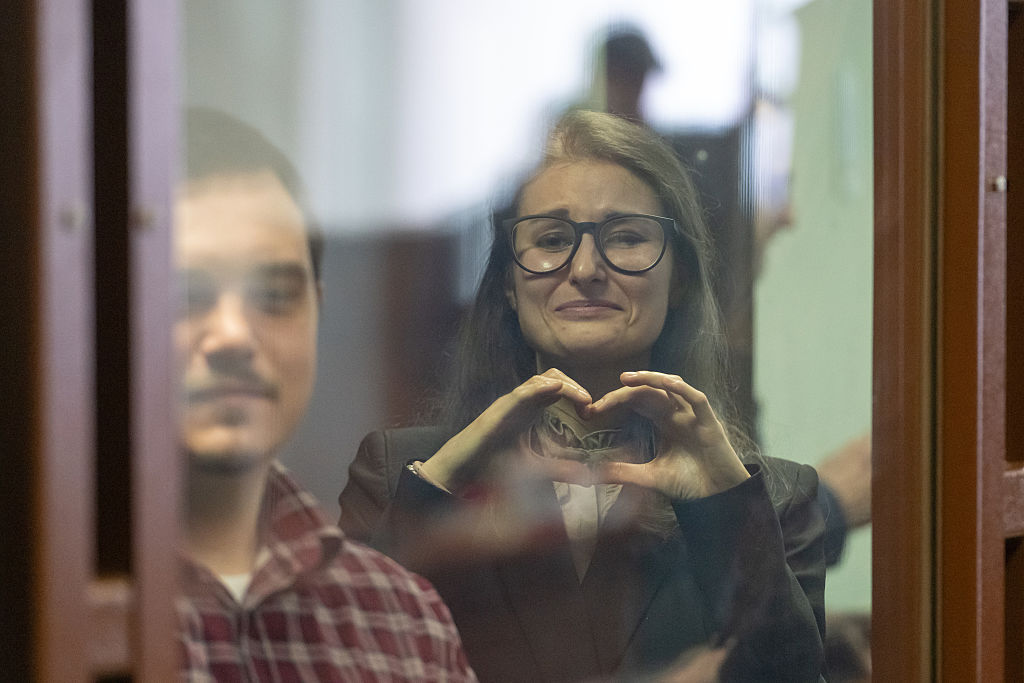
Antiwar activists Yevgeny Zateyev and Anna Arkhipova attend their sentencing hearing for dissident activity.

Yevgeny Zateyev and Anna Arkhipova attend a court hearing in the case against the Vesna movement, one of the leading voices of antiwar protest in Russia. A court in St Petersburg sentenced six defendants in the case to prison terms of up to 12 years. (Andrei Bok / SOPA Images / LightRocket via Getty Images)


Russia’s political prisoners are “outcasts in their own land,” Sergei Dudchenko, a biker tortured and framed by the security services, told his trial judges this month before being handed a seven-year prison sentence.

Those arrested for opposing the war in Ukraine had “fewer rights than a stray dog, and on top of that they bear the humiliating brand of ‘terrorist’ — and all this for their active civic stance.”

Dudchenko and his friend Nikolai Murnev, who received the same sentence, were arrested with others in October 2022 in Stavropol, in southern Russia.

While in detention on minor charges (petty hooliganism and drug possession), they were brutally tortured. A case was put together that they were preparing a “terrorist act” — setting fire to a military recruitment office. Another of the group died in pretrial detention, one fled the country, and one turned state’s witness.

The invasion of Ukraine on February 24, 2022, “split life into before and after, it divided the world into black and white,” Dudchenko told the court.

Russians, Ukrainians, Belarusians, Armenians, Georgians, Azerbaijanis, Kazakhs, Turkmens, Jews, and others had “paid an unimaginable price” to resist Nazism in World War II. How, decades later, could “so much hatred and anger” be directed against Ukraine?

Within days of the invasion, Dudchenko made a solo protest — a motorbike ride with the Ukrainian flag. In court, four years later, he said: “When I sped along, with the banner of the oppressed streaming behind me, past an astonished crowd of militarists, I felt the human in me come into bloom.”

Dudchenko is one of dozens of wartime protesters who have exercised one of the few constitutional rights that remains accessible: to say a “final word” before sentencing.

Some who exercise this right, like Dudchenko, are citizens whose antiwar protest was their first political action. Some, like the powerlifting champion Yulia Lemeshchenko, are Russians who joined the Ukrainian armed forces. She told her trial, in November of last year: “I am not a citizen of the country for which I decided to fight, but for me, Ukraine is home.”

Some are political activists, like Anna Arkhipova, one of six members of the Vesna protest network sentenced at a show trial in St Petersburg last month. “When the war began, it was my conscience that would not let me stand idly by,” she stated.

On Sunday May 17, Try Me For Treason: anti-war protesters’ speeches in Russian courts, an English-language film featuring readings of speeches, will be released on YouTube.

The title comes from a speech by Andrei Trofimov, who is serving ten years for pro-Ukrainian statements on social media — plus three for ending his “final word” to a closed court by saying: “Glory to Ukraine! Putin is a d–khead.”

At the second trial, before getting the three extra years, Trofimov scorned the charges of “discrediting the armed forces” and “justifying terrorism,” and invited prosecutors to charge him for deserting to Ukraine’s side. “Try me for treason. I betrayed your deranged state,” he told the judges.

The fifty-minute documentary was put together on a zero budget by a group of actors in Britain, to make the Russian antiwar movement more visible internationally.

Maya Willcocks, the actor-producer who reads a speech by Darya Kozyreva, said: “These are not well-known political leaders, they are people who have taken a stand against the state. I felt it was very important to have their words translated into English and out there for people to hear — to send the message that occupation is a crime, whether in Palestine or in Ukraine.”

Anthony Aldis, the videographer, said: “What I found compelling about these stories is that the beginning of any fightback is very often when people stand up against an apparently unassailable power.

“These people are not organized. It’s a raw push against something that they don’t believe they can beat, but they think they have to take a stand anyway, in solidarity with someone else who is being attacked and murdered.

“That idea is very important to us in the West, given what we face here in the UK, and in the USA, with the rise of the far right.”

As one of a small group of translators that helped prisoner support groups, I worked on the script, and on the book Voices Against Putin’s War from which it derived.

Having traveled to Russia and Ukraine since Soviet times, I was struck by the political depth and heterogeneity of antiwar protest, even as it is constrained by state terror to individual acts of defiance. Those punished with long sentences range from pacifists who quote Leo Tolstoy to Soviet-era dissidents who ooze contempt for the judges, and Russians who go out of their way to justify Ukraine’s defensive military action.

It would be easy — and stupid — to dismiss the “final words” as atomized cries into a dark, authoritarian night. Rarely are they pleas to judges or government; more often, they are consciously crafted appeals to society.

The “last words” often try to situate those who say them historically. Sergei Dudchenko, born in 1987, said in court that “people like us will always keep emerging, to pick up the fallen banner of good and reason” . . .  and recalled the seven protesters arrested on Red Square in 1968 for opposing the Soviet invasion of Czechoslovakia.

Noteworthy, too, is the infrastructure of support for political prisoners, comprising established human rights organizations such as Memorial: Support Political Prisoners, OVD-Info, and Mediazona; newly formed groups such as Fires of Freedom and Solidarity Zone, a website featuring “last words” going back to the 1950s; and Telegram groups caring for individual prisoners.

From California to the Caucasus, dozens of informal groups of Russians in exile gather and write letters to prisoners.

All these organizations support lawyers and activists in Russia who visit prisoners, send parcels, and support relatives — themselves now risky activities.

Ukrainian human rights groups including Zmina, the Crimea Human Rights Group, and the Kharkiv Human Rights Protection Group have a challenge of a different order in supporting Ukrainian civilian prisoners in Russian jails.

Bohdan Ziza, who features in our film, has family and friends who know where he is. (He is serving fifteen years for throwing blue and yellow paint, the colors of the Ukrainian flag, as well as a petrol bomb that was quickly extinguished by a security guard, at a municipal council’s office in Crimea.) So do many Crimean Tatar activists victimized by Russia’s racist, Islamophobic crackdown in the peninsula in 2017–19.

But hundreds, possibly thousands of Ukrainians are at unknown locations in Russia’s twenty-first-century gulag.

The Ukrainian government today counts ninety thousand people as “missing”: many are soldiers, imprisoned or killed, but at least sixteen thousand are civilians, according to the Organisation for Security and Cooperation in Europe. Many are victims of abductions, widespread in the territories occupied by Russia. Ukrainian lawyers and human rights activists have compiled a register of more than five thousand “enforced disappearances,” in addition to the widely publicized cases of kidnapped children.

Long prison sentences, imposed with little or no pretense of legal procedure, and savage torture — especially of those suspected of sympathizing with Ukrainian resistance — are ubiquitous in the occupied territories. The indefatigable Kharkiv Human Rights Protection Group’s website reports a stream of life-destroying sentences for peaceful activities deemed dissident.

Doing all we can to provide practical support for political prisoners and engaging with their compelling articulations of their motives is central to international solidarity.