The EdTech Backlash Is Here, and It's Just Getting Started
Tech vendors promised personalized, frictionless learning. What American schools got instead was mind-numbing, data-hungry junk software that devalues teachers and shortchanges students. A growing movement, led by alarmed parents, is saying enough.

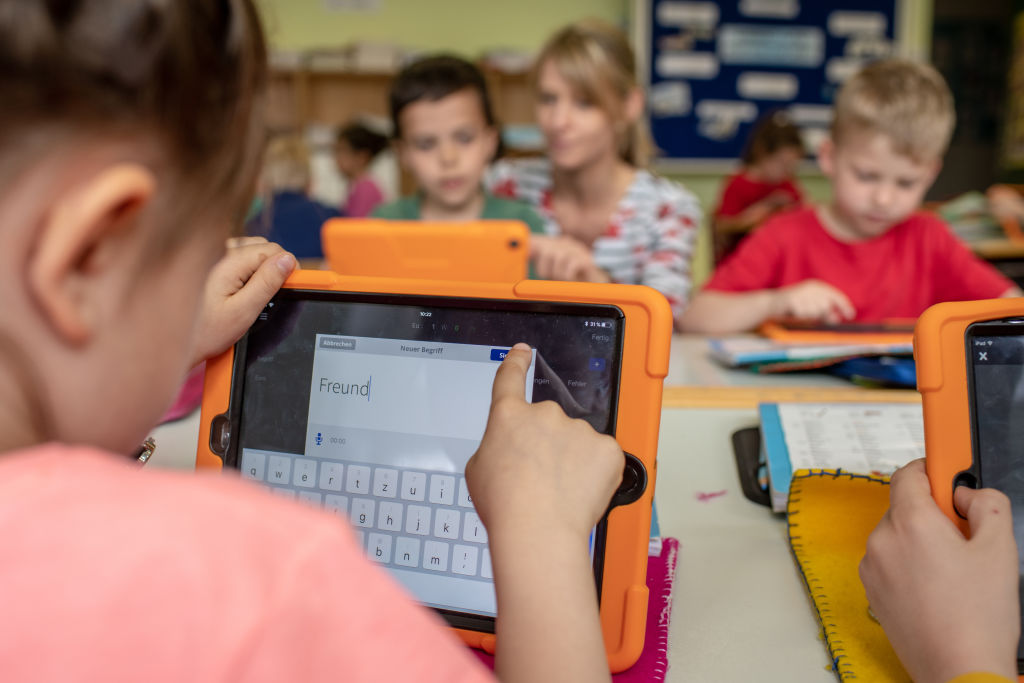
Tech vendors want students learning from screens, not teachers. (Armin Weigel / picture alliance via Getty Images)
When nine-year-old Sunny entered second grade at his Los Angeles public school three years ago, a surprise awaited him: a personal Google Chromebook to use in his classes and take home each afternoon. “Everyone was obsessed with the Chromebooks,” he recalls. Sunny was excited too, “but then it started to get boring.”
At the time, principals and teachers in the Los Angeles Unified School District (LAUSD) were under pressure from Superintendent Alberto Carvalho to increase engagement with MyPath, a component of a widely used (and widely loathed) digital product called i-Ready. MyPath was meant to prepare students for their i-Ready assessments, which would supposedly predict scores on California standardized tests. In exchange for their MyPath minutes, students like Sunny could earn digital coins to spend on i-Ready video games.
“It became this thing of just racking up minutes in the program,” explains Kate Brody, an LAUSD parent who fought for and recently won classroom screen-time limits with the grassroots Schools Beyond Screens coalition. “An ouroboros of psychotic time-wasting minutes.”
I-Ready has lately come under fire for a long list of problems, including a lack of evidence that it works and a federal lawsuit claiming that its private equity–backed parent company bypassed consent to harvest and transmit students’ personal data. But for Sunny, the main problem was a mind-numbing boredom. Paper-and-pencil test prep can feel boring, too, but there students can quickly check the right answer and move on. I-Ready, however, blocks users from clicking on anything until they sit through the slow audio question and accompanying animation — baking in the assumption, as one parent noted, that kids can’t read. This repeats all over for the next question, even if it’s nearly identical to the previous one. So Sunny found that his math and reading work now entailed staring at the screen for long stretches, eyes glazed over, waiting for a chance to answer multiple-choice questions well below his skill level.
The main selling point for products like i-Ready has been that “smart” technology can adapt materials to students’ individual skill levels, providing exactly what they need to learn. When Superintendent Carvalho announced the arrival of the district’s now-infamous custom AI chatbot, Ed — a scam that would ultimately land him on paid leave under FBI scrutiny — he boasted that it would provide “absolute personalization and individualization.” For Sunny, though, the move to digital learning felt like exactly the opposite: The tech wasn’t smart enough to grasp that he didn’t need all this monotonous repetition.
“They sold it as something that customizes to your kids. Really?” Sandra Martinez Roe, Sunny’s mom, told Jacobin. “That’s what a teacher is for.”
Meanwhile, as LAUSD signed onto an expansive number of pricey no-bid tech contracts, the district’s human educators felt increasingly squeezed. While Sunny was in second grade, teachers and support personnel walked out for three days over unsustainable conditions like bare-bones staffing and poverty wages for hourly workers. And last month, the two unions (United Teachers Los Angeles [UTLA] and Service Employees International Union Local 99) felt compelled to threaten another walkout, this time along with the administrators’ union. Armaghan Khan, a middle school science teacher and member of the UTLA bargaining team, told Jacobin that the district’s spending on tech contracts was a primary focus of the threatened strike.
Khan says LAUSD is at an inflection point — part of the nationwide bipartisan backlash against Silicon Valley’s takeover of public schools. In April, the LAUSD school board unanimously voted to place guardrails, including an audit of outside contracts, around student-facing technology. The district’s new guidelines, which will be finalized on June 23, have already inspired similar proposals in New York, Washington, DC, and elsewhere.
Schools Beyond Screens members Kate Brody and Sandra Martinez Roe say they’re just getting started. As parents, educators, and lawmakers across the United States make the case that school shouldn’t be a place where kids zone out on devices, interact with risky algorithms, or unwittingly hand over data to profit-driven third parties, we have the opportunity to ask ourselves: How should we think about school? To begin answering this question, Jacobin consulted stakeholders in Los Angeles, the nation’s second-largest district.
Think About School in the Present Tense
A key theme that emerged from these discussions is the importance of thinking about school in the present. Technology’s allure is always future oriented: Personal computing was going to supercharge productivity; social media and smartphones would strengthen interpersonal connections; and now AI will streamline the world of work. And for three-quarters of a century, education technology vendors have promised to optimize student learning and eliminate the busywork of teaching. But as Charles Logan, T. Philip Nichols, and Antero Garcia recently argued in Kappan, “the future they’re selling has not arrived — and perhaps it never will. But de-skilling, surveillance, and extraction — all of that is happening now, in our classrooms, today.”
“It just doesn’t make sense to train six-year-olds on technology that may be obsolete in a few years,” Kate Brody told Jacobin. Nor does it make sense to train them “on consumer-facing technologies that are designed to be used intuitively” — as opposed to, say, reading, which is anything but intuitive. Brody, who has taught English in public schools in New York City (now facing its own techlash) and LA, says children need ample practice to become good readers and writers — which research suggests is better done off-screen, possibly because the physicality of pencils and pages cements memory. She says we’ve been “making bizarre tradeoffs in K–12, and a lot of that is driven by fear.”
Armaghan Khan agrees that fear about test scores has caused school leaders to buy into overhyped edtech, telling Jacobin:
It’s no secret that test scores are down across the country. And I think these big [tech] contracts are an attempt to do something about that. But the test scores are down because of deeper challenges. When a student is hungry, or sleep deprived, or housing-insecure, they are not going to do well on a test.
Audrey Watters, who explored the surprisingly long, repetitive history of personalized learning in her book Teaching Machines, argues that despite tech titans’ futuristic rhetoric, what they’re selling is not, in fact, about the future at all. Rather, it’s a warmed-over Cold War fantasy that robot tutors can prevent another national embarrassment like Sputnik.
Deep Learning Requires Friction
The parents and educators who spoke to Jacobin say edtech’s sales pitch of “frictionless” ease is deeply misleading. For one thing, as Armaghan Khan points out, “Edtech creates as many problems as it solves. When teachers are monitoring student behavior on devices, that takes time away from instruction.”
This phenomenon has been observed across many domains: Within our lopsided labor market, sexy new tools like AI end up transforming creative knowledge workers into stressed-out middle managers with little time to do anything but supervise glitchy tech in between pings. And as the teachers and schools ditching screens have noted, when curriculum is mostly digital, a damaged device or crashed server can leave students stranded.
For Sunny, digital programs like i-Ready just make school “way too easy.” Beguiled by buzzwords, Kate Brody says we’ve abandoned the challenging classroom experiences that build perseverance and yield deep learning: “Like, ‘Oh they don’t need to read, they could listen to audiobooks. They don’t need to write, they could use voice-to-text.’” She elaborates:
There’s a form of care with kids that looks like you’re being hard on them, but it’s respecting their dignity. They’re not going to feel a sense of purpose unless you allow them to struggle and get strong and do hard things.
When Brody began teaching in LA, where digital tools were “more or less mandatory,” she missed the messy togetherness of her New York teaching practice. She remembers sitting in a circle with her students, talking about stories, and having surprising exchanges “when things kind of take a left turn and all of a sudden you’re having this other discussion.” Brody says the physical barrier of the laptop screen — to say nothing of its siren song of addictive distraction — makes those organic, memorable moments impossible. “And students are on their own. Whatever they’re learning, it’s separate from everybody else.”
As for the notion that edtech can reduce the burdensome drudgery of teaching, Armaghan Khan is skeptical. “I don’t find planning lessons, grading materials, or meeting with parents or students to be drudgery at all,” he told Jacobin. “Those are the elements of my profession that keep me coming back.”
And anyway, can you be a good teacher if you outsource such tasks? “I doubt it,” mused Audrey Watters in a recent speech for retired educators, “because grading and planning and communicating inform the work. They are the work.” If we offload this vital human labor, what’s left?
Invest Education Dollars in Human Beings
“When this whole thing started, I was like, who’s making money off of it?” Sandra Martinez Roe recalls. “I feel like these technology companies have their claws out for our little ones.”
None of the people interviewed for this piece dispute that technology is an essential feature of modern life, with valuable classroom applications. Rather, they’re concerned that the rush to embrace unproven edtech — which began in earnest during the Obama years and accelerated post-pandemic — has exposed an already ailing public school system to novel maladies.
Multiple recent edtech-related scandals in LAUSD demonstrate how ripe the market is for taxpayer-funded grift. More sinister still, leaked documents confirm that companies like Google view K–12 contracts as a means of grooming future customers. And increasingly, tech billionaires themselves are spelling out radical plans to weaponize their phenomenal wealth and power. What better place to start than by tracking and shaping the cognitive habits of young children?
Strung out on test score anxiety and inadequate school funding, leaders like Carvalho pinned their hopes on edtech silver bullets, all the while neglecting their most precious, proven resource: human educators. Martinez Roe, formerly copresident of the Parent Teacher Association at Sunny’s school, told Jacobin the organization has had to do intensive fundraising “to support an art teacher, a music teacher, an innovation lab — stuff that the school should be supplying.” She says teachers are forced “to beg for supplies,” and principals have to make impossible choices, because the district is “spending all this money on technology that’s not even helping our kids move forward.”
“Whatever they thought they were buying a few years ago,” says Kate Brody, referring to i-Ready, “it was not this program that’s now a daily thing for students.” Without a significant course correction, Brody fears young people “will be forced to be on their laptops because they actually can’t work with each other anymore.” Anyone who observed school lunches in the age of ubiquitous smartphones (now restricted on school grounds in thirty-four states and counting) can appreciate her point. Brody says we need to rethink “the individualistic promise of tech — that we should all be optimizing on our own schedule. It’s not really compatible with K–12 education.”
“Human connection is at the heart of learning,” Chelsea Confalone, an educator with two children in LAUSD, told Jacobin. “Classrooms should be places where students and teachers build knowledge together through experience and dialogue,” particularly around “difficult, open-ended questions.”
“This is a time for children to learn to resolve conflicts, get comfortable with problem-solving, and learn critical thinking,” says Martinez Roe. “This is when they learn about friendships. A screen cannot replace these experiences, and these experiences should not be replaced.”
Sunny agrees with his mom that screens can interfere with friendship, because his peers “only want to play on technology.” He and his friends used to sneak around the firewall to play Minecraft “for ages” during class and after school. At first, it was thrilling, but when the game entered survival mode, “you have to kill pigs, cows, anything to survive. I hate it because I die almost every single time.”
These days, Sunny wants to focus his energy on playing sports. Now in fourth grade, he feels hopeful about his district’s new resolution to limit screen time. “I’m excited,” he told Jacobin, “because now I can spend more time with my friends.”