The Democrats Are Determined Not to Learn From Their Failure

The Democrats’ botched 2024 autopsy doesn’t just leave out Gaza. It also simply pretends the left-populist upsurge embodied by Zohran Mamdani isn’t happening, while coveting its achievements.
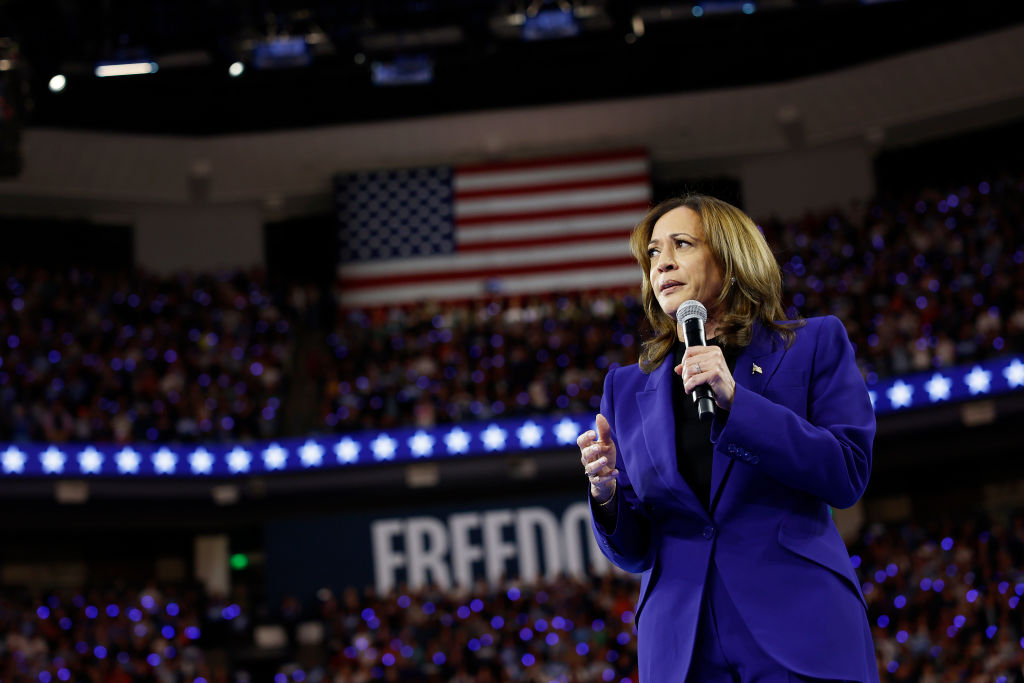
Kamala Harris speaking into a microphone with a stadium full of people and a sign that says "Freedom" behind her.

Maybe the most glaring absence in the controversial Democratic Party assessment of what went wrong in 2024 is the report’s silence on the left-populist upsurge happening within the party. (Anna Moneymaker / Getty Images)


Usually, a report might become major news because of some kind of damning or inconvenient revelation that’s contained inside it. But the Democratic Party is currently in such disarray, it’s managed to turn even the act of simply releasing a report to the public into an embarrassing debacle.

The Democratic National Committee’s (DNC) autopsy report on what went wrong in 2024 was finally released last week, and it has quickly, and somewhat hilariously, plunged the party into an internal crisis, with DNC chair Ken Martin now facing calls to resign. I say hilariously because the reason for this has very little to do with what’s actually in the report and is entirely due to Martin’s extremely public bungling of the messaging around it.

To be clear, there’s plenty embarrassing about the report’s content too. But it’s revealing and emblematic of a Democratic Party that has been utterly in shambles the past year that the production and release of the report has become somehow a bigger controversy than what’s in it.

While it’s unclear who exactly is responsible for it, arguably Martin’s first misstep was appointing his consultant friend Paul Rivera to head the task, for which he reportedly took months to get in touch with top names from the Joe Biden and Kamala Harris operations or simply never reached out to them at all. This appointment might have been overlooked, but Martin then serially delayed the report’s release, suddenly threatened to bury it, then reversed himself again and vowed to put it out, all while claiming that the nearly two-hundred-page report — which claims to have been based on interviews with more than 12,000 Democratic officials and surveys of 5,000 more people — had been written for free.

Naturally, given both this spectacle and the unfinished, error-ridden product that found Martin folding an apology into a press release announcing the report’s public reveal, the choice of Rivera, with his less-than-illustrious career, is now receiving extra scrutiny, further fueling questions about Martin’s leadership.

Then there’s the Gaza issue. Interest in the report soared the past few months thanks to leaks that suggested the party’s role in assisting Israel’s yearslong genocide, and how that contributed to its 2024 defeat, was part of the final copy. Instead neither Gaza nor anything to do with Israel or foreign policy in general appears.

Even more puzzling, the Institute for Middle East Understanding (IMEU) Policy Project insists they were told “clearly and unambiguously” that the autopsy found that Gaza was a “net-negative” for the party in 2024, and only a week before the report’s release, the Harris campaign’s digital director, who had spoken to the report’s authors, had described exactly how this had been the case.

“Gaza was an impossible issue to communicate around,” he wrote. “Protesters drove coverage away from campaign events. Digital creators (or even supporters) were afraid to say anything nice about Biden because their comments sections would get rocked. . . .  In ways that may not be reflected in a poll, it meaningfully reduced enthusiasm.”

In other words, it really, really looks like someone at the DNC excised the findings about Gaza from the finished product — an especially odd thing to do if those findings show that lockstep support for Israel was a major political liability and if the goal here is to avoid repeating the party’s 2024 disaster. The fact that the DNC under Martin’s tenure already rejected several resolutions condemning the American Israel Public Affairs Committee (AIPAC) and calling for a ban on weapons sales to Israel won’t help this perception.

But reading through the report, Gaza is far from its only problem.

I’m not even talking about the missing conclusion and other sections, or the many glaring errors, which sometimes involve the authors getting figures wrong that are accurately printed on the exact same page. Or the fact that at one point, the report appears to be advocating that the party flirt with breaking election law, all but calling for campaigns and the super PACs backing them to find some way to be better “aligned” and have more “clarity” around “the lanes they will occupy.” (For the record, it’s illegal for campaigns to coordinate with super PACs).

Maybe the biggest problem with the report is that there just isn’t all that much there. It’s not just Gaza: specifics about policy and messaging on virtually every front are totally missing from the postmortem.

Beyond vague calls for “addressing cost-of-living concerns” and pabulum about proving to Americans that the Democrats “think like them, with similar passions and priorities, and politics,” there is no real introspection about what exactly it was about Harris’s campaign that led Americans to reject her. There’s an early point about the fact that policies usually associated with Democrats — like Medicaid expansion, a higher minimum wage, and sick leave — have been voted for directly even by conservative voters, but there is no discussion of the fact that these policies were more or less absent from the actual Harris campaign.

The report opens with a pocket history of the party’s seesawing fortunes over the past decades, but it’s remarkably devoid of even the barest material political content. Barack Obama’s failure wasn’t related to his austerity push or letting bankers off the hook after the 2008 financial crisis; it was just a vague failure by Democrats at “cementing a relationship with working Americans.”

The 2016 loss was a result of an unspecified “series of dramatic events, massive election interference, and poor strategy,” not Hillary Clinton’s closeness to corporate interests and awful foreign policy record. Shadowy outside interference is likewise cast as the reason for the party’s ongoing failures today, a “conscious effort by foreign and domestic actors to shape electoral choices” through a “barrage of extremist misinformation,” apparently via X.

The authors extol the Democrats’ rightward lurch under Bill Clinton, for “turning the tide of defeat and ushering in a new era of political achievement” by working to “reclaim the vital center of American discourse,” which “is where most people live.” But there’s little consideration of how the “achievements” of that era fed into the party’s long-term decline, by alienating the exact voting constituencies that didn’t turn out for Clinton or flipped to Donald Trump in 2016, or how the Harris campaign failed to fundamentally break from this model.

But maybe the most glaring absence, with the party adrift and trying to figure out how to reconnect with voting groups it used to do well with, is the report’s silence on the left-populist upsurge happening within the party.

The most dramatic example, of course, is Zohran Mamdani’s New York City mayoral campaign, which managed to significantly expand the electorate, excite the exact voter groups Democrats dream of winning back, and run the kind of sophisticated, mass-mobilized ground game the report states the party needs to find a way to engineer.

There were other data points the authors could have looked at. The fact that left-wing politicians like Rep. Alexandria Ocasio-Cortez, now one of the party’s leading national figures, outperformed Harris with Trump voters. Or the independent Senate campaign of Dan Osborn, who bested both Harris and every Democrat who has run for a Senate seat in Nebraska since at least 2012. Or Graham Platner’s shockingly strong insurgent showing against the consummate establishment Democrat in Maine, who has since dropped out of the race entirely.

It’s not as if the report doesn’t cover events after the 2024 election: the gubernatorial elections in Virginia and New Jersey are discussed in detail, for instance. But this report simply exists in an alternate reality where none of these challenges from the Left have happened. Osborn is only mentioned as an independent who ran in a state where Democrats didn’t field a candidate. Mamdani’s upset only appears as an unspecified win in a list of various places that “may lead to a false sense of security and a belief the Democratic Party has again found ways to bring the voters back to the booth with their messaging.”

The reports’ authors seemed more interested in Charlie Kirk’s Turning Point USA and how it eschews the model of a “seasonal, churn and burn ecosystem” that runs a “program around the calendar, and across the nation.” There is, of course, nothing wrong with studying the Right and understanding its success — conservatives have certainly been more than happy to learn from the Left for their own successful organizing. But it’s telling that the Democrats seem completely uninterested in an actual electoral campaign that built a formidable and victorious field operation from small-dollar fundraising — and one that was built and operated within its own party.

It’s not surprising that a political party that botches the act of publishing a report, let alone one that cannot seem to bring itself to honestly evaluate its own electoral failure, would lose an election to one of the most intensely disliked Republican candidates in history, not once but twice. Whatever is or isn’t in the DNC autopsy, the reasons for the party’s current banishment to the political desert are clear, as is its pathway out: inspiring voters to get politically reengaged with an ambitious platform that actually promises to make their lives measurably better. All this fiasco tells us is that the Democratic Party leadership is still committed to refusing to see either.