Australia’s Right Wants to Ban “Globalize the Intifada”

State governments in Australia are trying to outlaw the phrase “globalize the intifada.” It’s an act of censorship that is willfully ignorant of the slogan’s meaning and connection with the Palestinian liberation movement.
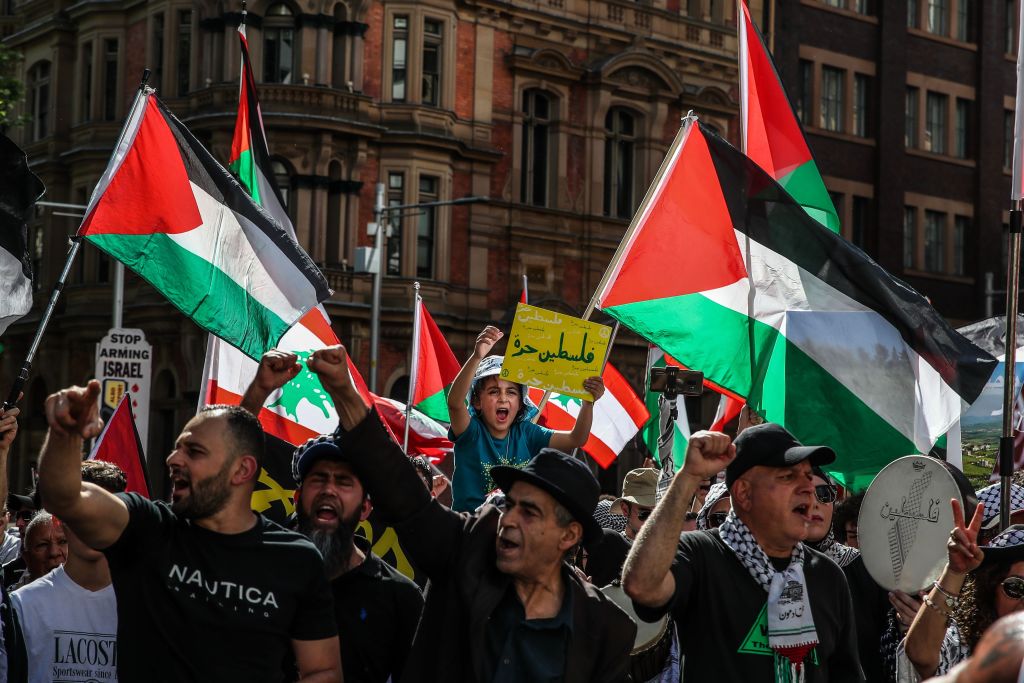
The Australian political establishment and pro-Israel lobby groups want to ban the slogan “globalize the intifada.” (Roni Bintang / Getty Images)

In Australia, the Parliament of New South Wales (NSW) is considering whether to ban the slogan “globalize the intifada.” This follows moves in the UK to criminalize the slogan, and the NSW government has similarly justified the push by arguing that the slogan “is hate speech and encouraging of violence in our community.” Their argument implies a causal link between calls to “globalize the intifada” and acts of anti-Jewish violence such as the atrocity committed at Bondi Beach on December 14, 2025.

The alarmist public discourse essentially asks Australians to believe that in calling to globalize the intifada, pro-Palestine demonstrators are inciting violence against Jewish people. Certainly this is how many Zionist organizations interpret the phrase. As David Ossip from the NSW Jewish Board of Deputies puts it, “Globalizing the Intifada means killing a Jew wherever you find one.”

For commentators like the Sydney Morning Herald’s David Crowe, the historic fact of Palestinian suicide bombings is enough to deem any use of intifada as a call for violence. “It is true that many interpret the term more broadly,” he acknowledges, “but the link to those attacks is indisputable.”

Political language, particularly language of resistance and rebellion, is always a site of contestation. “Intifada” refers to periodic flare-ups of mass Palestinian resistance, within which different tactics have come to the fore at different times. It cannot be reduced to any of those tactics. Arabic, like English, has its own words for those. But it is not enough to simply look up “intifada” in an Arabic dictionary to settle today’s dispute surrounding the term. Slogans have a life of their own and must be interpreted historically and contextually. Some consideration of how this language actually entered Western political discourse is therefore helpful.

From “Globalize Resistance” to “Globalize the Intifada”

The late 1990s saw a series of mass mobilizations targeting the World Trade Organization and other gatherings of the world’s superrich. The “battle in Seattle” was the catalyst for this summit-hopping movement, which came to Melbourne, Australia, in the three-day S11 blockade of 2000. “Globalize resistance” was a popular slogan of these mobilizations.

Two events at the turn of the millennium complicated this picture for the Left. First, in 2000, the Second Intifada erupted in Palestine. Then in 2001, the September 11 attacks on New York put the United States and its allies on a war footing. Activists in the United States and elsewhere had to quickly pivot and build bridges between the existing global justice movement and the emerging pro-Palestine and antiwar campaigns.

One important scene for these negotiations was a set of meetings and rallies held in Washington, DC, in late April of 2002. On the eve of the main rally, a conference was held at American University calling itself “Global Intifada: Globalization, US Militarism, and the Struggle for Justice in Palestine.” As one Arab American activist at the gathering put it, “The rights of the Palestinian struggle are linked to other countries’ struggles dealing with voting rights, wars on drugs and terrorism, suffrage, and so on. This is our kind of globalization, the linking of such common efforts to end injustice.” At the rally the next day — which ended up being the biggest ever pro-Palestine mobilization in American history — speakers on the platform called to “globalize the intifada.”

Two months later, the Group of Eight (G8) forum of leading industrialized nations convened in the Canadian mountain resort of Kananaskis, a venue deliberately chosen to preclude direct demonstrations. Small rallies were held in the nearby city of Calgary. Among the slogans raised there was “G8 says nada. We say global intifada.”

Then, at the end of August, a South African coalition of community organizations, trade unions, and social movements convened the Global People’s Protest March at the World Summit on Sustainable Development in Johannesburg. Their slogans included “end poverty: land, food, jobs,” “Africa is not for sale, our world is not for sale,” but also “globalize the intifada.” At a side event dedicated to the campaign to free Palestinian political prisoner Marwan Barghouti, the coalition festooned Johannesburg City Hall with banners including the phrase “globalize the intifada against imperialism.”

The new slogan reflected a conscious intervention to reorient the global justice movement toward a campaign that was both in solidarity with Palestine and against the looming US invasion of Iraq. Its frame of reference was not confined to Palestine alone, and its emergence had nothing to do with any stance toward specific tactics of Palestinian resistance. It recognized, and sought to build, links between Palestinian resistance and campaigns for justice elsewhere. At its most capacious, “globalize the intifada” embodied a call for a global spirit of resistance against injustice and imperialism. These remain some of the basic meanings that participants in today’s pro-Palestine demonstrations give to “globalize the intifada.”

A Paranoid View

The first prominent invocation of a “global intifada” on the right side of politics seems to date to 1990, when conservative commentator Charles Krauthammer wrote an article entitled “The New Crescent of Crisis: Global Intifada.” Krauthammer was writing during the first Palestinian intifada (1987–1993), but his mind was on America’s post–Cold War positioning. The end of America’s rivalry with the Soviet Union brought with it a need for new political paradigms.

Krauthammer’s “global intifada” was an interlinked front of Islamic militancy stretching across Eurasia, part of an emerging “clash of civilizations” (a perspective soon to be elaborated by political scientist Samuel Huntington).

For the critic Edward Said, Krauthammer’s vision relied on a “monolithic, enraged, threatening, and conspiratorially spreading Islam.” It was Islamophobic and served Israel’s interests by interpreting Palestinian resistance as motivated not by oppression but by global jihad. Such talk, as Middle East scholar John Esposito put it, “distracts and detracts from the nature and real causes of discontent in the Palestinian intifada.”

This is a paranoid view of a global intifada. It provided a convenient framing for the West’s “war on terror.” As America and its allies invaded Iraq, Australian journalist Paul Sheehan imagined “global intifada” as “a hot war driven by medievalism and resentment” in dysfunctional Muslim societies. According to Sheehan, Australia was on the “outer edges” of this violent conflagration, with “paramilitary flying columns of Muslim men assembling in Punchbowl and Lakemba.” Sheehan’s global intifada was racialized, serving to demonize Muslim migrants in the West.

For other right-wing commentators, the “global intifada” was widening. Speaking at Columbia University in 2005, conservative culture warrior Phyllis Chesler expressed alarm that “the intifada has gone global.” Yet her global intifada was one in which Westerners were complicit, and her ire was directed at domestic enemies. “Western academics and intellectuals have made an alliance with Islamist totalitarian terrorists,” she railed. At this time, the negative connotations of intifada were still self-evident to many in the West: to position academics as part of an “academic propaganda-intifada” was enough to discredit them.

This line of thinking lives on today in public commentary on the Palestine solidarity movement. On the Australian right, there is speculation that the local movement is coordinating with foreign actors. According to the Australian Academic Alliance Against Antisemitism (5A), a judicial inquiry into antisemitism was necessary to establish “the extent to which foreign and proscribed actors have been seeking to infiltrate and influence students and staff on campus.”

Among the recommendations in her Plan to Combat Antisemitism, Special Envoy to Combat Antisemitism Jillian Segal demanded the right to direct authorities to “investigate sources of overseas funding entering public institutions, including universities, which might drive extreme ideologies.” No doubt Segal and her allies will strive to make this line of inquiry a focus of the forthcoming Royal Commission.

A Lurid Spotlight

“Globalize the intifada” is a relatively rare slogan at Australian demonstrations. Its centrality to the current debate certainly cannot be explained by its prominence at these events. This history of conservative anxieties and fulminations against a “global intifada” helps explain the particular spotlight that has been put on the slogan today.

Talk of a “global intifada” has been with us for a long time, as have the divergent meanings given to it by both the Left and the Right. As Palestine activists have sought to shift prevailing interpretations of the term, they have elicited a strong response from Israel’s defenders.

Advocates of a ban interpret this slogan in a narrow and lurid way. Their spin does not stand up to scrutiny. When pro-Palestine activists argue that they associate “globalize the intifada” with a call for global solidarity against injustice, they are on perfectly sound historical footing. The slogan essentially gives a pro-Palestine tinge to late-’90s calls to “globalize resistance.” Those who say they are using it in this way have every right to be taken at their word. 

An outright proscription of the phrase would cross a major threshold in the erosion of civil liberties in Australia — particularly if it does not consider the intent of the utterer, the context in which it is uttered, or any demonstrable consequences that flow from the utterance. Such a move will do nothing to enhance public safety in NSW. Its main practical effect will be to boost ongoing efforts by pro-Israel organizations to frame all forms of Palestine solidarity as inherently antisemitic and illegitimate — efforts that predate the Bondi attacks by decades.