Lessons From San Francisco’s Fight Against Tech Displacement
A new book recounts how San Francisco tenant organizers took on tech-fueled displacement in the 2010s. Their campaigns were brave, media-savvy, and sometimes successful — but the conditions that made them possible have changed, and so must the strategy.
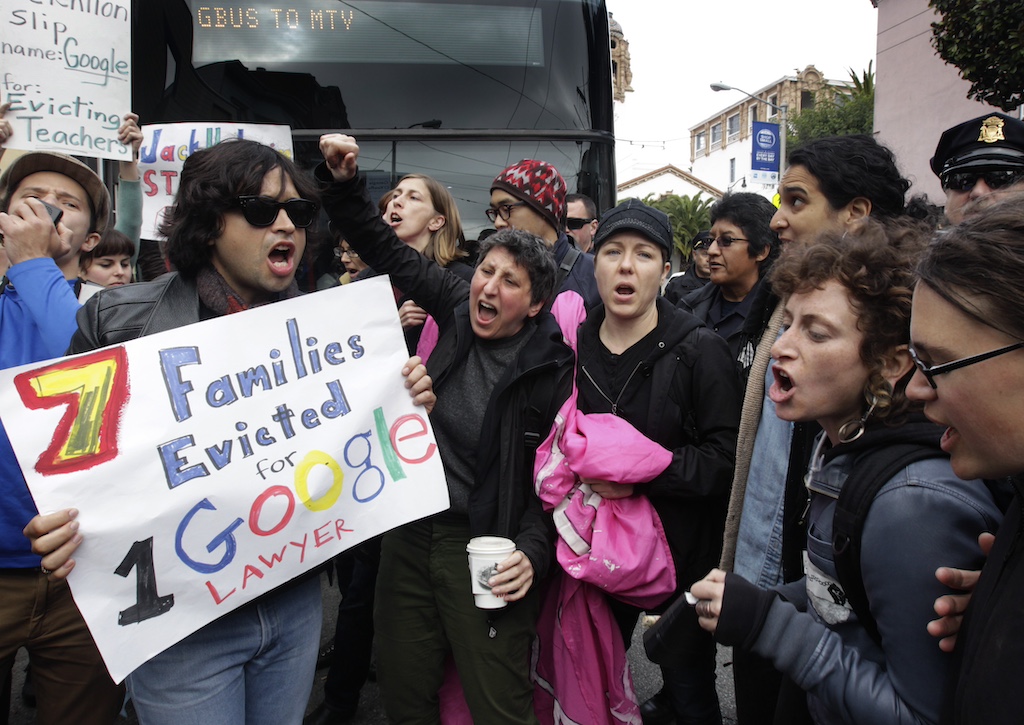
San Francisco's tenant movement is and experimenting with new strategies for a longer-term fight. (Paul Chinn / the San Francisco Chronicle via Getty Images)
In 2012, a Google in-house lawyer named Jack Halprin bought a 107-year-old Victorian multifamily home — painted all white, with handsome burgundy window trim and a stately, hexagonal turret — for the artificially low price of roughly $1.48 million. Halprin moved into one of the building’s seven rent-controlled units, located in San Francisco’s historic Mission District, and took the Google bus (a private, corporate-run shuttle) to work. Soon, he decided he liked the arrangement well enough that he wanted the building to himself. He filed eviction notices for everyone else in the building, among them a high-school teacher, first-grade teacher, Uber driver, and elderly disabled woman.
Some tenants moved out; others organized. Their protests quickly drew wide attention. The fact that Halprin worked at one of the major tech firms (Facebook, Apple, Amazon, Netflix, and Google — collectively known as the FAANGs) lent the evictions a broader political meaning. Perhaps most memorably, San Franciscans came together to blockade his Google bus, practically a segregated metro system for tech employees. Many held signs in a mock Google font reading “7 Families Evicted for 1 Google Lawyer” and “Google: Can I Ride Your Bus Back to SF After My Eviction?”
Among the groups behind the campaign against Halprin was Eviction Free San Francisco (EFSF), a media-savvy and seemingly tireless coterie of about five activists, give or take, whose history and practices are rooted in lessons from Occupy Wall Street. San Francisco has a long history of working-class struggle: during the worst of McCarthyism, it became something of a refuge for Communists and fellow travelers keeping a low profile. In the 1970s, as the city underwent a cycle of “Manhattanization,” displacing large swathes of Manilatown, the International Hotel (nicknamed the “Red Block”) anti-eviction fight set a historic example for the Bay Area tenant movement. And in the ’90s, the region’s Eviction Defense Network combated Bill Clinton’s national push to demolish public housing.