What New York Tenants Are Building Beyond the Courtroom
Tenants across buildings owned by Pinnacle Group are testing whether collective power can force new arrangements with landlords and the city government under a new pro-tenant mayor, Zohran Mamdani.
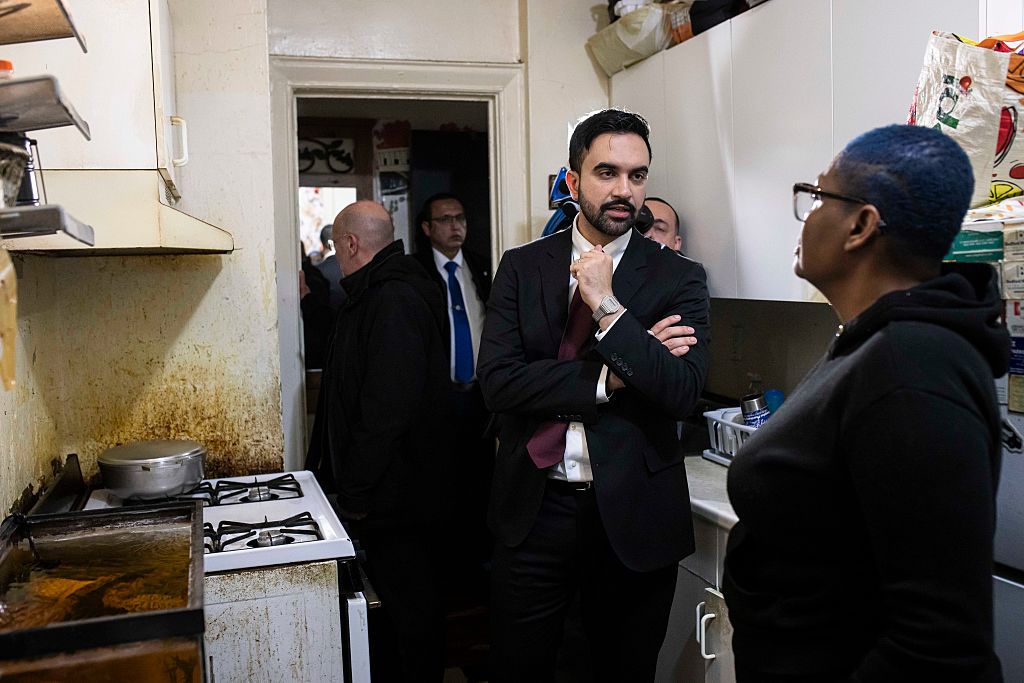
Organized tenants in New York City are experimenting with what they can win through the combination of a mayor, Zohran Mamdani, who says he’s on their side, and organizing their own buildings. (Dave Sanders - Pool / Getty Images)
For months, tenants in dozens of rent-stabilized buildings owned by Pinnacle Group tried to do something New York housing law almost never permits: stop their landlord from selling their homes to another speculative owner.
They organized across buildings, formed what became a tenants’ union across Pinnacle’s real estate portfolio, staged protests, and went to court. As one tenant put it during the town hall, the organizing began because “nothing else was working”: complaints went unanswered and conditions worsened. Eventually, they won the backing of city hall under Mayor Zohran Mamdani. They still lost in court.
Last month, a federal bankruptcy judge rejected the city’s request to delay the sale of roughly 5,100 rent-stabilized apartments across more than ninety buildings, clearing the way for the portfolio to be transferred from Pinnacle Group to Summit Properties USA. The case grew out of years of neglect. Under Pinnacle’s ownership, the properties fell into severe disrepair and accumulated thousands of housing code violations, before the company declared bankruptcy last year after defaulting on more than $560 million in loans.
Tenants described years of neglect, including buildings left without power after the landlord failed to pay Con Edison bills. One resident described living with heat outages and broken elevators while management remained unresponsive, saying conditions had become “unlivable.”
The bankruptcy triggered a citywide wave of tenant organizing, as Pinnacle residents formed the Union of Pinnacle Tenants (UPT) and tried to slow the sale and push for what they considered to be a more responsible buyer who would address their concerns with disrepair. That effort ultimately failed. Summit Properties USA lined up a $451 million bid for the portfolio, positioning itself to take control of the buildings despite tenant opposition.
The city was not alone in raising concerns. In court filings, Brent Meltzer, head of the New York attorney general’s Housing Protection Unit, said that Attorney General Letitia James supported the city’s effort to delay the sale, citing “significant concerns” about Summit’s ability to maintain rent-stabilized housing. Meltzer pointed to Summit’s existing record: more than four thousand open housing code violations across roughly three thousand apartments already owned by the company — conditions he said mirrored what Pinnacle tenants had long endured.
Meltzer also highlighted Summit’s business ties to Chestnut Holdings and Denali Management, connections that deepened tenant fears about continuity rather than reform. A Gothamist analysis found that Jonathan Wiener, a Chestnut executive and the brother of Pinnacle CEO Joel Wiener, had signed more than fifty deeds and loan documents for buildings currently listed on Summit’s website, blurring the line between old and new ownership.
In a separate filing, attorneys for the city questioned whether Summit’s bid was financially viable. They warned that it was unclear whether the company could afford to make long-overdue repairs and maintain the buildings while also servicing its own debt and turning a profit, given that rents are regulated in most of the apartments.
Those facts help explain why tenants moved quickly to organize, and why the fight was not only about stopping one sale but building enough leverage to force accountability from whoever ultimately took control. Despite failing to stop the sale, they extracted significant concessions: as part of the sale framework Summit put on the record, the buyer committed to an immediate repair push — including a pledge to address roughly half of outstanding violations within the first sixty days of ownership — backed by dedicated first-year repair funding, a multiyear capital commitment totaling tens of millions of dollars, and a repair-focused credit facility intended to ensure liquidity for the work.
On Sunday afternoon, roughly three hundred tenants logged onto a virtual town hall organized and facilitated by members of the UPT. Tenant organizers walked participants through the ruling, explained what it did and did not change, and devoted most of the meeting to strategy: how to enforce the commitments extracted from the buyer, how to continue organizing buildings, and how to push beyond one-off concessions toward something more durable.
As speakers talked, the Zoom chat filled with accounts of what life in Pinnacle buildings had been like. Tenants described long-standing leaks, mold, broken elevators, and heat outages. One tenant said in the chat that a resident in their building had been hospitalized over the weekend after going without heat, adding that repeated complaints to management had gone unanswered. Others asked whether organizing collectively was the only way to prevent the same neglect from continuing under new ownership.
Mayor Mamdani and Cea Weaver, a longtime tenant organizer who is now director of the Mayor’s Office to Protect Tenants, attended, but neither ran the meeting. Mamdani framed the administration’s role as contingent on tenant pressure rather than a substitute for it.
“I want to be very clear that this work has only just begun,” Mamdani told tenants. “It is also work that would have never even been able to be started, were it not for all that you had already done prior to this moment.”
Pointing to the repair commitments Summit made as part of the sale, the mayor told tenants that these were “commitments that would never have been set aside had tenants like you not agitated, organized, and demanded the respect you deserve.” He also emphasized that the city’s involvement came under tight constraints both legal and temporal, but said the administration viewed the case as part of a broader fight over tenant power.
“I think of this fight frankly as the same as standing with nurses who are on strike or delivery workers seeking back pay,” Mamdani said, urging tenants to see themselves as “the eyes and the ears of the city on the ground” in enforcing housing law.
Weaver, who helped found the Crown Heights Tenant Union (CHTU) before entering city hall, echoed that orientation from inside the administration. The goal, she said, is “to bring landlords to the bargaining table for repairs and for the things that you need,” describing the moment as an experiment in “mass governance and tenant leadership and city hall in a way that we never have done before.”
The legal loss, in other words, was treated as a constraint rather than an ending. What mattered was whether the organization tenants had built could now be turned into leverage.
Outside the courthouse days earlier, tenant organizer Emma Rehac framed the stakes with the kind of moral arithmetic bankruptcy court is built to ignore, asking whether the judge would side with “10,000 rent-stabilized tenants . . . or . . . two brother slumlords.” The judge’s answer was clear.
Enforcement of the commitments wrung from Summit remains an open question. But the shape of the concessions marked a departure from what bankruptcy sales typically produce when tenants are absent from the process.
The focus now is on what tenants are trying to build beyond the courtroom.
Turning the City From Regulator to Ally
Much of the public discussion around the Pinnacle fight has framed city hall as either a failed rescuer or a frustrated bystander. That framing misses something more basic: “Bankruptcy court was never designed to give tenants a meaningful voice,” UPT organizer Tracy Rosenthal told me.
That is not a rhetorical complaint so much as a structural description. Bankruptcy proceedings exist to protect creditors and facilitate asset transfers, not to adjudicate housing conditions or tenant stability. That reality helps explain why the court loss, while consequential, does not fully capture what the Pinnacle fight was about.
The organizing was never only about persuading a judge. It was about forcing concessions, reshaping political alignments, and constructing leverage where the law offers little. Even in defeat, tenants succeeded in altering the terms of the sale — an outcome that fits a broader pattern in housing struggles, where collective action can change what is politically and economically possible even when formal legal remedies are weak.
From that vantage point, city hall was not a neutral arbiter to be appealed to but terrain that could be moved. “What we did was turn a target, the city, into an ally,” Rosenthal said.
Rather than treating elected officials as saviors, tenants treated the city as something to be pressured, realigned, and used. The Mamdani administration’s intervention did not substitute for tenant power; it was produced by it.
There is empirical support for this approach. Research compiled by the Eviction Lab has shown eviction to be a routine market mechanism rather than an exceptional response to individual hardship, and that housing outcomes change when tenants have structured support rather than facing landlords and courts alone. In New York, analyses of the city’s Right to Counsel program point to a similar conclusion: legal protections are most effective when paired with organizing capacity and political enforcement.
Tenant Collective Bargaining
The longer-term horizon of this strategy is tenant collective bargaining, a concept that only sounds foreign because housing law keeps tenants atomized.
“There is no national tenant relations board,” Rosenthal explained. “There are no regulations for landlords having to recognize tenant unions.” They framed the organizing challenge with a maxim drawn from labor organizer James Boggs: “Rights are what you make and what you take.”
That is a practical description of what bargaining looks like in a field where no one is obligated to bargain with you. In that sense, tenant organizing resembles labor organizing before the United States developed a formal collective bargaining framework. Workers forced employers to negotiate not because the law required it, but because sustained pressure made refusal more costly than engagement.
Tenant collective bargaining follows the same logic. It means assembling leverage — legal, political, reputational, and financial — until negotiation becomes the least bad option for a landlord.
There are precedents for this aim. In New Haven, Connecticut, a group of tenants known as the Blake Street 16 moved from eviction notices to formal negotiations with their landlord after sustained collective action. In the aftermath, the city adopted an ordinance recognizing tenants’ right to unionize and collectively bargain. In Los Angeles, members of the citywide tenants’ union have organized rent strikes that compelled landlords into negotiated, multiyear agreements covering rents and repairs — bargaining achieved without legal recognition.
National organizations like the Tenant Union Federation define the project explicitly as building power “to bargain for tenant protections.” Legal scholars have argued along similar lines, noting that tenant unions already bargain outside formal labor law frameworks using enforcement actions, rent withholding, lawsuits, and direct action because those are the tools through which leverage actually appears in housing.
The Pinnacle fight is reaching toward the same underlying idea: tenants can bargain collectively as a matter of power, even when the law does not yet recognize the relationship.
The city’s eventual intervention was shaped above all by timing. The Pinnacle bankruptcy was already underway when Mamdani took office on January 1, inherited from the prior administration; tenants say that under Mayor Eric Adams, the city remained largely absent from the process even as conditions deteriorated and the sale moved forward. New York’s standing stems from its status as a creditor owed nearly $13 million in unpaid fines tied to housing violations. But the intervention came late, and under those conditions, it could only do so much. The more consequential question is what happens next time, when tenants are already organized and city hall is aligned with them from the beginning.
The Experiment
The Pinnacle sale is not yet finalized, but it will almost certainly go through. What remains unsettled is whether tenants can turn organization into a durable bargaining relationship with the people who profit from their homes, and whether the city will continue to treat organized tenants as a collective actor rather than a problem to be managed.
New York housing law does not require landlords to recognize tenant unions or negotiate with them. It never has. But employers did not voluntarily recognize unions either. Workers organized anyway — striking, withholding labor, and bargaining before the law caught up.
Tenant movements in New York have followed a similar path. Rent strikes in the 1930s did not begin with favorable rulings. The expansion of rent regulation in the 1970s followed years of abandonment and defeat. Even the 2019 rent law overhaul came after courts repeatedly declined to intervene on tenants’ behalf. In each case, law followed power, not the other way around.
The experiment now underway is whether tenants can once again act as if a different relationship already exists — and force landlords and the state to catch up.
“There’s still so much more we can win together,” Vivian Kuo, a UPT leader in Harlem, told her fellow tenants at the town hall. “Better roofs, boilers, pipes, wiring, elevators, succession rights so my neighbors can stay in their apartment even if their name is not on the lease, paying legally stabilized rent and not being overcharged for it: we deserve all these things too. How do we keep organizing, keep using our collective power to get what we lawfully deserve? We make Summit give it to us.”