In San Francisco, a Divided Left Eyes Nancy Pelosi’s Seat
Two progressives — Justice Democrats cofounder Saikat Chakrabarti and union-backed city hall veteran Connie Chan — are fighting to advance past the primary for Nancy Pelosi’s congressional seat. Their race has become a referendum on the SF left’s future.
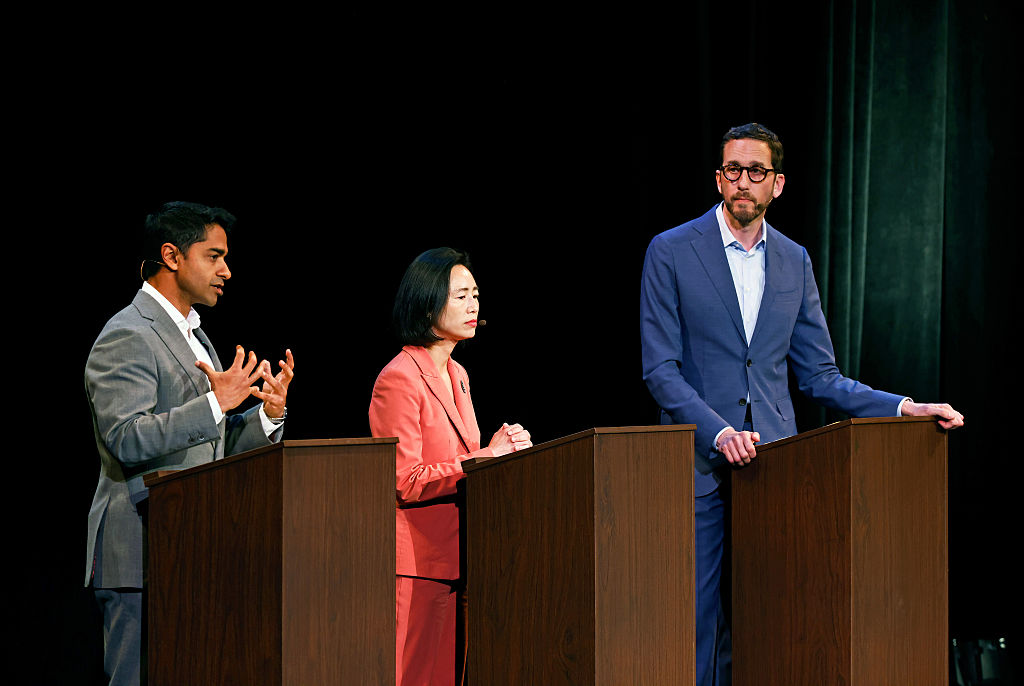
San Francisco’s primary to determine who gets the chance to succeed Nancy Pelosi has turned into a progressive showdown between Saikat Chakrabarti and Connie Chan. In that contest, the SF left sees a referendum on the city’s future. (Carlos Avila Gonzalez / San Francisco Chronicle via Getty Images)
Saikat Chakrabarti would, on the surface, appear to be a slam-dunk progressive choice to succeed retiring Rep. Nancy Pelosi as San Francisco’s representative in Congress.
In just more than a decade, the forty-year-old Chakrabarti has built a redoubtable record in left-wing politics: he worked on Bernie Sanders’s first campaign for president, cofounded Justice Democrats, and then wrote the Green New Deal bill when he served as Rep. Alexandria Ocasio-Cortez’s pugnacious first chief of staff. He supports Medicare for All, tuition-free public universities, raising taxes on millionaires, abolishing Immigration and Customs Enforcement (ICE), and terminating all military aid to Israel. He has the backing of Represenatives Ilhan Omar and Rashida Tlaib and has promised to take on entrenched interests in the Democratic Party. Last month, he and influencer Hasan Piker filled a club in SoMa for a rally. Chakrabarti may be a centimillionaire, flush with cash from helping to found the payment processing platform Stripe, but he identifies proudly as a class traitor. “I grew up with this simple idea,” Chakrabarti said. “If you get lucky, it’s your duty to help.”
But while Chakrabarti has received the vocal support of a segment of the city’s young and progressive voters, who have plastered signs around the Mission District touting his opposition to the Gaza genocide, other progressive voters have tilted toward Supervisor Connie Chan — leaving Chakrabarti in a fight just to finish second in Tuesday’s primary and qualify for a November runoff against moderate State Senator Scott Wiener. It’s a race that has raised questions not only about the bona fides of each candidate, but also about what San Francisco has become after decades of skyrocketing housing costs and Silicon Valley encroachment and what its embattled progressive community most values in its torchbearers.
Chakrabarti’s wealth, and the extent to which he’s utilized it in his campaign, has been a millstone with some voters. But perhaps nothing has harmed Chakrabarti with his would-be allies on the Left like his thin record in local politics — and, in particular, his support of Bilal Mahmood in a race for the Board of Supervisors against democratic socialist Dean Preston two years ago.
Preston was not only the most progressive member of the Board of Supervisors, but he was also during his term of service the only socialist holding elected office in what is — or was — one of the country’s most progressive cities. For the coalition of tech barons and real estate interests intent on remaking San Francisco, ousting Preston became an obsession in much the way that ousting reformer District Attorney Chesa Boudin and a trio of Board of Education members had been previously. Elon Musk, ever understated, tweeted multiple times that Preston should be “in prison.”
Just one day after the 2022 election, the tech-backed political organization GrowSF, which had helped fund the efforts to recall Boudin and the school board members, filed papers to register a campaign committee aimed at defeating Preston for reelection. By the next summer, the “Dump Dean PAC” had raised more than $300,000 — with Garry Tan, the CEO of Y Combinator and a ringleader of local moderates, announcing that he’d personally donated $50,000. Chris Larsen, a blockchain billionaire, pitched in $50,000 as well. Musk pledged $100,000.
You might assume that Chakrabarti, given his campaign rhetoric and work in national politics, would have stood in Preston’s corner. But he did not. Not only did Chakrabarti endorse Mahmood, but he also donated $10,000 to his campaign. And it wasn’t just Mahmood: Chakrabarti lined up behind moderate candidates up and down the ballot, supporting Levi Strauss heir Daniel Lurie for mayor and Michael Lai’s bid for supervisor against progressive Chyanne Chen. In each of those races, Chan, who was also a target of GrowSF’s, lined up on the opposite side. She endorsed Preston, Aaron Peskin for mayor, and Chen to join her on the Board of Supervisors.
Unlike Tom Steyer, another obscenely rich candidate who has courted the Left in his race for governor, Chakrabarti has not issued a mea culpa for his past actions and alliances. In fact, at a Working Families Party forum in February, Chakrabarti defended his support of Mahmood — telling an audience member that Mahmood is a “progressive” because he supports the city’s tax on any large corporation whose best-compensated employee makes more than one hundred times its median employee. Whether or not Mahmood qualifies as a progressive, his replacing Preston has resulted in what is likely one of the largest single swings to the right in the modern history of the Board of Supervisors. A San Francisco Chronicle analysis found that while Preston was one of the most progressive supervisors serving between 2020 and 2025, Mahmood was one of the two most moderate.
Of course, mapping ideologies in the context of city politics can be challenging — and in San Francisco, where progressive policy is still generally popular, candidates like Mahmood have used housing politics as a cudgel against more progressive candidates. Mahmood and Preston’s other opponents spent months arguing that Preston’s insufficient support of market-rate housing construction effectively made him an impediment to tackling the city’s affordability crisis, and it’s this point on which Chakrabarti appears to have been swayed.
In a more extensive explanation of his support for Mahmood on social media last year, Chakrabarti wrote that while he voted for Preston in 2020, he soured on Preston’s approach to housing and felt Mahmood took the crisis “more seriously.”
“Over time, I came to believe that [Preston] was not interested in making the sweeping changes that are needed to tackle the housing crisis in SF, and to solve many other issues either,” Chakrabarti wrote:
I believe SF has a deep housing shortage that will require us to build new housing at a pace we have never done before. I don’t believe cutting red tape alone will do it — I also believe we need massive amounts of public finance and social housing and a proactive approach that makes sure housing actually gets built at all income levels. . . . I didn’t back Bilal as part of some larger tech plot — I just backed him because I thought he was the better candidate.
Suffice to say that the city’s most progressive voters did not agree with Chakrabarti’s assessment. Preston, a former tenant attorney and tenants’ rights activist, had a robust housing record of his own, albeit with different points of emphasis than the YIMBY movement’s: he authored bills to protect renters from eviction during the pandemic, pushed to acquire sites to house homeless people, and, perhaps most significant, introduced a successful ballot initiative to raise hundreds of millions of dollars for affordable housing measures annually by increasing the transfer tax on property sales of more than $10 million.
Roots, Money, and Allies
Whether Chakrabarti’s local political record particularly matters in a race for Congress may be debatable, but there is perhaps another reason why he has struggled to endear himself to a segment of the city’s progressive base: he is, like so many of the men responsible for financing the right-wing takeover of the city in recent years, is a centimillionaire who attended Harvard, began his postgraduate life at the hedge fund Bridgewater Associates, moved to Silicon Valley, and made a fortune helping to found Stripe.
For some of those dismayed by San Francisco’s transformation into an increasingly exclusive, sanitized tech enclave, there is a disquieting quality about Chakrabarti’s biography. Likewise, there’s something unnerving about his transience, having vacated and returned to the city several times over recent years. It’s a vulnerability Wiener and his allies have repeatedly attempted to exploit in both mailers and the side of a van, and it’s likely why Chakrabarti has used one of his final advertisements to remind voters not of his position on Palestine or health care but of his San Francisco credentials. The spot features old photographs of Chakrabarti at the Golden Gate Bridge and on Baker Beach. I’m one of you, it seems to say.
Chan does not need to convince anyone of that. Born in Hong Kong and raised in Taiwan, she arrived in the city at thirteen and initially lived with her mother, brother, aunt, and uncle in a one-bedroom Chinatown apartment. Chan didn’t go to Harvard, but rather to the University of California, Davis, an hour and change away. She spent the first years of her career working not for a start-up in Silicon Valley but for the Community Youth Center of San Francisco.
None of that necessarily means that Chan would make a better representative than Chakrabarti, but it has given her campaign a certain symbolic weight for people concerned that the San Francisco they love is in danger of slipping away: a city where a child can arrive without English, attend public schools, make a career in public service, raise a family, and go to Congress. It fits the narrative all too neatly that Chakrabarti, who has given his campaign nearly $10 million of his own fortune, has outraised Chan by a margin of nearly twenty to one.
More than that, perhaps, Chan is a known quantity. She has racked up endorsements from teachers, nurses, and firefighter unions, the San Francisco Labor Council, and a broad array of local progressive organizations. She has been backed by Preston, Peskin, and Chen, the candidates Chakrabarti overlooked two years ago, as well as by Sen. Adam Schiff and Pelosi herself. Chakrabarti, though his platform may go further than Chan’s, does not list a single union endorsement on his website. He has not been endorsed by a single active member of the Board of Supervisors or a single member of the California legislature. He does, however, boast the support of New York Councilman Chi Ossé.
Pelosi, whose animus for Chakrabarti seems to date at least to 2019, when he compared moderate House Democrats to segregationists over their support for a border aid package, has taken to publicly suggesting he’s a carpetbagger: “I don’t have any idea who he is,” she told KQED in a recent interview. “I’ve never seen him at a homeless shelter, or a food bank, or at an immigration center. I’ve never seen him in the community.”
San Francisco voters will have to decide how to weigh it all — whether an energetic candidate who cofounded Justice Democrats but has a questionable local record is worthy of left-wing votes, or whether a candidate backed by Schiff might well be the safest progressive bet. The American Israel Public Affairs Committee has routed hundreds of thousands of dollars to a Super PAC supporting Chan, though its motivations for doing so are not entirely clear, given that Chan is a vocal opponent of Israel’s assault on Gaza. AROC Action, the political organization of the Arab Resource and Organizing Center, issued a joint endorsement.
California Democratic Socialists of America (DSA) did not recommend a vote for either candidate, calling both “decent but flawed” choices, and DSA San Francisco likewise abstained. Aditya Bhumbla, cochair of DSA SF, told Jacobin that both candidates were “deeply imperfect,” calling Chakrabarti entrenched in tech circles and Chan entrenched in the machinery of the Democratic Party. Bhumbla characterized Chakrabarti as “spending tens of millions to blanket the airwaves in the absence of a long-term connection to local organizing” and criticized Chan for bad votes related to policing and homelessness. “The absence of a true socialist in the race is an indication that the Left has work to do if we’re going to be able to exert power in Congress,” Bhumbla said.
Polls suggest Chan and Chakrabarti are neck and neck, though Chan’s campaign has insisted that some surveys have missed her robust support among Chinese speakers. Whoever triumphs will likely face Wiener, who, in some respects, is an even better avatar of modern San Francisco than Chakrabarti is. Wiener, who was raised in southern New Jersey and came out as gay while attending Duke University, landed in San Francisco in the late 1990s. He has been a fixture of the city’s political life for the better part of two decades — first representing a district including the Castro on the Board of Supervisors before winning election to the state senate a decade ago.
Wiener has carved out a reputation in Sacramento as one of the legislature’s most productive members, and he has championed the kind of deregulatory, abundance-style YIMBYism that has gained rapid popularity in recent years. He also has close connections to major real estate interests and Silicon Valley players, including Larsen, who has donated $100,000 to a Super PAC supporting him. Perhaps not coincidentally, Wiener opposes both a onetime tax on California billionaires and a San Francisco tax on CEOs who make more than one hundred times what their median employee makes. Even Pelosi supports the latter measure; both will be on the ballot in the fall when Wiener faces either Chan or Chakrabarti.
That race, too, will be a referendum on San Francisco’s political direction. Whoever triumphs between Chakrabarti and Chan will need the other candidate’s validation and supporters. With San Francisco continually under threat from big money interests, the Left cannot afford to be divided — or pick the wrong candidate to elevate.