John Roberts’s About-Face on Supreme Court Activism
During the Reagan administration, John Roberts was known for denouncing judicial overreach. Today he has adopted an assertive use of judicial power, using the Supreme Court’s shadow docket to fast-track corporate wins on climate and federal policy.
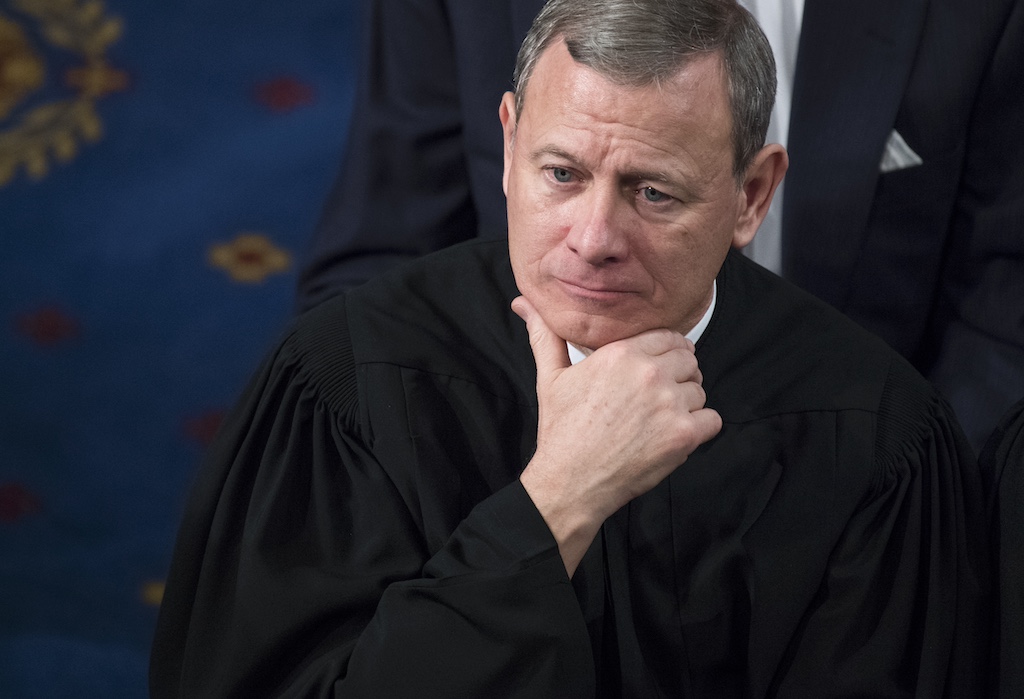
Chief Justice John Roberts has become the kind of tyrannical, politically unaccountable “activist” judge that he himself once warned about. (Tom Williams / CQ Roll Call via Getty Images)
Though America has become a goldfish-brain society that forgets its entire world every fifteen minutes, it’s worth taking a moment to appreciate the cautionary tale implicit in the New York Times’ new blockbuster story about the Supreme Court’s shadow docket. The secret memos that the Times unearthed show Chief Justice John Roberts has become the kind of tyrannical, politically unaccountable “activist” judge that Roberts once warned about.
As a young lawyer, Roberts made a name for himself within Reagan administration, casting himself as a leader of a movement to curtail judges’ power. Indeed, in one memo, Roberts provided talking points about judicial selection, urging Reagan officials to declare that “this Administration is attempting to restore a balance on the Federal judiciary that does not exist now with the judicial activism we see. Judges should interpret the law, not make it or execute it.”
In another memo, Roberts gave Ronald Reagan’s attorney general a crafted “Judicial Activism Q&As: Specific Examples.”
And in a particularly ballsy memo, Roberts explicitly took issue with the Reagan administration’s own Justice Department and its defense of lifetime tenure for judges. Roberts countered by asserting that judicial term limits were a “healthy” idea, specifically because judges were intervening in matters best left to the other branches that the Constitution says should be making and executing laws.
“To the extent the judicial role is unabashedly viewed as one in which judges do more than simply figure out what the Framers intended, the case for insulating the judges from political accountability weakens,” he wrote. “The federal judiciary today benefits from an insulation from political pressure even as it usurps the roles of the political branches.”
This all culminated in Roberts promising at his 2005 Supreme Court confirmation hearing that “I have no agenda” and that “I will remember that it’s my job to call balls and strikes and not to pitch or bat.”
Rise of an Activist
Now, the Times shows us “shadow paper” memos proving that a few decades after all that posturing and promising, Roberts built a new shadow docket in order to let him be perhaps the most activist justice in American history.
Indeed, Roberts used this weapon to expeditiously insert himself and the court into a battle between the Obama administration and fossil fuel–backed state politicians trying to block the Environmental Protection Agency (EPA) from wielding the climate regulatory power that the Supreme Court had already seemed to validate as the EPA’s prerogative.
What’s important here is not just that Roberts was ideologically opposed to Barack Obama’s climate policy nor is it that he supported the petition to hear the Clean Power Plan case. It’s that he pushed the court to intervene immediately, without any meaningful process at all. There was no oral argument. There was no painstaking review of facts. There was just a ruling.
Roberts was apparently angry at one line in an EPA blog post and upset that energy companies would have to reduce their emissions. He wrote that “the EPA’s own models show that the rule will cause immediate shifts in power generation” (the horror!) and asserted that such a shift away from climate-destroying coal would cause “irreparable harm.”
He then prejudged the entire case without any process (“I also believe that there is a fair prospect for reversal”) and then pressed the court to instantly barge in to decide the case.
Maybe you agree with Roberts’s action on the legal merits. Maybe you don’t. But it’s inarguable that he was an activist. And not just any judicial activist — he was acting as an aggressive, enthusiastic activist.
He ignored Justice Elena Kagan’s argument to go through the normal judicial process because he was an activist focused on a predetermined outcome. He was so focused, in fact, that he demanded the court intervene immediately. He wielded massive judicial power on an impulse and, in the blink of an eye, did so with a powerful weapon of judicial activism — the shadow docket.
In short, on a set of policies affecting the livable ecosystem that supports all life on the planet, Roberts was the activist judge he righteously derided as a young lawyer and promised never to be when lawmakers were reviewing his Supreme Court nomination.
Roberts Warned Us
I remember that nomination clearly — because I was one of the few left-of-center people in politics at the time desperately trying to sound the alarm about Roberts. I told the Chicago Tribune that “his major experience has been representing large corporations.” I suggested to NPR that a vote for Roberts would end up being a black mark on any Democratic senator’s record. I was frantic and yet hopeful that exposing his record and agenda would prompt some real opposition.
I was naive and wrong. His nomination sailed through on an overwhelming vote — seventy-nine senators backed him, including many Democrats. Adding insult to injury, then-Senator Barack Obama — who laudably voted against Roberts — used his platform to defend Roberts-supporting Democrats from criticism about their vote for a justice whose activism would end up crushing Obama’s very own signature environmental initiative.
I note all this not as an “I told you so” or to depict the younger version of myself as some prescient visionary. Back then, you had to be willfully blind to avoid seeing who Roberts actually was and what he represented, and in the 2000s, many Democrats in Congress were willfully blind (as many remain today).
No, I bring this all up in hopes that we never again repeat that kind of history. It’s the same hope I have in surfacing all these forgotten Roberts memos from the Reagan era (and in separately reminding readers about the betrayal of alleged “moderate swing vote,” Anthony Kennedy).
I want there to be a documented history of who created this dystopia and how they betrayed what they purported to stand for and were touted as, so that nobody can ever purport to be fooled again.
John Roberts was the bogeyman John Roberts warned of — and we will all now pay a terrible price in the form of more pollution and an out-of-control climate crisis.
The next time around — if there is a next time — we must remember this cautionary tale.