The Landless Workers’ Movement, 30 Years After a Massacre

Thirty years after the Eldorado do Carajás massacre, Brazil’s landless poor still find themselves under the heel of Latin America’s most powerful and impudent rural oligarchy.
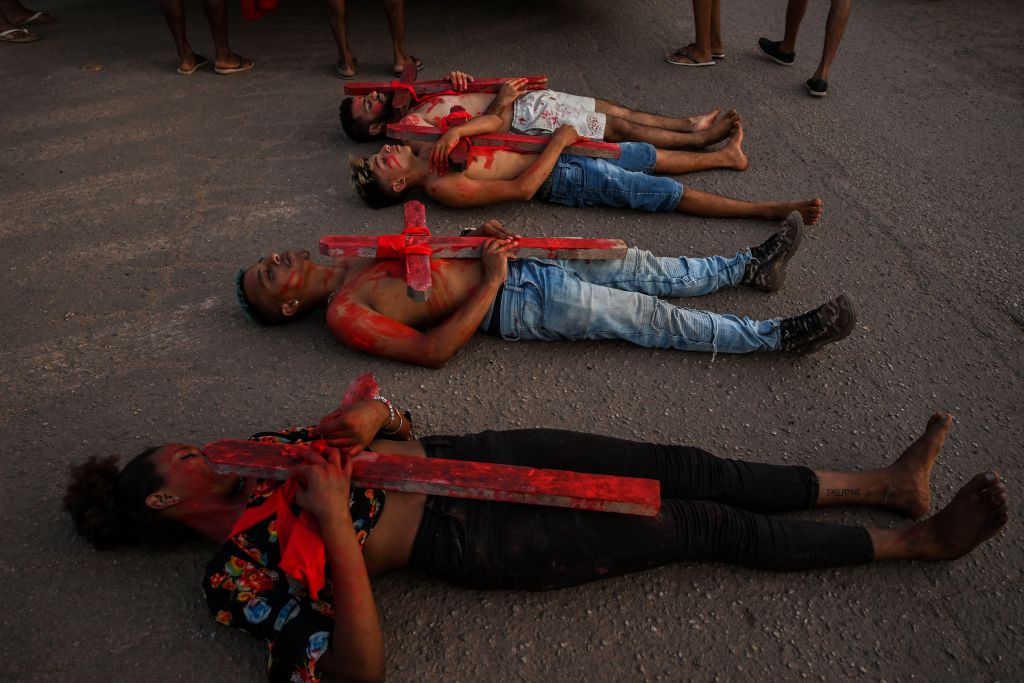
Members of the Landless Workers’ Movement (MST) protest on the PA-50 highway on the eve of the twenty-seventh anniversary of the Eldorado dos Carajás massacre on April 16, 2023. (Nelson Almeida / AFP via Getty Images)

This Friday, the landless workers of Brazil are marching two thousand strong into Salvador, a river of red crawling up the BR-324 highway. They are occupying fazendas in Madalena and in Darcinópolis, where just three years ago a hundred workers languished in modern slavery. And in Pará, three thousand landless move to occupy a stretch of highway some nine kilometers from the town of Eldorado do Carajás.

They hold up banners and wooden crosses and red flags on poles. “If we are silent,” says one sign, “the stones will scream.” They are not silent: they cry, they beat drums, they sing. Their voices are echoed in India, in Indonesia, in South Africa, where peasants and landless rural laborers likewise rally in solidarity with their Brazilian counterparts.

This phenomenal spate of political activity marks the thirtieth anniversary of the Eldorado do Carajás massacre, when Brazilian military police opened fire on a peaceful demonstration led by the Movimento dos Trabalhadores Rurais sem Terra (MST, the Landless Workers’ Movement), killing twenty-one landless activists and wounding more than sixty others. It is an atrocity in the history of the global labor struggle on par with Peterloo, Ciénaga, and Marikana — a litany attesting to the terrible power of the state against the protesting poor.

The marchers in Salvador invoke the massacre’s legacy as both a denunciation and a defiance. “Thirty years of impunity,” proclaim the banners, “but also of resistance.” Impunity and resistance continue to define the struggle of Brazil’s landless poor for agrarian reform against Latin America’s most powerful rural oligarchy. Carajás remains a touchstone for Brazil’s far right, an extreme expression of the violence required to maintain one of the world’s most unequal systems of land tenure. At the same time, Carajás reaffirms the tenacity and pride of the movement that survived it.

The massacre of Eldorado do Carajás remains woefully underrecognized in Brazil and even more so in the wider world. Yet it punctuates a living history, and in revisiting this atrocity in light of the present, we can trace the long arc of landless struggle in our time.

The Massacre on the PA-150

The Eldorado do Carajás massacre took place on the PA-150 highway in Pará state in Brazil’s far north. That the MST was active in Pará at all is astonishing in its own right. The huge state, twice the size of France, has long been the fiefdom of a coterie of oligarchic families whose hostility to land reform is bolstered by the police and courts — as well as by intimidation, kidnapping, firebombing, and murder. “They act as a state within a state,” says one monitor of rural violence. “It is difficult to imagine any area of public administration where they don’t have their say.”

Pará’s abysmal poverty is the direct product of the fortunes extracted daily from its forests and earth. Since Brazil’s military dictatorship opened up the Amazon to extraction in the ’70s, Pará has generated billions in value for the mining and agribusiness industries. These extractive sectors simultaneously attracted tens of thousands of landless workers (sem terra) for precarious labor in mines and large plantations and expelled those already dwelling in the region as the land was concentrated in even fewer hands. Landlessness became endemic under the shadow of latifundios the size of small nation-states.

The MST began to mobilize in Pará in 1989, counting on its discipline and organization to withstand the landlords’ coercive power. Yet its strategy was deliberately confrontational, aiming, through large-scale land occupations, to wrest concessions from state leadership and government ministries. In Pará, they arguably overplayed their hand. Having successfully pressured the Instituto Nacional de Colonização e Reforma Agrária (INCRA), Brazil’s state land reform agency, into purchasing a working farm for settlement, the MST moved quickly to occupy a sprawling fazenda called Macaxeira.

Occupying Macaxeira was a flagrant challenge to Pará’s rural oligarchy and a demonstration of the MST’s scorn for INCRAs gradualist approach to land reform. When some 1,500 landless families decided to occupy the PA-150 highway to force authorities to the negotiating table, the state intervened in the MST’s plans by force of arms. Governor Almir Gabriel ordered the Military Police to clear the highway “no matter what.” There was little chance of the operation proceeding peacefully. Local land barons had provided the authorities with lists of MST leaders to take out, and when the police arrived they had already removed their badges. The stage was set for a massacre. “They were intending from the beginning,” said a local journalist, “to teach the MST a lesson they would never forget.”

Just after 4:00 p.m. on April 17, 1996, 155 military police arrived at the MST’s blockade, kettling the landless activists from both directions. A skirmish promptly broke out. Despite the landless’s numbers, there was no parity of force. The police blasted the crowd with tear gas and shot their machine guns into the air; the sem terra returned fire with sticks and stones. This gave license for outright butchery. Within minutes, the police opened fire into the crowd.

The police did not merely saturate the throng of peasants, replete with women and children, with gunfire from a distance. The killing at Carajás was protracted and personal. Police pursued the wounded and bleeding into the undergrowth on the margins of the highway to finish them off. Of the nineteen men killed during the massacre (two more would later die of their wounds), seven were shot at close range in the head. But some police were not satisfied with the efficient dispatch of the peasants by firearm. They seized what farming implements lay at hand and set about literally butchering their victims. Twelve of the corpses were found to be hacked with sickles and machetes.

Witness testimony paints a scene of frenzied pandemonium. “They machine-gunned a 22-year-old lad who was standing beside me,” said “Garoto” da Conceição. “I saw him fall. Everyone started running. There was a lot of blood. A lot of dead people. I couldn’t believe what was happening.” Yet the police proceeded methodically, isolating known leaders, whom they captured, tortured, and executed. These included the eighteen-year-old organizer Oziel Alves Pereira, who was forced to shout “Long live the MST!” as he was beaten to death. “When I saw pictures of his corpse, I couldn’t recognize him,” said Eva Gomes da Silva. “They knew he was a leader and they wanted him to suffer for it.” Thirteen of the nineteen confirmed killed were MST leaders, bolstering accusations that the murders were targeted.

The killing did not end on the highway. The police summarily executed at least one wounded man en route to receive medical care and roamed the hospitals in nearby Curianópolis the following night, walking from bedside to bedside in search of other protesters. “The police just walked in and shot one man dead, just like that,” recounted Gomes da Silva. Doctors soon became afraid to treat the wounded, many of whom live with bullets in their extremities to this day.

For the Polícia Militar, this vigorous bit of protest dispersal was a resounding success. They rounded off their campaign of terror by rambling through the encampment, looting corpses for objects of value. One cop claimed a saucepan for his upcoming wedding. “They started clapping when they got in the coach,” a local teacher recalled. “They seemed like soldiers returning from a war against an enemy country.” Far from waging war on foreign enemies, many of these police were the sons of landless workers themselves.

The official death toll is almost certainly an understatement. “I’m sure that more than nineteen people were killed [at the scene],” one survivor told journalists. “They put one heap of bodies into a lorry and the other heap into a van. Those in the lorry reappeared, but those in the van were never seen again.” Reports of children hacked to death, plus the unusually high number of murdered leaders in the official statistics, bear out the idea that the true scale of the Eldorado do Carajás massacre has never been fully acknowledged.

“Scoundrels and Vagabonds”

“Mission accomplished,” Colonel Pantoja told his troops once the shooting stopped, “and no one saw anything.” He was wrong on both accounts. The massacre was filmed by a local TV crew and quickly made international news. Brazil’s President Fernando Henrique Cardoso took a break from waging war on the MST to decry the killing as “an embarrassment for the country.” Portugal, France, and Germany registered formal concerns with Brasília, and even the Vatican condemned the massacre.

The prevailing narrative holds that the genuine upswell of outrage that followed Carajás rebounded to the MST’s benefit. A slate of reforms indeed proceeded to expedite land expropriations and curb resistance in the judiciary. Yet organizers within Pará were less optimistic. “It may have affected the behavior of the federal government, but the state government here in Pará didn’t change,” recounted one observer. “The landowners continue to enjoy complete impunity.”

To this day, justice has not been served for the martyrs of Carajás. Only the police commanders, Colonel Pantoja and Major José Maria Pereira de Oliveira, were ever convicted of crimes — and only in 2002, following a trial “riddled with irregularities.” The other 153 policemen present were acquitted entirely. This was unremarkable. In Brazil, the landless can be killed with impunity. Of 1,833 land-related murders recorded by the Catholic Church’s Pastoral Land Commission between 1985 and 2024, just forty-two pistoleiros were ever convicted.

Thus, for the Movimento sem Terra, this is not ancient history. Thirty years later, many of Carajás’s survivors remain traumatized and broken. Some who went on to attain land found themselves too disfigured to tend it. As the country lurched to the right, Carajás was increasingly invoked in laudatory terms. In 2018, then presidential candidate Jair Bolsonaro opted to give a stump speech from the scene of the massacre, declaring: “Those who should have been imprisoned were the MST — [those] scoundrels and vagabonds.” As for the police, they only “reacted not to get killed.”

Fruit of the Latifundio

The massacre at Eldorado do Carajás was not an isolated incident. Violence is the fruit of the latifundio as much as soy or beef. It is the corollary of the extractive juggernaut that brings the bounties of the Amazon into global markets at the expense of the land and the laborers that work it. “An agrarian structure based on the extreme concentration of land,” as MST leader Ayala Ferreira puts it, “mandates violence as a mechanism for [its own] maintenance.” Across Brazil, more than 350 people have been killed over land in just the past decade.

Where does the struggle of the Landless Workers’ Movement stand today? In some ways, the sheer violence of the late ’90s reflected the genuine threat the MST posed to the prevailing system of land tenure in Brazil. The movement’s strength rested in a mass base of disenfranchised workers willing to endure serious deprivations in order to claim land. This would not last. The irony is that the MST’s fight for agrarian reform was ultimately absorbed by its political ally, the Workers’ Party (or PT), which cracked down on rural violence and disbursed land more freely but at the cost of entrenching the latifundio as the basis of Brazil’s agricultural system. As a rising economy diverted landless workers away from the countryside, the MST gradually ceased its large-scale occupations.

Today the MST lacks the mass base to directly confront agribusiness and the extractive industry at the systemic level. It has pivoted instead to foreground its practices of agroecology, leveraging its infrastructure to assuage urban hunger, rural joblessness, and illiteracy. In cultivating a market niche for its produce (the movement is Latin America’s largest grower of organic rice), the MST has prioritized autonomy and security for its two million members over the conquest of new territory. All worthy goals, but a far cry from striking terror into the land barons, as the organization had decades prior.

Yet liberation is a long and sinuous road — an elaborate interplay of entrenchment and expansion, militancy and co-optation. Following seven years of far-right rule and the ravages of the pandemic, the movement’s very survival is remarkable. The MST remains the largest social movement in Latin America and undoubtedly the most important link between Luiz Inácio Lula da Silva’s PT and the rural poor. Recent years have seen the MST start to recultivate its militant posture, seeking to galvanize the mass base necessary to restore the land struggle to national prominence.

For its members, the fruits of struggle cannot be doubted: land is a tangible thing. “Of course, it’s not much,” reflects Raimundo Gouvêa, an MST leader in Pará. “But it is much more than before, when we had nothing — just the dreams we dreamed, sometimes, of a piece of land to work. I say sometimes because we could almost never bring ourselves to dream.”

Those dreams — of land, of dignified labor — echo far beyond Brazil. They underlie the struggles of India’s Dalits, South Africa’s squatters, and disenfranchised peasants from Colombia to the Philippines. That universal quality led the world’s largest coalition of rural movements, La Vía Campesina, to declare April 17 the International Day of Peasant Struggle.

Dreams cannot, in themselves, wrest land from the landlords. But their recurrence stands as proof that a struggle so long waged cannot now be relinquished. “Because if dreams are eternal,” wrote the MST poet Ademar Bogo, “eternal also is the certainty of victory.”

Today that certainty is affirmed in Brazil.