Brazil’s Massive Landless Workers’ Movement Leads the Way

João Paulo Rodrigues

After 40 years of struggle, Brazil’s Landless Workers’ Movement is now at nearly two million members and taking center stage in the fight for democracy and equality. It’s done that by flying the most unlikely militant banner of all: organic food.
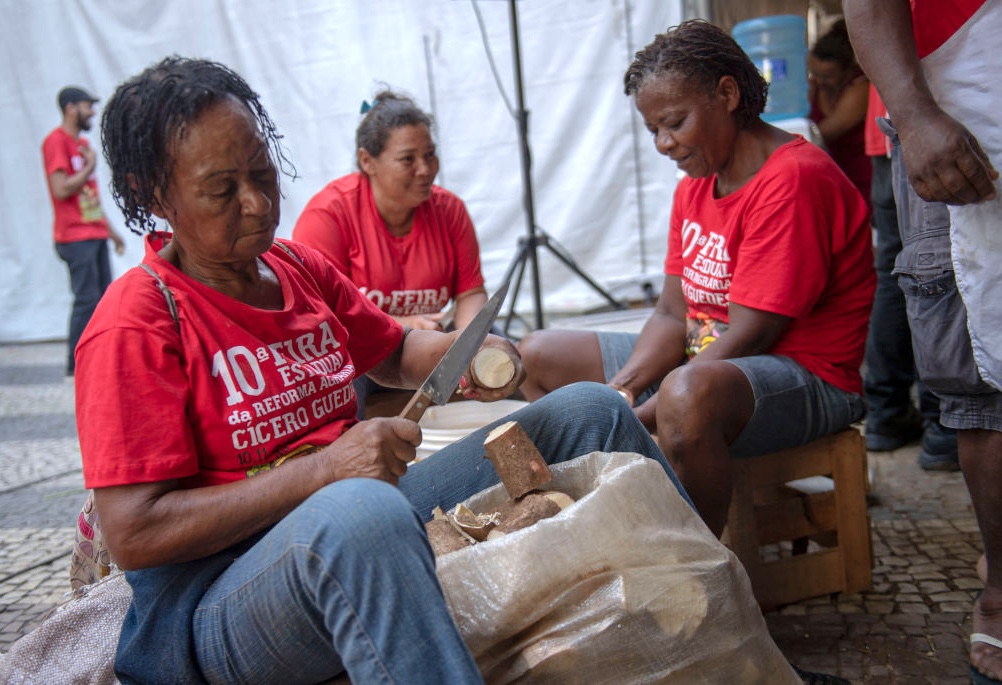
Flying the unlikely banner of organic food, the MST successfully repackaged agrarian reform as a mission to deliver nutritious, sustainably sourced, and affordable produce to the Brazilian masses. (Mauro Pimentel / AFP via Getty Images)

Interview by
Nicolas Allen

If you visited Brazil in the last few years, you will have seen it: “the other red hat.” Now a trendy accessory on the beaches of Rio de Janeiro, the decidedly anti-MAGA baseball cap represents not the hard right but the Landless Workers’ Movement (Movimento dos Trabalhadores Rurais Sem Terra, or MST).

At nearly two million members strong, the MST is now likely the world’s largest social movement, battle-hardened now after four decades, demanding agrarian reform. Even more impressively, the MST has thrived under adverse conditions, namely the far-right government of Jair Bolsonaro. The MST’s goal is to make good on the unfulfilled promises of Brazil’s democratic transition and to break up colonial relations that still reign in the countryside.

The last decade, though, saw that historical mission gain new momentum. The growing visibility of the MST was, in fact, part of a canny “rebrand” — retreating to a defensive posture as the Bolsonaro government declared open war on the movement’s land occupations. In response, the movement made overtures to the progressive urban middle class.

Flying the unlikely banner of organic food, the MST successfully repackaged agrarian reform — and its contentious land seizures — as a mission to deliver nutritious, sustainably sourced, and affordable produce to the Brazilian masses. In doing so, public opinion began to see the movement less as a “mere” peasant movement and more like a project of national transformation. Though allied to the left-leaning government of President Luiz Inácio Lula da Silva, the movement maintains a complicated relationship with the Brazilian state.

For Jacobin, Nicolas Allen spoke to MST national leader João Paulo Rodrigues about the MST’s strategic vision for the future and how the movement plans to fight to put working-class politics on the national agenda.


Nicolas Allen

The Landless Workers’ Movement was the subject of a recent Nation cover story. Vincent Bevins, the author of the piece, explains how the movement adapted to changing times over its forty-year existence and how it even grew stronger under the far-right government of Jair Bolsonaro. How do you explain the growth of the MST over the last decade?

João Paulo Rodrigues

The MST has been an important political force since the restoration of Brazilian democracy in the late ’80s — that’s nearly forty-five years in which the MST has been active, with varying degrees of strength, in every struggle.

It’s true the MST has become an important political actor. But it’s just as important to recognize that the last ten years have been very hard for the Brazilian left. Prior to the coup against Dilma [Rousseff] in 2013, there was a great uprising that saw a new generation of Brazilians fall under the influence of the conservative right. That conservative force sought to expel any left-wing movement from the streets: the MST, the CUT [Unified Workers’ Central], the PT [Workers’ Party], they all lost ground to the Right.

The MST survived that moment but things after 2013 only got worse. Next came Dilma’s impeachment, Lula’s imprisonment, the [Michel] Temer government, Bolsonaro’s election, and then the pandemic. During the last ten years, the Brazilian left, the MST included, suffered a lot of setbacks.

During that period, the MST remained a political force by pivoting in a new direction. Instead of exclusively focusing on its traditional concerns — the seizure of vacant and unproductive land, the fight against large landowners, and so on — the MST put a new issue on the political agenda. That issue was food.

The food agenda — producing cheap, healthy, organic foods — transformed the banner of agrarian reform into something more tangible for the average Brazilian. Whether they were members of the middle class and interested in organic foods, or the poorer sectors who wanted affordable prices, the banner of nutrition made the cause of agrarian reform more relatable. That shift toward food production also changed the opinion of the so-called developmentalist sectors, who could no longer look down their noses at the MST as a mere “protest movement.” Now they are forced to recognize that the movement is offering economic, political, and social alternatives.

That’s not to say, of course, just because the movement has raised the banner of food it has abandoned the fight against large landowners, imperialism, and capitalism. It just means the MST is also offering an alternative vision of society.

Nicolas Allen

How does the MST food system work in terms of production and distribution?

João Paulo Rodrigues

There are around 1,900 productive associations, 185 cooperatives, and 120 agribusinesses spread across MST settlements and camp areas. These are involved in the production, processing, and marketing of the foods of the Popular Agrarian Reform. There are at least fifteen main production chains, with more than 1,700 different types of products moving along the MST’s lines of distribution. The lion’s share consists of staple foods such as rice, beans, corn, wheat, coffee, milk, honey, cassava, and various other fruits and vegetables.

Rice yields alone amount to more than 42,000 tons, of which 16,000 tons are organic. The MST has been recognized for over a decade as the largest producer of organic rice in Latin America. MST also produces around 30,000 tons of coffee per harvest. We are also one of the largest producers of cocoa in Brazil, with more than 1.2 million tons.

Simply put, our goal is to become one of the largest producers in the world of organic and ecologically sourced foods. From north to south Brazil, our production chains are organized around the principles of soil conservation, proper management, responsible industrial methods, and using our own commercial channels to put food on the tables of Brazilians. As for distribution, we rely on our Armazéns do Campos [rural grocers], which are MST-associated stores specializing in the sale of agrarian reform products. There are currently twenty-four such stores, present in the main capitals and in inland cities in Brazil. We also hold regional fairs where a large part of the production from the camps and settlements is distributed locally.

However, the main way our peasant families commercialize their production is through fulfillment sales to meet public nutrition guidelines, such as the PAA [Food Acquisition Program] and the PNAE [National School Nutrition Program]. There is a law in Brazil that requires any PNAE program to purchase at least 30 percent of their food resources from small family farms. And although this legislation is not always complied with, these laws guarantee the distribution of MST-produced foods in a direct and institutionally backed market. One might prefer a less bureaucratic model that operates on a larger scale, but the PNAE is extremely important for promoting peasant production and ensuring that schools and other public institutions have healthy and varied foods.

Nicolas Allen

Earlier, when you spoke about the weakness of the Brazilian left, were you referring to electoral politics, organized labor, social movements, or all the above?

João Paulo Rodrigues

Modern Brazil has always been a politically divided country. Traditionally, 30 percent of the population votes for the Left, and the right wing usually wins a similar vote share — around 30 percent. The political center, meanwhile, has tended to vote for the Right. That was the major historical novelty of Lula: since his presidential victory in 2002, Lula has managed to attract the political center and strengthen the PT, which has become a large center-left camp. Through that process, though, the Lula government itself became more centrist than leftist.

This ended up diminishing the strength of the center-right parties, which in recent years have been swallowed up by the Lula and Dilma governments. Center-right parties lost their importance in Brazil because the Lula government, a left-wing government, broke up the long-standing partnership of center-right politicians and capitalist sectors. There was no room for a center-right party in Brazil — it was already incorporated into the government’s base.

The far-right government of Jair Bolsonaro shook that up, though. Lula’s governing strategy is based on forming alliances — a strategy incapable of dealing with the Bolsonarista threat. The far right, meanwhile, has formed its own alliance with the center. They were initially a tactical alliance, as far as the center right was concerned, but the far-right bloc has now swallowed up large parts of the center right. As a result, center-right support in Brazil is split between Lula’s government and the far right.

In other words, hegemony in Brazil is currently disputed between the Lula administration and the far-right Bolsonaro camp. These are the two poles constituting the Brazilian political field. It’s my opinion that by the end of this year, as those tensions play out, we will either see a camp emerge to the left of Lula’s government, or one situated more to the center — though it is very difficult to see how the center could form its own government. Ultimately, the Brazilian political center will become a tributary of the far right or the Left.

As concerns the MST, we must prepare for whatever will happen in the next five years — a future defined not only by Bolsonaro’s judicially enforced exit from the political stage but also Lula’s inevitable departure. That period will see a reorganization of the Brazilian political field, which will be dominated by new party leadership, the heavy presence of technology, and, of special worry for us, the waning influence of working-class power. In other words, we will see a “weaker” left that is more removed from the world of production and much more linked to identity issues.

Nicolas Allen

Did that weakening of working-class power inform the MST’s strategic shift?

João Paulo Rodrigues

You need to understand: Brazil has one of the highest rates of land inequality in the world. The struggle for agrarian reform is a historic necessity and will determine the future of Brazilian democracy — it is impossible to accept that 46 percent of Brazil’s land should remain in the hands of 1 percent of landowners. The struggle for land was and remains the basis of the MST’s existence. But once that struggle advances and land is acquired, families need assistance to produce; they need public structures such as schools, health clinics, electricity, sanitation, and roads. In short, there is a need to continue mobilizing after a family gains a plot of land.

During the movement’s nearly forty-two years, we have embraced this larger political challenge, allying ourselves with urban workers based on the understanding that it is not enough for rural workers to simply fight for agrarian reform — it must be a struggle for everyone if agrarian reform is to be achieved. Moreover, many problems the urban working class faces are directly linked to the lack of agrarian reform in the countryside. Urban sprawl, hunger, the lack of healthy food at fair prices, these are urban issues that have broadened the horizons of our struggles.

True, when the MST was first founded, we believed that a classic agrarian reform would solve the problems of the countryside. Today we have a different conception of agrarian reform. We want a popular agrarian reform, which means the democratization of land access, the widespread use of sustainable agricultural practices, education that liberates, and human relations free from exploitation. It is impossible to produce “healthy” food in a land so full of exploitation. We are fighting for an agrarian reform that is a popular national project, where there is diversity, social justice, and the cultural and economic colonialism that still prevails in Brazil is a thing of the past.

Nicolas Allen

You spoke about the future of the Brazilian left in the post-Lula era. Where do you see the MST in that future scenario?

João Paulo Rodrigues

In the immediate future, the MST plans to join forces with the left wing of the Lula camp. Beyond that, the movement will join the Left more broadly as Brazil enters the post-Lula period. But the MST is not a party and will not become one.

We do, however, look to fight along three political fronts in the next five years. The first is the front in the struggle for land. The MST must consolidate, strengthen, and establish itself as an organization fighting for land. For us, the struggle over land is central. There are one hundred million hectares of land up for grabs in Brazil, and we need to dispute that agenda side by side with the indigenous peoples and the quilombolas [descendants of Afro-Brazilians who fled slavery].

Whoever controls the land controls the future of Brazil. Let’s make that clear. In Brazil, land is synonymous with food production, environmental conservation, and care for nature. To that end, I think the MST will need to gain strength in and shift its attention toward those conflict regions that are still in dispute on the so-called agricultural frontier, in the Amazon, Matopiba, or even in the Cerrado, where we have less presence.

The second struggle is to become a major economic force in the production of nutritious food. In the not-so-distant future, the MST will go head-to-head with large industrial agribusiness in the struggle over food hegemony. We may have only ten million hectares compared to the sixty million controlled by large agribusiness. But we have something they don’t have: labor. There are over two million rural workers living and laboring on MST settlements.

That is why we hope that our policy of cooperatives, agroecology, and food production will become a powerful economic force in the coming years. That way, society will see the Left as an alternative model of economic and social development. Our struggle is not just an ideological one to combat hunger — it’s an alternative way of life and a model that can address the organization of cities and even national job creation.

In pursuing that mission, MST will push for new public-private partnerships, combining state support with small entrepreneurs who want to partner with the MST to form medium-sized agricultural businesses. We must build an economic base and show all Brazilian society that the MST is not just an ideological vision but a national project.

Finally, the MST and other left parties will dispute representation in all political institutions. We need to have more left-wing councillors, mayors, parliamentarians, student officers, more people in all institutional spaces so that the state becomes democratic and more responsive to the needs of the working class. We cannot give up on any space of governance because there is a far-right force waiting in the wings that is much fiercer than any of us can imagine.

Nicolas Allen

Could you say more about the relationship between the MST and the state? The movement’s banner cause, agrarian reform, is advanced by autonomous land seizures. But agrarian reform ultimately depends on favorable state policy, doesn’t it?

João Paulo Rodrigues

The relationship between agrarian reform and the state is and has always been fraught. Historically speaking, the Brazilian state was founded in a conscious effort to prevent agrarian reform from taking place. In fact, improvements in the situation of land concentration have only ever resulted from violent conflict and massacres, as happened during the Fernando Henrique Cardoso administration. During the Dilma administration, there were very few settlements, and policy agreements remained precarious. Under Lula’s administration, there has been very little concrete progress.

That said, the state is the only thing that can implement agrarian reform. That is the contradiction we live with: we have no alternative but to dialogue with the state.

Nicolas Allen

What about the MST and urban movements? How does the movement see itself related to urban political struggles?

João Paulo Rodrigues

First, a word about Brazilian cities. Urban areas pose three specific challenges for the Left as a whole. First, the city is no longer the site of working-class political hegemony, as was the case in the 1980s. The Brazilian trade union movement used to have a very strong presence in large cities and was highly organized in the world of labor. Today we are seeing all that come undone through an ongoing process of precarity in the world of labor, often through apps and other forms of precarious labor organization.

Second, poor people in Brazil are overwhelmingly concentrated in the urban periphery, an area controlled by militias and organized drug trafficking. This makes it very difficult to establish a more structural relationship with the urban working class. Traffickers and militia groups have a lot of power and money, and they apply violence in a way that the Left in its current state is not equipped to deal with.

Finally, evangelical churches are doing the kind of social work in the urban periphery that was once done by the left wing of the Brazilian Catholic Church. So, there are three issues — the militia, precarity, and the evangelical church — which together make it difficult for anyone to reach the periphery with a left-wing program.

The challenge for the MST is to figure out how to translate our experience with settlements and camps into an urban program. How can we bring this experience to the city through cooperatives and food production?

We must carry out this task without developing a paternalistic, welfare-type relationship. We need to reach a generation of young people and workers who genuinely share our belief that the world of labor and nutrition should be at the center of our politics. But, again, we can only do that if the Left puts forward a serious vision of urban reform. Until the Left can tackle the classic issues — poverty, inequality, housing, public safety, health, and so on — we are limited in our options.

Nicolas Allen

Have changes taking place in the world of labor affected the MST’s strategic vision?

João Paulo Rodrigues

The working class is always adjusting to changes in the world of work, ever since workers in the Ford era were adapting to the factory floor. The problem today is that labor precarity is only growing worse. The Brazilian working class is extremely precarious and impoverished.

More than half of the Brazilian working class is employed without a formal contract and most of them live on less than three minimum wages [less than $900]. The Brazilian working class is very poor and has great difficulty organizing itself due to the precarity of informal and seasonal labor. That’s all to say, I do not see in current working-class conditions any signs of a new form of organization emerging in the medium or even long term. If immiseration gave rise to new forms of labor organization, Africa as a continent would have already had a revolution. Instead, we see the opposite: you have poverty producing more poverty.

We have been unable to put forward a Brazilian labor reform that would simply maintain minimum living conditions. Here, all we see are new forms of exploitation and disorganization in the world of labor. We are hostage to new technologies and new capitalist forms of exploitation that leave us scrambling just to keep up.

The MST will continue to organize rural workers in the face of those challenges. In the short term, we need to attract a new generation of young people who are not necessarily peasants or farmers but want to work in labor cooperatives and produce organic food. Our challenge is to invent a new model of agrarian reform in which people can devote part of their time to working in the countryside while keeping another type of employment in the city.

Brazil has near full employment, by the way. But poverty has not decreased, and people’s lives have not improved. On the contrary, their lives have worsened. Why? Because employment is so precarious, and people are unable to meet the extremely high costs of living with existing wage levels. Many Brazilian workers cannot even afford basic foodstuffs.

Nicolas Allen

What can the MST offer in the face of those challenges?

João Paulo Rodrigues

We often hear Brazilian tycoons say there is a shortage of workers in the labor market because of Bolsa Família and other federal social assistance policies. The Brazilian elite hate Lula because they think government assistance makes people complacent and disinterested in work. The fact is that the working class, young workers especially, don’t want to be exploited with starvation wages. The service sector complains about labor shortages, but they fail to see that what workers want is a job and a decent wage. Today’s workers want an end to the six-day workweek, they want labor rights and an income that is compatible with the cost of living.

Rural workers no longer want to be exploited by large landowners and forced into labor conditions analogous to slavery. So long as there are many landless hands and too much land in the hands of too few, MST occupations will continue. Agrarian reform is a project of emancipation for the exploited working class that sees land occupation as their only way to a dignified life, with a piece of land to live on, to cultivate, and to harvest.

The Left is only a viable political force insofar as we maintain our hold on the world of labor. And that is a political project that requires mobilizing the poor but also speaking to issues of the middle class. We have to rise to the occasion and lift the banner of labor or we are failing in our job as Marxists.

Another challenge will be to intervene around environmental issues. The Left cannot lapse into environmentalist posturing, saying things like “nature is a sanctuary” and pretend like the natural world should not serve the betterment of humanity. But the Left also can’t fall into the lazy developmentalist rhetoric that says we can destroy everything at any cost in the name of progress. Fortunately, the Left has made advances on this front.

But things are not going to be easy. Brazilian popular movements and left-wing organizations will have to resist in the short term just to defend the Lula government. In the medium term, over the next five years, they need to start building the foundations for the coming transition — which will mean putting forward a national vision that can defeat the Right.