Jean-Paul Marat Was the Prophet of the French Revolution

When historians of the French Revolution discuss Jean-Paul Marat, they usually focus on his bloodthirsty rhetoric. But Marat also had an uncanny ability to anticipate major events thanks to his grasp of the social forces the Revolution had set loose.
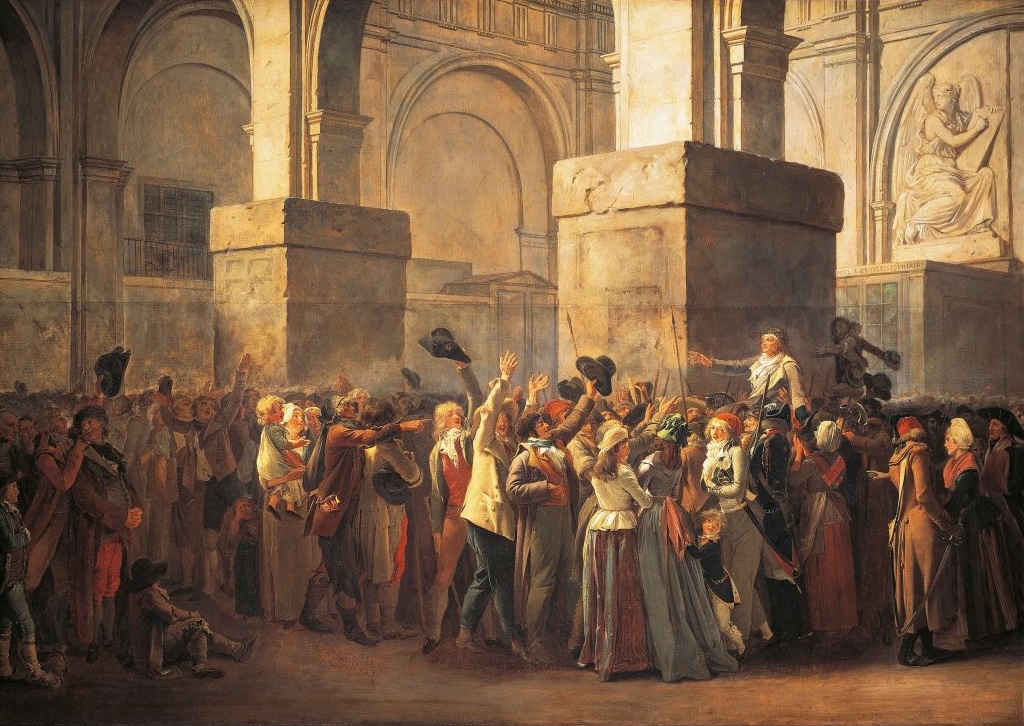
Jean-Paul Marat was not simply an icon of radicalism or a notorious demagogue: he was an indispensable leader, second in importance only to Maximilien Robespierre among the radicals whose actions in 1793–94 consolidated the gains of the French Revolution. (DEA / G. Dagli Orti /De Agostini via Getty Images)

Until this book by Keith Michael Baker appeared in late 2025, there had been only two English-language biographies of Jean-Paul Marat published in the previous ninety-nine years. As it happens, I am the author of the other two.

I find Baker’s work to be an invaluable contribution to the anglophone literature on the history of the French Revolution and a scrupulously honest account of by far its most controversial character. Baker’s specialty as a historian of ideas adds a great deal of value by situating Marat’s ideological writings in the context of the Late Enlightenment, and his earlier intellectual biography of Nicolas de Condorcet provides a perfect basis of comparison with Marat, ideologically, politically, and axiologically.

However, my positive appreciation of this biography requires one essential qualification. It is still a product of the Anglo-American academic historical establishment, one that perpetuates a Cold War bias and distorts almost all anglophone accounts of the French Revolution, and especially Marat’s role in it.

The Two Terrors

That bias starts with the subtitle of the book, describing Marat as a “prophet of terror.” If you were to give English-speaking readers a word association test with the prompt “French Revolution,” the most frequent response you would get probably is “terror.” That is an unthinking Pavlovian reflex, instilled by more than two centuries of academic contempt for the climactic radical phase of the French Revolution.

The vilification of the Revolution as simply a catalogue of mayhem and arbitrary violence elicited this powerful remonstrance from a moral giant of American letters, Mark Twain:

There were two “Reigns of Terror.” . . . The one lasted mere months, the other had lasted a thousand years; the one inflicted death upon ten thousand persons, the other upon a hundred millions; but our shudders are all for the “horrors” of the minor Terror, the momentary Terror, so to speak. . . . A city cemetery could contain the coffins filled by that brief Terror which we have all been so diligently taught to shiver at and mourn over; but all France could hardly contain the coffins filled by that older and real Terror — that unspeakably bitter and awful Terror which none of us has been taught to see in its vastness or pity as it deserves.

Twain wrote that in 1889. Sadly, the all-pervasive distortion of history he addresses is no less in evidence today.

Baker’s long quotations with which he illustrates Marat’s violent rhetoric are accurate and in no way unrepresentative of Marat’s oeuvre. However, making that the central focus of an assessment of his historic importance not only produces a serious misconception of Marat but also renders impossible an accurate understanding of the dynamics and consequences of the French Revolution as a whole.

Victor Hugo recognized Marat as a timeless icon of social revolution. “As long as there are misérables,” wrote the author of Les Misérables, “there will be a cloud on the horizon that can become a phantom and a phantom that can become Marat.” Fear of that powerful phantom, and of its reappearance, has made a dispassionate evaluation of the historic Marat all but impossible. It has led innumerable authors, consciously or subconsciously, to distort their portrayals of Marat.

In general, conservative and liberal historians alike have detested Marat — the conservatives because he was a threat to the status quo; the liberals because of the extremism and calls to violence that permeated his agitational writings.

Marat’s Violent Polemics

Marat’s journalism was indeed characterized by an apparent bloodlust that discomfits me as much as it does Baker. What’s more, it also disturbed Marat’s contemporary allies.

Both Camille Desmoulins and Maximilien Robespierre urged the “People’s Friend” to tone down his intemperate screeds, but he refused to do so. He insisted that the only way “the people” could defend themselves from wholesale slaughter by their enemies was for the people to eradicate those enemies first.

Marat despaired at what he perceived as the complacency of the people, who were behaving as if the Revolution had achieved its final victory, while he was convinced that it was in grave danger of being extinguished. If the people were asleep, then he would just have to shout louder. He decided that in order to shock the comatose masses out of their stupor, he would have to make a major adjustment in his agitational techniques.

As early as the beginning of June 1790, he lamented to his readers:

Soon you won’t open your eyes to anything but cries of alarm, of murder, of treason. How can I keep your attention? How can I keep you awake? There’s only one thing left for me to do; I’ll have to take your tastes into consideration and change my tone. Oh, Parisians! No matter how bizarre this will make me appear in the eyes of scholars, I won’t hesitate to do it — your old friend cares only for your safety. I have to keep you from falling into the abyss.

It is amusing that the prophet Marat foresaw the judgment of future historians who would cite his inflammatory rhetoric to depict him as a “madman.” He announced in advance that he was going to become more shrill, more frenetic, more hysterical, more “bizarre,” if that was what it took to rekindle the revolutionary spirit of Parisians. And that is what he did.

To understand the social context of the French Revolution, it is necessary to accept that Marat’s hyperaggressive rhetoric was precisely what made him by far the most popular and influential of its journalists. The Parisian public in 1789–93 was not bloodthirsty; it was angry and fearful.

Nor can its fears be dismissed as irrationally paranoiac — after all, its enemies, both external and internal, explicitly announced their intention to destroy Paris root and branch and massacre its inhabitants. Marat’s writings appear less extremist when the extreme circumstances in which he was operating are taken into account.

“It’s All Over for Us!”

Marat launched his new shock-tactics campaign on July 26, 1790, with a pamphlet headline screaming “It’s All Over for Us!” It was destined to become the single most notorious example of Marat’s extremism and violence-baiting.

In it, he claimed that a reliable source had just given him a document containing positive evidence of a counterrevolutionary plot to help Louis XVI flee Paris, join up with an émigré army at Metz, and launch a military assault on Paris. The pamphlet ended with a passage designed to startle his readers into sitting up and taking notice:

Five or six hundred heads chopped off would assure you peace, liberty and happiness. A false humanitarianism has restrained your arms and has prevented you from striking such blows. That will cost the lives of millions of your brothers. Let your enemies triumph for an instant and torrents of blood will flow. They’ll cut your throats without mercy, they’ll slit the bellies of your wives, and in order to forever extinguish your love of liberty, their bloody hands will reach into your children’s entrails and rip their hearts out.

As he had hoped, the explicit call to chop off a few hundred heads had the effect of tossing a dynamite charge into the political discourse.

For more than two hundred years, authors hostile to Marat have quoted these lines as evidence of his bloodthirstiness. But Marat’s violent polemics, or the actual violence of the September Massacres and the Reign of Terror, are ultimately only sidebars to the essential story of the historical significance of the French Revolution.

Revolutionary Prophet

What was Marat’s role in this world-historic transformation? It is my contention that he was not simply an icon of radicalism or a notorious demagogue but an indispensable leader, second in importance only to Robespierre among the radicals whose actions in 1793 and 1794 consolidated the gains of the French Revolution. Without the decisive measures accomplished by Robespierre, Marat, and their Jacobin comrades, the subsequent history of the world could have unfolded in dramatically different ways.

A significant aspect of Marat’s leadership was manifested in his widespread reputation as a prophet. At every juncture from the insurrection of July 14, 1789, until his assassination four years later, he analyzed the current political situation and predicted what lay ahead. He thereby exemplified an essential attribute of political leadership: knowing what to do next.

In August 1790, Camille Desmoulins reported on a shocking injustice known as the Nancy Massacre and identified it as the “horrible awakening” Marat had foreseen. “Oh People’s Friend! Oh Cassandra Marat!” Desmoulins exclaimed. “How right you were when you warned that it was all over for us!” He later added: “When I consider how many of the things [Marat] predicted have come to pass, I am inclined to buy his almanacs.”

Marat predicted the king’s attempted escape from Paris and frequently accused Mirabeau of being on the king’s payroll — indisputable evidence to back up that charge was discovered after Mirabeau’s death in April 1791. He also anticipated the defection of General Lafayette to the enemy, which duly transpired in August 1792, and a similar betrayal by General Charles-François Dumouriez before it came about in April 1793.

Marat had no crystal ball or supernatural powers. His “secret” was, above all, a deep understanding of the class dynamics of French society. That gave him the ability to accurately assess the political actors of the moment and forecast their subsequent trajectories. While rival journalists allowed themselves to be misled by naive hopes and wishful thinking that Mirabeau or Lafayette or even Louis XVI might “do the right thing,” Marat was immune to such illusions.

Marat’s apparent clairvoyance was also greatly facilitated by his journal’s loyal sources: an underground network of informants, which undoubtedly included sympathetic eyes and ears within the palace walls, police headquarters, and army barracks.

Revolutionary Strategist

As a political strategist and tactician, Marat consistently and accurately identified the central issues of the moment, as well as the main line of the revolution’s development, and tirelessly hammered them into the consciousness of his readers. His early recognition of the reactionary essence of the Girondin appeal for an international military crusade is a prime example.

Marat’s most significant strategic move was the “new course” he embarked upon following the insurrection of August 10, 1792, which aimed at constructing a political alliance of Jacobins and sansculottes. That coalition was essential to the process of consolidating the revolution’s gains, and no one was more important in bringing it into being than Marat.

Marat’s tactical acumen was repeatedly demonstrated by his uncanny ability to provoke the authorities while evading arrest. When the time came that he no longer had to evade the authorities, his tactical prowess remained evident in his ability to continuously force his agenda upon the National Convention.

Marat’s tactical masterpiece was the conversion of his own trial in April 1793 into a decisive triumph over his Girondin prosecutors. His decision to evade arrest until a formal indictment had been brought against him was a critical one. Had he allowed himself to be imprisoned on the initial vague decree of accusation, the Girondins could have stalled and left him to rot in jail.

The most spectacular example of Marat’s tactical genius was his intervention in the events that resulted in the insurrection of May 31–June 2, 1793. At the beginning of April, he had warned the overzealous sansculottes against prematurely rising in revolt. At the end of May, when he felt the time had come, he embarked upon a whirlwind of agitational activity, injecting an element of clarity into an otherwise confused mass movement.

However, the balance sheet of Marat’s political leadership has one significant entry on the deficit side. He did not organize his followers into a political party. Both Robespierre the Jacobin and Jacques Pierre Brissot the Girondin, by contrast, created solid, loyal, organized followings they could count on to follow their lead in crucial situations.

Marat’s failure to create a party was related to his conviction that being at the head of such a party would compromise his political independence. His only “party,” he once declared, was “the people.” By the time he decided to subordinate himself to the Mountain, he may well have come to regret the lack of a Maratiste party, but it was too late — the parties of the revolution had already been formed.

The fact that Marat’s role in the revolution was not as central as that of Robespierre is evidenced by the fact that the revolution continued to deepen in the wake of Marat’s assassination, while Robespierre’s defeat and execution resulted in its definitive reversal.

What Would Marat Think?

If Marat were to return today, what would he think of the state of our planet in the third decade of the twenty-first century? He could read in the history books that the Great French Revolution — his revolution — is recognized as crucial to the making of the modern world. “But what did it accomplish?” he might ask.

Today despite two centuries of mind-boggling technological progress, a handful of multibillionaires control most of the earth’s resources while billions of people remain mired in hunger, disease, oppression, and grinding poverty. Marat would surely be shocked and dismayed to learn that after more than two hundred years, his struggle for social revolution had lost none of its relevance and urgency.