Iraq’s Communists Are Fighting Against Sectarian Politics

Ra’id Fahmi

Although Iraq’s Communist Party has lost much of the support it enjoyed at its peak, it still has a real presence on the Iraqi political scene. Its general secretary Ra’id Fahmi tells Jacobin about the need to challenge Iraq’s sectarian power structure.
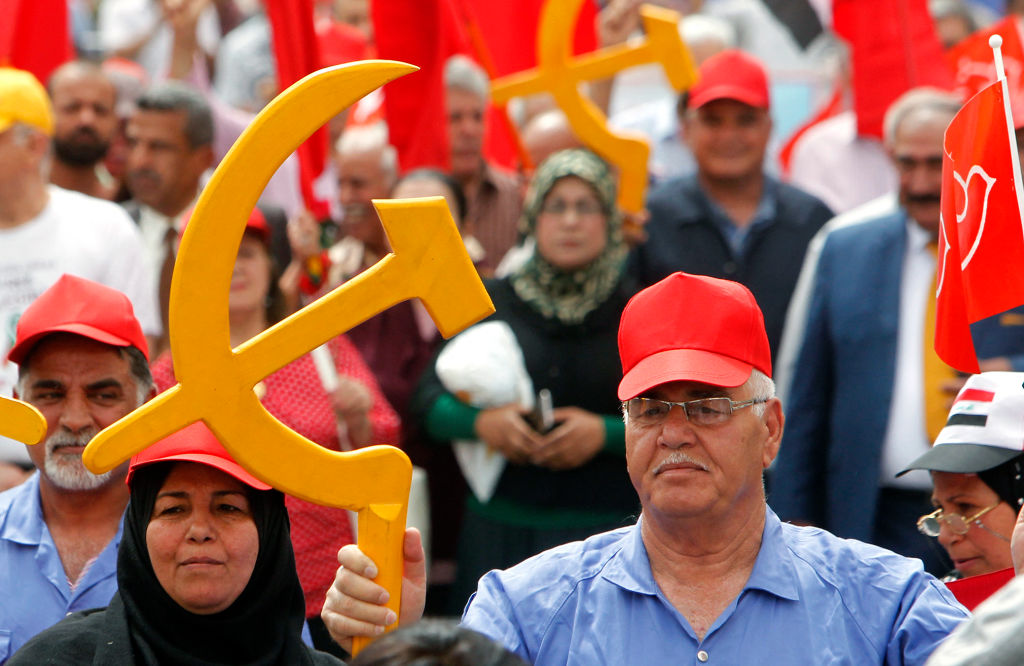
Iraqi supporters of the Communist Party take part in a rally to mark International Workers' Day in Baghdad in 2017.

The Iraqi Communist Party was a major force in Iraqi politics before it was savagely repressed under Baathist rule. Since it reemerged as a legal force, its members have been working to challenge the sectarian mold of Iraqi politics. (Sabah Arar / AFP via Getty Images)


Interview by
Nabil Salih

During the 1950s and ’60s, the Iraqi Communist Party (ICP) was a major force in Iraqi politics and one of the largest communist parties in any Arab country. But it was savagely repressed under the long period of Baathist rule and was only able to reemerge as a legal organization after the fall of Saddam Hussein.

Although the ICP is much weaker than in its heyday, it has still been a real player on the Iraqi political scene in recent years. The party formed an alliance for the 2018 parliamentary elections with the movement led by Shia cleric Muqtada al-Sadr that won nearly 15 percent of the vote — more than any of its rivals.

This interview with Ra’id Fahmi, general secretary of the ICP and a former minister of science and technology, took place on February 15, 2026, at the ICP headquarters in Baghdad. He spoke about the need to replace Iraq’s sectarian political system with a state based on citizenship, the challenges of organizing in Baghdad’s impoverished peripheral quarters, and the ICP’s own strategic choices since the US invasion of 2003.


Nabil Salih

The latest parliamentary elections in 2025 witnessed a return of blatant sectarianism. What is the ICP’s strategy to overcome legalized and institutionalized sectarianism imposed on Iraq during the US occupation?

Ra’id Fahmi

To contextualize events, after the [regime] change, a process was proposed, based on an ethno-sectarian division of the political leadership. We were against the division from the outset. It had its inception in the days of external opposition. In 1992, with the late Ahmed Chalabi’s Iraqi National Congress conference [held in Iraqi Kurdistan], the opposition transitioned from projects that were divided according to political ideology between Islamists, leftists, and Pan-Arabists to sectarian Sunni and Shia divisions.

What eventually took place after 2003 was the institutionalization of this division. The emerging political process was a divisive one. From the outset it eclipsed the emergence of a unifying patriotic identity, and the political parties themselves were sectarian in nature. Lacking a political project or a coherent ideology, they placed their bets on narrow identitarian politics, fomenting sectarianism, especially in critical times and ahead of elections. It is no surprise that sectarian tones resurface at election time — that is how they mobilize their constituencies.

This constellation of forces is incapable of building a state when the state itself is divided by their own doing. It functions as an incubator for corruption, bearing in mind that its state-building effort is erected over a clientelist foundation. In the end, this constellation creates crises instead of finding solutions. At best, it manages crises in lieu of solving them.

It is a story we have been repeating for a while. We have struggled for an alternative in the form of a democratic civil state based on citizenship where social justice is achieved. We have a rentier state, with a system distributing rents rather than one of production. The political strife is over larger shares of oil rent. Ethno-sectarianism is not simply a reflection of ideological or religious beliefs, but also a way to gain access to power and rents.

The transition from the status quo to a civil state is not going to be a walk in the park. Over the past few years, a new social crystallization has taken place, with new social categories emerging, their wealth having been earned from corruption in addition to a share of oil rent. What are these social forces?

We think there are bourgeois groups of a sort, with all due reservations about using the term “class” to describe them, given the insufficient degree of class crystallization. But the contours are there, and we see commercial capitalism and real-estate capitalism, the parasitic groups and the armed groups. In sum, they form the upper level of the structure, while state employees are at the base, being tied to the status quo and the flow of rent.

The latter are not necessarily pushing for a civil state. Meanwhile, those with no stake are the marginalized groups, the unemployed, large segments of youth, daily wage laborers, taxi drivers or delivery boys. They constitute, according to some estimates, 40 percent of the work force, a considerable number. But neither the first nor the second categories represent homogenous groups.

Those in the first category have an interest in the survival of the regime, while those in the second function outside organizational frameworks and tend to be more attuned to populist discourses and charismatic figures. That’s why religion is key, and one only needs to look at the Sadrists [followers of Sayyid Muqtada al-Sadr]. But they remain susceptible to political awareness.

Our project is to rid ourselves of the muhasasa system and erect the pillars of a civil state where law is upheld, with a system built on efficiency and transparency and aiming to carry out positive forms of legislation. Some existing laws are sound, but aren’t put into practice. The labor law, for instance, and the Rights and Freedoms section of the Constitution. Who is implementing the rights they grant to work and housing?

This is where our strategy comes in. The ICP has worked to solidify its legitimacy after 2003, to develop its organizational capacity, and to formulate a discourse worthy of the present moment. This has proven difficult to achieve, and critics point out that our language is not understood by the masses we are trying to reach. But at the same time, education levels were going downhill and illiteracy rates rising.

We have been working from above, through the political system where I once was a minister, as well as from below. We understand this is a US-installed political system, but the process isn’t over yet. Still, we believe that reforming the existing system has become a difficult task to achieve.

The stakes are high; power, weapons, and ideology have entrenched the position of the system’s leaders. Change requires popular pressure and exploiting the failure of this system to deliver the simplest services for the people. We hope to be the force that brings change into being.

Nabil Salih

Looking back, does the ICP regret taking part in the US-appointed Governing Council, when Hamid Majid Mousa, who was then the party’s general secretary, joined and lent legitimacy to an occupation body as a representative of the Shia community. Will the ICP ever recover from this choice?

Ra’id Fahmi

This is a distortion. We made a stance against the war. I was involved in the French antiwar movement, at times holding panels with figures like Gilbert Achcar. When war came, a new situation emerged. We reached out to all opposition groups at the time, asking them to fill the power vacuum and form an interim government. They stalled and failed to respond until the Americans were declared an occupation authority [by UN Resolution 1483 of May 2003].

The Americans had a project to set up an advisory body to their power. We, of course, were against it. The resulting formation of the Governing Council was a compromise between our separate visions. Then [Paul] Bremer came, and he reached out to our late comrade Aziz Muhammad.

Aziz, who was a Sunni Kurd, told them he was not the general secretary. He told them Hamid Majid Mousa was the head of the party. In the end, they reached out to us as a communist party, not as the representative of a Shia quota. They had already divided the chairs along sectarian and ethnic lines, and ours was taken from the Shia portion. It was not a choice of ours — it was their game that they were playing.

Why did we join? This wasn’t an easy question, and there were [internal] deliberations at the time. Now, it is possible, in retrospect, to judge whether it was the right decision or not. But at the time, the country was in total disarray. People’s lives needed some kind of Iraqi organizing governmental framework. There were forces opposing the [regime] change, the remnants of the former regime and armed groups, in addition to pan-Arabists. Could the ICP stand outside?

After 2003, the party returned with diminished cadres after years of repression. It had barely started gathering its members, organizing itself, and mending its wounds. The people were exhausted. They had survived terror, sanctions, and war, and they wanted stability. Those thinking they would be mobilized to carry arms against the Americans needed to know that it wasn’t feasible. That’s why the ICP decided to struggle within the Governing Council and the political process.

How things ended up is a different story. But what were the alternatives? The ICP could have stayed and operated outside, but it would have been facing a draining war, leading to its eventual marginalization. It could have ended up with no role whatsoever, while the path it decided to take offered us an opportunity to reorganize ourselves.

Of course, as the years have passed, we have had our own evaluation of that decision. Time allows you to judge based on results, but it is different when a decision needs to be made.

Nabil Salih

Historically, the ICP enjoyed the support of Baghdad’s old quarters, like Bab al-Sheikh and the impoverished periphery. Today we have an inequitable construction boom and deepening class divisions, especially with the emergence of a nouveau riche class, thanks to two decades of corruption and the ease with which they can gain access to capital and land for investment. How is it possible to harness the masses under these conditions?

Ra’id Fahmi

By 2003, Iraq was no longer the country I had left in 1978–79. Society was not the same after waves of migration, warfare, and a dictatorship that eliminated every trace of civic activism, and not only from the left. This was followed by the rise of religious trends, from the regime’s own faith campaign to the populist religiosity of later years. Societal patterns and ways of thinking were altered.

Then the urban fabric of our cities was transformed after 2003. Go to Najaf: it has been swamped by outsiders, and the same goes for Basra. The ruralization of cities intensified, and popular mindsets were no longer as progressive as they had been. Incomers to the cities carried their own outlook with them, and they remain the major force behind the Islamist currents today. If you consult the original residents of Najaf, their voice is different. The same is true of Basra and Baghdad.

These incomers suffer from the current conditions, but no organizational bodies incorporate them other than the traditional ones, meaning the tribe and the sect. The downtrodden are mobilized by religious parties and charismatic figures. If you are seeking to penetrate their ranks, these obstacles will be standing in the way: religious orientations, tribal networks, and traditional relationships.

At the same time, they languish under the sway of a semifeudal, antagonistic society. It’s a dilemma, and new modes of organization are needed. It’s a challenge for us, since the Left is not the dominant current in these layers of the population, unlike in the middle-income segments of society. The old factories are defunct, and class struggle no longer unfolds in this domain.

This is a rentier society with no production. The struggle takes place not over surplus value but over a share of oil rent. What are the adequate mechanisms for mobilization under these conditions? What forms of discourse are adequate? What causes move the masses?

We are constantly learning from the people. When the Uprising [of October 2019] erupted, it was not immediately clear what segment constituted the larger part of the whole. They had a patriotic discourse that was not structured. They said “we want a homeland.” But when time came to make the pilgrimage [to mark the martyrdom of Imam Husayn ibn Ali in Karbala], the uprising was brought to a momentary halt.

Ra'id Fahmi with a mural of former general secretary and ICP martyr Yusuf Salman Yusuf (aka Comrade Fahd) at the party's headquarters in Baghdad on February 15, 2026. (Courtesy Nabil Salih)

This was not an engagement stemming from a civic consciousness, but it was one that had the seeds for it. Objectively, it aligned with a civic awakening. This was its strength but also its weakness. It attracted different currents but had no clear reasoning and organization, leading to its co-optation and the elimination of its immediate consequences.

We have been hesitant to use “class” as a definition. This is not a departure from our traditions, but a class needs to exist on the ground, instead of us projecting a conception of it. Iraq’s society was plowed upside down after 2003. Not only did the Baathists leave, but an entire dominant class was gone.

Other segments of the population have since been forming in the meantime, but they have yet to constitute a class. Only now are the nouveaux riches starting to form what could be called a class of their own. That is the reason why we spoke of social segments or categories in the past.

Today there needs to be a sociological study for us to understand whether class consciousness prevails, and if people are aware they are part of a class for which to struggle and which they defend. Society remains fragmented. There are the Sunni, the Shia, and the Kurds, and capitalists finding common cause in the wealth over which they compete. Organization in this situation needs to be horizontal rather than vertical in nature.

Technology poses another challenge. One can write and opine without needing a party or making the effort to attend its meetings. Each person may regard himself as an organizing center. Why would anyone join a party? Parties need to adapt; their role in raising awareness isn’t as pressing as that of unifying efforts. Hence the party should not be heavily centralized, even if some centralization is required.

Historically, the ICP has been able to mobilize both the educated and the uneducated masses. Take, for instance, Shia traditions of solidarity and spiritualism — the ICP gave them a progressive dimension and tied them to revolutionary thought.

Someone asked at a recent event why the Communists are against tribesmen. We are not against them, I told him. But tribes have their own domain, and once they enter the state, they despoil it. What does the state have to do with your blood ties? When I was a minister, some tribal leader came in with a list of thirty-five names for me to hire. I refused. Such behavior is wrecking the state.

This conflict between tribalism and the meaning of citizenship continues. The collective is there, with its behavior swayed by religion. This time the tide is not in our favor, but perhaps the opening will be the failure of these forces in addressing the country’s woes. People are already rejecting the system for its impotence, and there may be an opening for us to seize the opportunity.

Nabil Salih

Iraqi streets are witnessing merchants’ strikes and protests by impoverished degree holders, while the state is indebted, projecting a simulacrum of a resurgent Iraq. What needs to be done differently to address the neoliberal policies and concomitant corruption of the period since 2003?

Ra’id Fahmi

As I mentioned earlier, this is a rentier economy, and the country’s economic life is contingent on the flow of oil revenues. One of the contradictions of such a model is that the political leaders, who to a large extent draw their legitimacy from their control over this rent, try to expand their presence within the state apparatus. As a result, we officially have some four million state workers, a figure that in practice could rise to eight million. Salaries have increased to nearly 60 percent of the state budget, which is a great burden.

Mohammed Shia’ al-Sudani, prime minister since 2022, has hired a million more employees. Why? To co-opt potential disrupters from Iraq’s youth. There was no need for these employees as far as production and the country’s demands are concerned. To solve a political crisis, al-Sudani presented a clientelist solution that resembles a communal bribe.

The process of getting hold of state revenues takes place in two ways. The first is legal, through inflated salaries and senior positions. The second is budgetary corruption. All forecasts are inflated. A project that was actually supposed to cost $1 million, for instance, would be said to require $2–$3 million dollars. In the end, barely $200,000 of that money would be spent on the project itself, if it even saw the light at all.

These habits squander the state budget, and the margin for reform is limited when there is an imperative to maintain such spending. Borrowing increases, and more taxes are imposed. But our tax system is rigged, and we have no progressive taxation. Merchants in the private sector are accustomed to paying bribes. As far as trade is concerned, Iraq’s imports from 2024–25 had a value between $69 and $70 billion, according to a report I recently read, which should generate some $8 or $9 billion of tax revenue in return. In practice, this doesn’t happen; Iraq’s border crossings remain under the control of partisan actors.

Savings have been drained, and without progressive taxation, government levies heap further burdens on the people. As for the merchants, Iraq is a country that imports some 90 percent of its needs. As a party we are in favor of tariffs; not everything imported is necessary. Vehicles worth some $7 to $8 billion are brought in every year when our streets are already crammed; no one knows why.

Tariffs could increase revenues, but, more importantly, they could protect national industries. But the state has so far failed to gradually introduce its new tariff plans, leaving merchants stunned. When the latter increase their prices and everything is imported, the consumer suffers.

What happens is a momentary convergence between the interests of merchants and consumers, and the merchants appear to be articulating the grievances of the whole society. Instead, the tariffs should have been introduced as part of a package. National industries should have been encouraged, with new projects initiated and alternatives presented.