Was the Ba‘ath Party Socialist?
Despite its early accomplishments, Ba‘athism was always subject to the whims of a party elite more concerned with preserving power than revolutionary transformation.
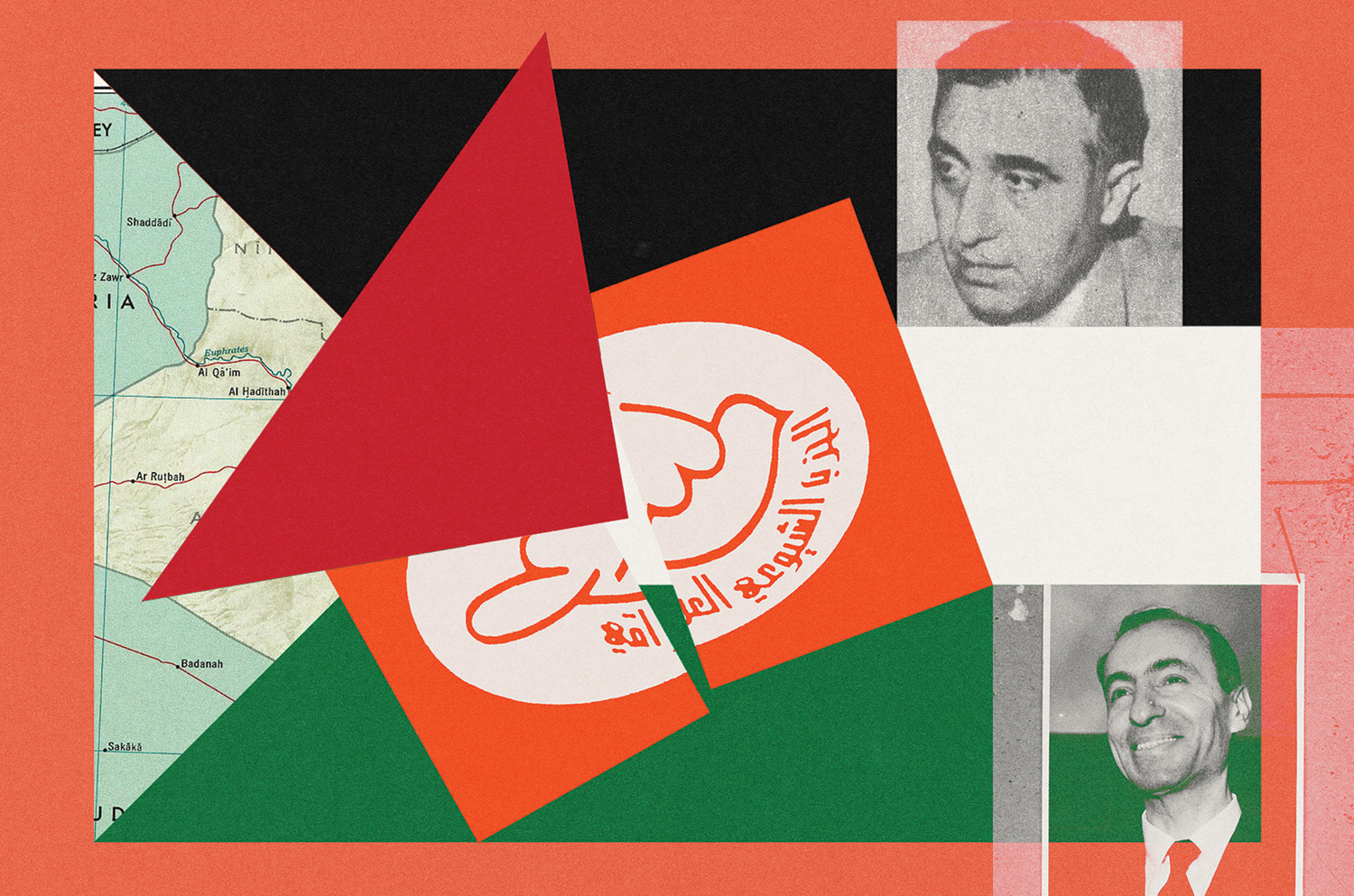
Illustration by Ricardo Santos
Was the Ba‘ath Party socialist? The simple answer would be yes. In its first meeting in a Damascus café in 1947, the Ba‘ath Party adopted the slogan “Unity, Liberty, and Socialism.” It was the principles of Arab nationalism and unity, however, as well as liberty from colonial rule, that shaped its early political agendas. The organization’s founders, Michel Aflaq and Salah al-Bitar, embraced socialism, but their socialism was spiritual. It called for justice for the oppressed and avoided analysis of the social forces that led to such oppression. It was a commitment to social change without the class analysis that formed the basis of socialist political action.
The socialism of the Ba‘ath Party has, from its inception, been governed by political expediency. At various times in its history, its leadership borrowed from the politics and language of other activist parties with a mass base, like the Arab Socialist Party of Syria, with which it merged in 1953, and the Iraqi Communist Party. Its politics, however, were vehemently anti-communist. It orchestrated violent campaigns against communists and, in the case of Iraq, led the first Ba‘athist coup in 1963, supported by the CIA, against the republican revolutionary government that the Iraqi Communist Party played a critical role in upholding. It remained putschist at heart, dependent on the military takeover of the state to implement what it viewed as socialist policies. It had a deep distrust of the people’s abilities to shape the agendas of social and economic justice through political organizing.
This does not mean, however, that Ba‘athist ideologues and activists within the party did not embrace the ideas of socialism, particularly in the 1960s and early 1970s. They introduced class analysis into their party’s regional political reports and espoused Leninist forms of party organization. Their state socialist policies were modeled on a version of Soviet socialism.