The Loans Bleeding Colombia’s Poor Dry, Drop By Drop

In Cali, Colombia, where few qualify for bank loans, the predatory “gota a gota” lending industry generates massive profits for criminal organizations. Many of the working poor don’t even know who their lender is — until they miss a payment.
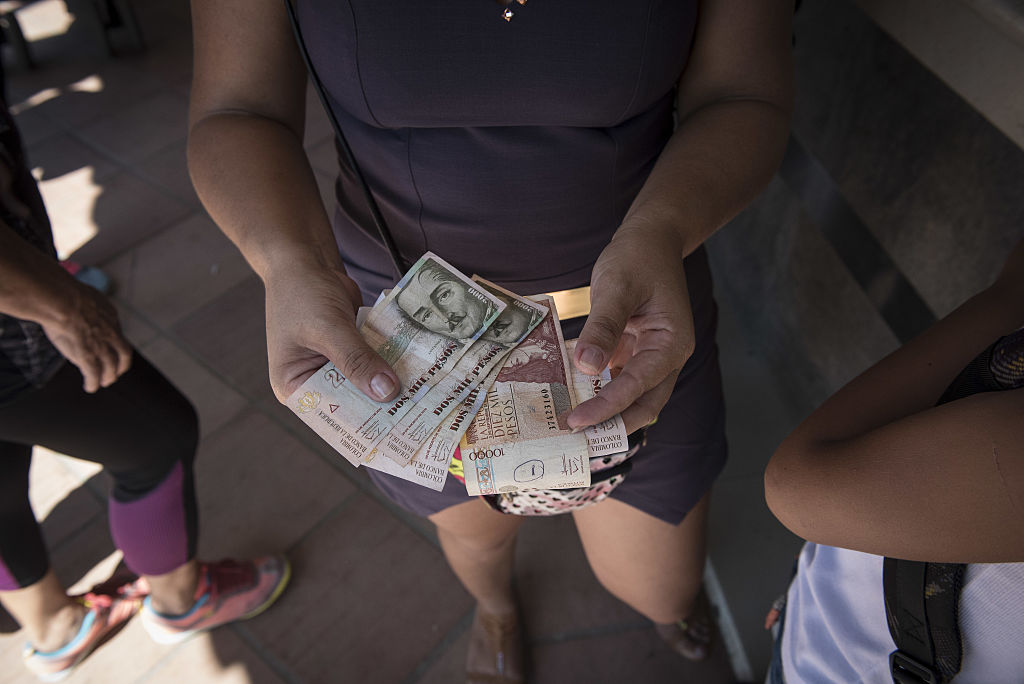
A woman receives Colombian pesos in exchange for Venezuelan bolivars after the reopening of the borders in Cúcuta, Colombia, on Tuesday, December 20, 2016.

In Cali, Colombia, where most people lack formal employment and don’t qualify for bank loans, an illicit industry of predatory “gota a gota” lending generates massive profits that now even rival the cocaine industry’s. (Carlos Becerra / Bloomberg via Getty Images)


C, a man in his late sixties with a head of thick white hair and a large, bright red nose, sits on a plastic chair under a small tree in front of my building every day from 6 a.m. to 6p.m., except Sunday. C is a parquero, whose job is to help people, both those who come to the hospital on one corner and to the police station on the other, find a place to park their cars. When C is finished for the day, he stores his plastic chair and wheels his bicycle out from the hospital garage, carrying with him a large plastic bag weighed down with coins and small bills to his home in a distant part of the city.

C is an alcoholic who moderates his drinking, except for one weekend every month when he lets himself indulge to the point of unconsciousness. It was due to his excessive drinking that he lost the support of his middle-class family and must fend for himself on the streets of the city. And it is due to his heavy drinking that he hasn’t been able to keep a steady job or even scrape together enough to pay his rent at the end of the month, for which he often has to borrow the money.

C is very social, and everyone from the neighborhood says hi or stops to chat when they pass by. C receives a visit from a big guy on a motorcycle almost every day. Without taking off his helmet, the man stops to chat with C for a few minutes under the shade of a tree. At the end of the conversation, C hands the man some cash in small bills, at which time the man pulls from his jacket pocket a small notebook and jots down the amount. On the days when C has blown all his money on drink and doesn’t have enough to pay his quota, the man on the motorcycle shoves him around a bit and then gets onto his motorcycle, revs the engine, and drives off.

Often afterward, C will receive a visit from three guys on motorcycles. They tower over C, who sits on his plastic chair, chatting quietly until C pulls out a wad of small bills from his pocket and hands it over to them, at which point they pat him on the back. Everyone is calm and courteous; there is never any yelling or violence at all, and thus the policemen who frequently come and go from the police station next to them never pay the men in motorcycle helmets any mind.

The business of gota a gota (drop by drop), or gota agota (to wear someone down drop by drop) — that is, lending small amounts of money to the lowest strata of society — first emerged in Colombia as a way for narcos to launder dinero caliente. Using the cocaine dollars obtained in the United States to buy General Electric and other top-brand products, narcos would send down washing machines, kitchen appliances, or car parts to Colombia. Their organization, posing as authorized dealers, would sell the products on layaway plans, capturing ignorant clients dazzled by the American dream by offering them luxury items with easy access to credit, without requiring any official contracts or receipts and with no taxes paid. In this way, narcos were able to launder millions of dollars calientes.

At first, narcos footed the bills, buying American products in the US and importing them to Colombia where they were unavailable to be sold on layaway. When the US government began to crack down on this mode of money laundering, however, the narcos stopped selling and importing appliances and converted the oficinas into informal lending institutions called gota a gota. Realizing how the real money was in the layaway plan, they began lending small amounts of money at high interest throughout the city. Since these criminal organizations didn’t ask for property titles or other assets, didn’t require any paperwork, and handed over cash to people instantly, they were able to easily hook clients.

By the mid-1990s, there were around fifty gota a gota offices in Cali, and since then business has grown exponentially, preying on the most economically desperate sector of society. In order to get a bank account, and thus to be able to apply for loans, people must have formal employment, something more than half of the workforce in Cali lacks. Without access to loans, people from the lower classes have a hard time making ends meet, let alone starting up small businesses that might help to lift them out of poverty.

Filling an economic niche that the banking sector deems too risky, gota a gota offices lend up to one million pesos (around $250), a small but significant amount of money to those from the poorest parts of the city, which explains their popularity.

To hook clients, gota a gotas advertise their services in official media, with street flyers, or in small shops. The newest technique is online mass messages on WhatsApp that offer to immediately transfer money to people’s accounts, asking only for the person’s cédula (the official ID for all Colombians). As much as a quarter of the city’s population has borrowed money at one time or another from a gota a gota.

In Colombia, profits derived from gota a gota nearly equal that of the cocaine industry, and it is estimated that just the interest collected on such loans is equivalent to 2 percent of Colombia’s gross domestic product. Lending cash to the poorest in a city while charging high interest rates is such a profitable business model that it has recently been exported throughout Latin America and has even emerged in Europe, especially in Spain, where there is a large community of Colombians.

Today the hundreds of oficinas that dedicate themselves to gota a gota in Cali are run mostly by members of the city’s narcos, criminal organizations, or gangs, all of whom have large quantities of cash on hand. To attend to all their clients who owe them money, the oficinas employ hundreds of young men to race around the city on motorcycles every day as cobradores (debt collectors). It is easy to recognize gota a gota debt collectors: with over fifty clients to visit each day, they tend to leave their motorcycle helmets on when collecting payments from clients. Gota a gota collectors rarely carry weapons and depend instead on strong-arm or terror tactics.

Many clients either don’t understand or have no option but to accept the high interest (up to 40 percent monthly and almost 400 percent yearly) that is compounded and collected daily, and which must be paid within a short period. When people can’t meet the daily payments, they are charged interest on the interest, and their debts quickly spiral out of control. To “help” people pay their debts, oficinas often give their clients the option of reclaiming the goods that were bought with the loans and handing over other items of value, either their own or those belonging to family members. When loans aren’t paid on time, people can find themselves at the mercy of debt collectors and the criminal organizations behind them.

Many people, when they borrow money from a gota a gota, don’t even know whom they are borrowing from — that is, until they miss a payment. In extreme cases, those who cannot or refuse to pay their debts are forced to hand over family members to work for the oficinas as cobradores or for carrying out other illegal activities. If no agreement can be reached, clients can be gunned down on the street. To avoid the consequences of not paying their debts, people have committed suicide or fled the country together with their families who would be held accountable.

A gota a gota debt collector on a motorcycle, with his helmet on, talks to another man on the streets of Cali, Colombia.
It is easy to recognize gota a gota debt collectors: with over fifty clients to visit each day, they tend to leave their motorcycle helmets on when collecting payments from clients. (Courtesy of Kurt Hollander)

A law was recently passed in Colombia that makes gota a gota lending a punishable crime. Up until then, the owners and managers of oficinas could only be convicted if they or the cobradores were caught engaging in violence, which is why the big, tattooed cobradores that ride around the city dealing with dozens of clients every day are usually affable and understanding. When negotiations break down and people refuse to pay back their loans and the interest accrued, however, debt collectors give way to sicarios.

The majority of the homicides in Cali are carried out by these freelance assassins. Like gota a gota debt collectors, sicarios ride around the city on motorcycles with helmets covering their faces. In fact, so many sicarios have done their dirty work from the back of a motorcycle that it is now illegal in Cali for two men to be on a motorcycle together.

The rise of professional sicarios in Cali coincided with the rise of the Cali Cartel in the 1990s. The cartel often employed killers to do their dirty work, including ensuring the delivery of drug shipments, providing security for drug capos, shaking down clients, or sowing terror among politicians, judges, and the general population.

Sicarios working for the Cali Cartel always utilized the same modus operandi: shots to the back of the head, hands and feet tied, the corpses at times burned to a crisp or mutilated and dumped on the outskirts of the city. By assassinating people in such a way that everyone knew who was responsible, the cartel used the threat of sicarios to terrorize the local population.

In the 1980s and early ’90s, half of all murders in Colombia were committed by sicarios. When the Cali Cartel was dismantled in the mid-90s, the oficinas de cobro responsible for managing the sicarios for the narcos and criminal organizations took over most of the cartel’s illegal operations, and Cali became the homicide capital of Colombia once again. Assassinations are part of the urban landscape in Cali and can be seen as part of a process of the “democratization of death.” No longer employed just for business purposes, sicarios are used to settle personal jealousies and exact revenge, often against women, but they can also be hired by women to take out their abusive husbands or lovers.

The poorest neighborhoods in Cali, those populated by those violently displaced from their homes in the countryside and on the Pacific Coast, are where most gangs exist, where the most drugs are sold, and where most sicarios live and operate. They are also where most teenage boys are enlisted to work as cobradores or sicarios for oficinas. The young kids, initially enticed by offers of money and a motorcycle as recruitment techniques, are then forced to work for free afterward, their families threatened if they don’t comply. Most of the more than one thousand murders a year in Cali are homicides related to the settling of accounts between rival criminal organizations within the poorest neighborhoods, and thus, ironically enough, in the end the cobradores and sicarios who work for gota a gota offices are themselves the most common victims of violent death in Cali.

These abusive moneylending operations leave many victims in their wake, especially poor and working-class people, bedazzled by the American dream of quick cash and credit. Until a more equitable banking system is put in place, the poorest Colombians and other Latin Americans will be bled dry by criminal organizations, victims of an economic violence that produces the physical violence that plagues cities like Cali.