The GOP Is at War — Without the Foreign Policy Establishment
For a century, American wars were planned by think tankers drawn from the boards of Goldman Sachs and Chevron. It gave rise to horrors like Vietnam and Iraq. That era is over. What comes next is very likely worse.
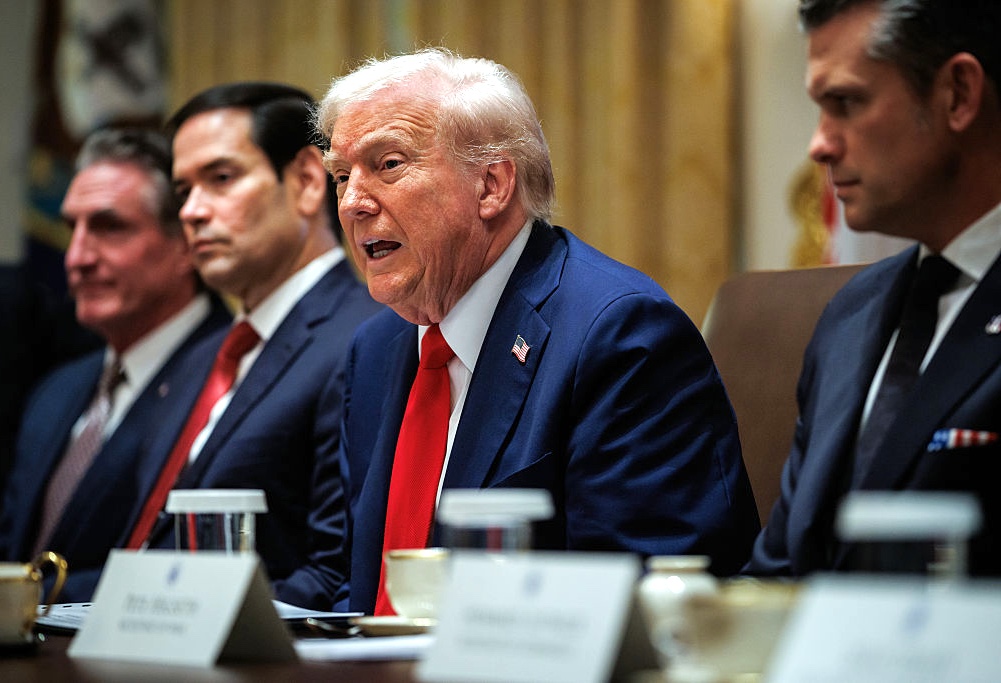
Trump’s war party has formed a profound break with the American foreign policy establishment and its backers among the corporate leadership. (Samuel Corum / Sipa / Bloomberg via Getty Images)
The Trump administration’s attack on Iran was hardly a surprise. Since January, the military buildup around Iran has telegraphed that an attack was imminent. Yet despite being long foreseen, the attack was no less shocking. The assassination of Iran’s Ayatollah Ali Khamenei signaled this would not be a repeat of the Twelve-Day War last summer but a far more bitter and destructive conflict. At the same time, the administration has proudly declared its contempt for traditional rules of engagement, suggesting a disregard for “collateral damage” that eclipses even the sordid record of Operation Iraqi Freedom.
At the same time, there are signs that the administration was woefully underprepared for their war. Their announced war aims have been shifting and inconsistent. There was no plan for evacuating American citizens from the region, despite the predictability of Iran’s response. Finally, it is not even clear that the American military has sufficient armaments for the length of engagement that is now being predicted.
All of this raises the question of who exactly is planning Donald Trump’s war. Investigating this question reveals more than just the incompetence for which both Trump administrations are justly famous. It also reveals what a profound break Trump’s war party forms with the American foreign policy establishment and its backers among the corporate leadership.
Much of what makes this break possible is itself in need of explanation. In my recent book, Rogue Elephant, I argued that what is most novel about Trump and today’s Republican Party stems from the GOP becoming unmoored from the control of America’s capitalist class as a whole — importantly, not from the control of individual capitalists or narrow sectoral interests but from the kind of class-wide oversight that the foreign policy planning network was designed to provide. While warmaking and imperialist horror are far from aberrations in American foreign policy, it is this structural break from the establishment that goes a long way toward explaining the particular form Trump’s bellicosity has taken in recent months.
The Foreign Policy Planning Network
Since the emergence of the United States as a global power in the early twentieth century, American foreign policy has been shaped by a network of think tanks that are themselves overseen by the leadership of major American corporations. The Council on Foreign Relations (CFR) is the most venerable of these institutions, emerging after World War I out of planning councils assembled by Woodrow Wilson’s administration (the council’s journal, Foreign Affairs, was founded after one of its principals sent fundraising letters to the thousand richest Americans). Other similar institutions include the Atlantic Council, the RAND Corporation, the Aspen Institute, and the Trilateral Commission.
These organizations make foreign policy through two channels. First, they attempt to influence the climate of opinion on key issues of the day. For example, the CFR’s 2001 report, Strategic Energy Policy: Challenges for the 21st Century, argued that leaving Saddam Hussein in power in Iraq would “encourage Saddam Hussein to boast of his ‘victory’ against the United States, fuel his ambitions, and potentially strengthen his regime. Once so encouraged . . . Saddam Hussein could be a greater security threat to U.S. allies in the region.” This report was part of a broader push by the foreign policy planning network in favor of regime change in Iraq. More generally, these sorts of reports attempt to define the key problems in American foreign policy as well as the space of possible policy solutions.
The other channel through which the think tanks set foreign policy is by providing personnel to a new administration. The American security state is vast, and there are dozens upon dozens of high-level administrative positions that turn over with each new administration. The people who will staff these positions are often drawn in large part from the network of foreign policy think tanks, and after an administration’s end, many staffers return to these environs. This revolving door between think tanks and policymaking positions is indeed one of the reasons the former exists. As Joseph Nye, a leading thinker and administrator at the Trilateral Commission, put it, the “most powerful way [to influence policy] is when you develop ideas with people who then actually go in and have their hands on the lever or you get your own hands on the lever.”
The links between the think tanks and the American corporate elite are strong. First, many of the most prominent think tanks receive a large portion of their funds directly from large corporations ranging from Goldman Sachs to Coca-Cola. Second, the actual boards of directors of the think tanks consist of figures drawn directly from the corporate leadership class. As Bastiaan van Apeldoorn and Naná de Graaff conclude in a 2016 study,
more than half of the directors and trustees governing the policy planning institutes that have been central to the last three post-Cold War administrations are thus closely affiliated with the corporate community through their simultaneous corporate board memberships. These directors connect to a total of 318 different companies. In other words, we find that a substantial number of these directors are . . . part of the corporate elite while directing the policy planning process.
Both the George W. Bush administration and the Biden administration exemplify these dynamics. Donald Rumsfeld, Bush’s first secretary of defense, was a trustee of the RAND Corporation before his appointment (as well as chair of a large pharmaceuticals corporation). Condoleezza Rice, his national security advisor, had been a fellow with the CFR and a director of corporations like Chevron and Hewlett-Packard. Joe Biden, likewise, had corporate think tankers aplenty. His secretary of state, Antony Blinken, was a member of the CFR (as well as founder of a defense industry consulting group), while his national security advisor, Jake Sullivan, had been a fellow at the Carnegie Endowment for International Peace, whose board consists largely of leaders of various financial firms.
From Wilson to Biden, this is who made foreign policy in the United States. Though policies might shift from administration to administration, personnel was persistently drawn from a network of think tanks funded and overseen by the leaders of the country’s largest corporations. This supervision, in turn, ensured that the policies being made in these institutions would be congruent with the policy desires of the corporate leadership class. Indeed, in bringing directors from multiple corporations together on one board, they serve an important role in facilitating agreement between representatives of different firms on a common policy agenda.
Crashing the Network
Trump’s first administration marked a sharp break with this tradition. To be sure, there were figures from the think tank network in key positions. James Mattis as secretary of defense; Mark Esper as secretary of the army (and later secretary of defense); H. R. McMaster as national security advisor; and John Bolton later as national security advisor all came from a quite similar institutional background as analogous figures in previous administrations.
But examined in the aggregate, the disjuncture between Trump’s personnel and the administrations that preceded his is clear. To measure this, van Apeldoorn and de Graaff counted the number of links between top foreign policymakers in each administration and the think tank network. For example, a figure who was a member of the CFR would count as having one link, while a figure who had positions at the Atlantic Council and the Trilateral Commission would count as two links, and so forth.
In the Bush administration, there were 131 links between top foreign policy officials and the think tank network. In the Obama administration, there were 133 links. In the Trump administration, there were only thirty-nine. As van Apeldoorn and de Graaff conclude, the “Trumpian foreign-policy elite is poorly integrated into the transnational foreign-policy elite that had such close links with all three former administrations. We thus observe a real and significant break with the previous configuration of elite power.”
In Trump’s first term, however, this did not make for a dramatic break with existing foreign policy. To be sure, Trump’s gangsterish shakedown of the Ukrainian government for dirt on the Biden family was a new kind of geopolitical intervention. But overall, his foreign policy continued in tracks laid down by previous administrations. The more confrontational posture toward China was only continuing what the Obama administration had begun. On Russia, Trump’s policy was actually slightly more belligerent than his predecessors’. And while pulling the United States from the Joint Comprehensive Plan of Action with Iran was certainly a violent break from the Obama administration, who had just negotiated that deal, the Republican Party as a whole had never accepted its legitimacy.
Though Trump’s personnel in his first term had a quite different institutional background from the typical foreign policy elite, his administration did not, on the whole, attempt a significant revision of American policy. The reasons for this stem from the unexpected nature of Trump’s victory. Most of the Republican Party spent 2016 waiting for Trump to lose, and Trump himself did not even have a victory speech written on November 8. There was little effort to put together a real foreign policy team with a cohesive vision. Once in office, key roles were occupied by figures like Mattis or Bolton, who worked to actively frustrate any attempts at too drastic a policy change. In the first Trump administration, continuing in the familiar grooves set by previous policy was the path of least resistance.
The second Trump administration has been quite different. There are no figures comparable to Mattis or McMaster remaining. Secretary of Defense Pete Hegseth has no background in policy whatsoever, having worked as a Fox News host after failing to manage right-wing veterans’ groups. Vice President J. D. Vance and Director of National Intelligence Tulsi Gabbard have no connections to the think tank network. Many other senior policymakers come straight out of finance (Scott Bessent at the Treasury, Stephen Miran at the Council of Economic Advisers) or real estate (Special Envoy to the Middle East Steve Witkoff).
The figure who comes closest to the traditional foreign policy elite is Secretary of State/National Security Advisor (repeating Henry Kissinger’s portfolio in the Nixon administration) Marco Rubio. Rubio had been a senator since 2010 and has been part of more traditional Republican foreign policy circles. But institutionally, he has none of the sort of connections that were typical of similar figures in previous administrations. The think tank with which he is most closely associated is the Foundation for the Defense of Democracies (FDD).
The FDD is not a typical foreign policy think tank. Instead, it is best conceived as an adjunct of the Israel lobby. Incorporated in 2001 as Emet (Hebrew for “truth”), the FDD’s original mission was to “provide education to enhance Israel’s image in North America and the public’s understanding of issues affecting Israeli-Arab relations.” It has been a key player in pushing for regime change in Iran.
Another think tank that is outside of the corporate policy planning network but very much on the inside of the Trump administration is the America First Policy Institute (AFPI). The AFPI was only founded in 2021, and from the beginning was deeply connected to Trump. Though the group doesn’t disclose its donors, it has close ties to Texas oil money through board members like Tim Dunn and Cody Campbell. In 2024, Politico called the group Trump’s “White House in waiting,” and several high-ranking foreign policy officials (Kevin Hassett at the National Economic Council, John Ratcliffe at the CIA, and ambassador to NATO Matthew Whitaker) had positions with the group. Its board of directors has virtually no overlap with other think tanks in the foreign policy planning network.
In sum, the traditional foreign policy network has almost no presence in the second Trump administration. In fact, the administration has been openly contemptuous of institutions from the network. Last summer, the Pentagon abruptly canceled top officials’ plans to speak at the Aspen Security Forum, denouncing the gathering for promoting “the evil of globalism, disdain for our great country, and hatred for the President of the United States.”
This has translated into a much more dramatic break with previous policy than in the first administration. From the beginning, tariff policy has been chaotic, disrupting military and diplomatic alliances that previous administrations considered sacrosanct. The administration has undermined NATO even more drastically than in the first administration, as threats to take Greenland by force have impressed upon European governments the need for a security policy that is independent of the United States.
And now, Trump has launched an assault on Iran without any kind of well-defined war aims. Reporting has suggested that Trump believed he could replicate what he achieved in Venezuela, where the head of state was removed, and the remainder of the state apparatus bent quickly to his will. If this is true, it indicates a staggeringly incompetent policy team behind this latest war.
No Glory to the Victor, No Sympathy to the Defeated
None of this should be taken to suggest nostalgia for the good old days of elite control. The bloodbaths in Vietnam and Iraq had unimpeachable provenance from the corporate foreign policy planning network. These were the circles in which the American ambition of global domination was nurtured and articulated, and no one with a commitment to basic democratic principles should be nostalgic for the era of their hegemony.
Nonetheless, there are reasons to believe that the Trump administration’s turn away from the think tank network could inaugurate an even more destructive and chaotic era for American foreign policy. One effect of the think tank network is to bring a wide variety of interests into the overseeing of foreign policy formulation. Directors of financial firms, pharmaceutical companies, manufacturers, and defense firms all come together to ensure that policymaking in the think tanks follows lines that conform to their interests. And while these interests are all those of the ruling class, they encompass a wide range of sectors. This means the firms represented are exposed to many different sources of risk, which they seek to ensure that any policies made will not exacerbate.
Policy planning in the second Trump administration encompasses no such comprehensive set of interests. As a result, the administration seems willing to risk far more with less planning than previous administrations. Given the level of savagery they were willing to countenance in pursuit of their interests, we should expect Trump and his war party to go even further.