English Life After Empire
As British political life exhibits ever more morbid symptoms, the reissue of Elizabeth Taylor’s 1971 novel Mrs Palfrey at the Claremont is well-timed. Its sharply observed and amusing portrait of England’s post-imperial decline speaks to us across the decades.
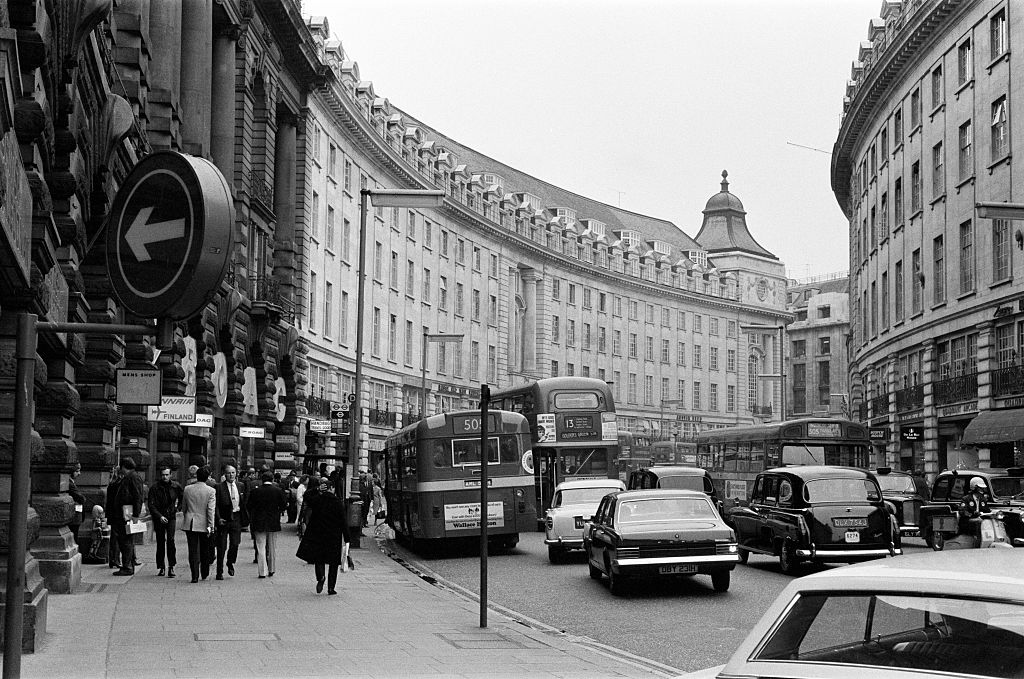
Regent Street in Central London, circa 1971. (Daily Mirror / Mirrorpix / Mirrorpix via Getty Images)
“You could not shock her more than she shocks me,” wrote W. H. Auden. “Beside her Joyce seems innocent as grass.” The shocking “her” of these lines is not, surprisingly, one of Auden’s outré modernist contemporaries, but a novelist usually associated with staid domesticity: Jane Austen. “It makes me most uncomfortable to see,” Auden continues,
An English spinster of the middle-class
Describe the amorous effects of “brass”,
Reveal so frankly and with such sobriety
The economic basis of society.
As Auden realized, the most politically unsettling works of art often have little to do with politics — or their authors’ intentions. Austen herself — a “spinster of the middle-class” — would almost certainly have feared revolutionary change, but her novels are rooted in a radically economic understanding of human relationships. Take, for instance, the famous first line of Pride and Prejudice: “It is a truth universally acknowledged, that a single man in possession of a good fortune, must be in want of a wife.” While the plot of the novel will be about finding a spouse, Austen makes it clear that the fortune comes first: beneath the soft surface of the marriage plot lies the hard kernel of economic reality.