ICE vs. High Schoolers
We spoke with high school students in Minneapolis about how they were affected by ICE’s occupation of the city.
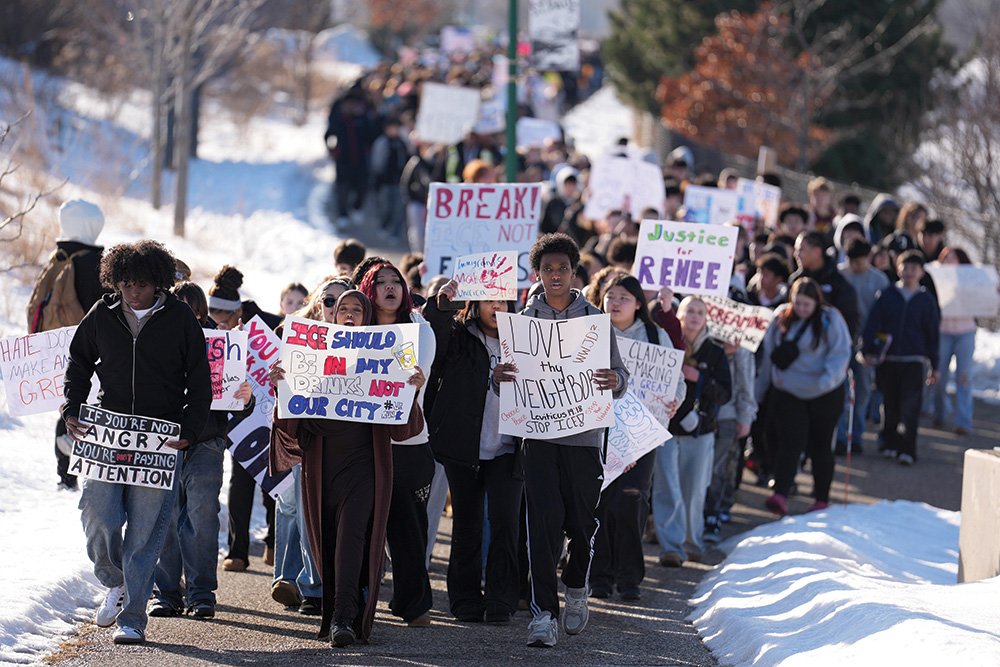
Students from North High School in North St Paul, Minnesota, marched to their local city hall following a mid-afternoon school walkout in protest of ICE and the killing of Renée Good, which had taken place two days prior in neighboring Minneapolis. (Anthony Souffle / The Minnesota Star Tribune)
The January 7 killing of Renée Good sparked national outrage and mass protests, especially in the Twin Cities, which had been roiling since the Trump administration sent thousands of agents to occupy the area as part of Operation Metro Surge.
Immigration and Customs Enforcement (ICE) agent Jonathan Ross’s murder of Good was not the only violent encounter between immigration agents and Minneapolis residents that day. That same afternoon, Border Patrol agents entered the grounds of Roosevelt High School while in pursuit, they claimed, of a US citizen who was “actively trying to impede operations.”
The scene outside the school soon erupted into chaos; the Department of Homeland Security (DHS) alleges that a teacher “proceeded to assault a border patrol agent” and other people started pelting officers with objects and trying to spray-paint them and their vehicles. The Minneapolis educators’ union accused Border Patrol of wrongfully detaining a Roosevelt staff member and of using tear gas on the crowd. Minneapolis Public Schools shut down for the next two days and, soon after, announced it would allow students to stay home and receive remote instruction until February 12.
Jacobin spoke with two area high school students about how Operation Metro Surge has disrupted their daily lives and how they and their classmates have responded to the ongoing occupation.
Zakariya, a sophomore at South High School in Minneapolis, about two miles north of Roosevelt High, stresses about his family having run-ins with ICE. “Literally every day, I have to worry about my mom and sister when they’re going to work. My mom is a bus driver for the Minneapolis Public School District. And my sister works at a psych ward in St Paul,” he told us.
“And then there’s my baby sister,” he added. “She started first grade this year. So I have to worry about her when she gets on the school bus as well.”
Boisey, another sophomore at the school, reported that he and his friends have suspended many of their typical after-school activities since ICE came to town. “I go to the Y, which is just across from school, but it’s near Lake Street. That’s where a lot of ICE agents drive by,” Boisey said. “A lot of students who are either Somali or Latino can’t hang out with their friends, in fear of ICE.”
The students didn’t mince words in their political assessments of Operation Metro Surge: “It’s basically Nazi Germany down here,” Zakariya told Jacobin, while Boisey described the immigration crackdown as a bid by the Trump administration to achieve “absolute power,” drawing comparisons to both the Third Reich and the Jim Crow South.
Their fears of federal agents are well founded, whether you agree with their analogies or not. Zakariya has friends at Roosevelt, where Border Patrol reportedly deployed tear gas; he also said two students from his school were kidnapped by ICE in late January, just a block away from the campus, though they were released the same day. And elementary school students as young as five and ten years old in the Columbia Heights Public School District, in the suburbs north of Minneapolis, have been detained by immigration authorities.
The prospect of immigration raids at schools has been a flash point throughout the second Trump administration. Under Joe Biden’s presidency, DHS agents were instructed not to carry out immigration enforcement operations near “protected areas,” including hospitals, places of worship, and schools. In line with Donald Trump’s campaign promises to carry out massive deportations of undocumented immigrants as well as his broader embrace of authoritarian spectacle, the administration revoked this guidance immediately upon taking office.
The move stoked fears about immigration raids at schools that were soon vindicated. In Chicago last year, for instance, federal agents arrested a mother and her seventeen-year-old daughter outside Thomas Kelly College Prep. The current situation in Minneapolis suggests that this may become a more common occurrence.
But the administration’s aggression has also inspired student resistance. “I’ve seen lots of adults organizing ICE patrols and putting up posters, lots of kids organizing teach-ins, walkouts, sit-ins, and just bringing more general awareness to people who might not think this is a problem,” Boisey told us. He mentioned a student-led walkout at Roosevelt High School in the wake of the confrontation with Border Patrol.
In the last few months, students across the country, from New York to Los Angeles, have staged walkouts by the hundreds protesting ICE brutality. And over the past year, campaigns have been mounting for campuses and school districts to take a stand against raids and notify students when operations are being conducted near them. If one aim of Trump’s scorched-earth approach to immigration enforcement is to instill fear in immigrant neighborhoods and liberal “sanctuary cities,” students’ continued willingness to protest suggests the administration may not be succeeding in that goal.