Gavin Newsom’s Closely Curated Vulnerability Isn’t Convincing
In Young Man in a Hurry, Gavin Newsom tries to get in front of the critiques he knows are coming. But reading the book, you can’t escape what he himself establishes: Newsom is a product of one of the most gilded patronage networks in modern US politics.
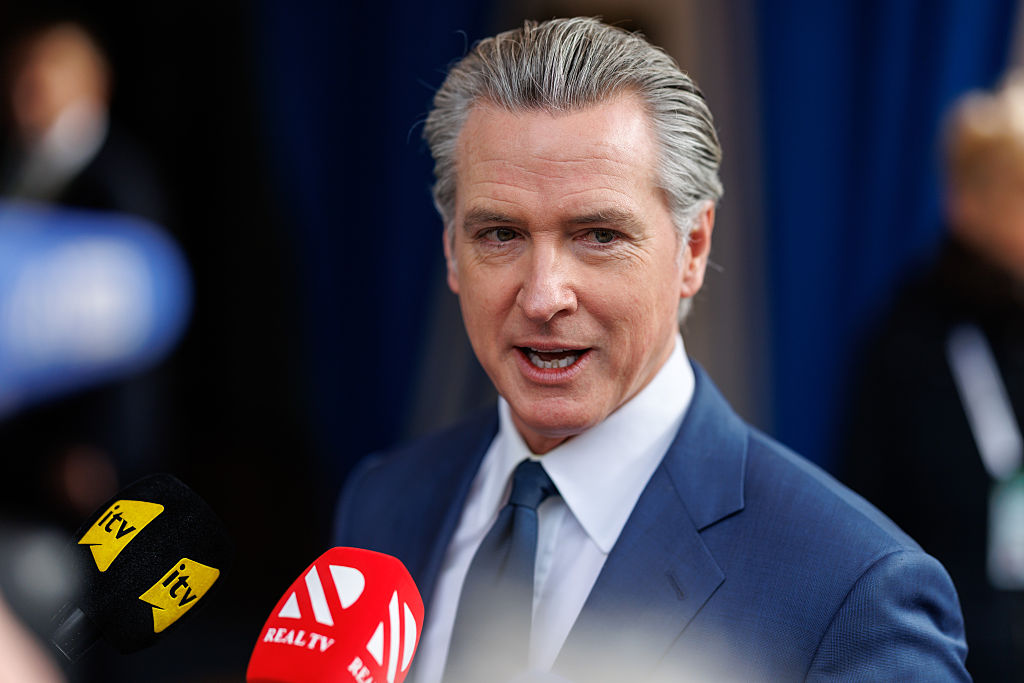
If Gavin Newsom’s new memoir’s purpose is to prove that he made himself, it ends up proving the opposite. (Matthias Balk / picture alliance via Getty Images)
“I’m not better than you. I’m a 960 SAT guy. You’ve never seen me read a speech because I cannot read a speech. Maybe the wrong business to be in.” This is California governor and presidential aspirant Gavin Newsom, speaking to a packed auditorium in Atlanta recently on a book tour that has also routed him through South Carolina, New Hampshire, and Tennessee before finishing in his home state of California.
The memoir, Young Man in a Hurry, is supposed to kill a caricature. Newsom knows exactly how most of America perceives him: as the New Yorker recently put it, “The Tom Cruise of politics, more successful than beloved,” a privileged California politician with a knack for political theater and little else beneath it. The book, which traces his difficult childhood alongside his political career, is his bid to change that — and, not incidentally, to defuse the opposition research before anyone else can use it.
His grievances come early. In the eyes of the press, Newsom was “forever the ‘golden boy’ whose daddy had prospered because of his ties to the Gettys and now the son was simply following suit.” Newsom’s father, Bill, was a well-connected judge who met members of the dynastic Getty family at their Catholic high school, became the family’s lawyer, and was once sent to Italy with the ransom to secure the release of the kidnapped John Paul Getty III.
He eventually became entrusted with directly managing the multibillion-dollar Gordon P. Getty family trust, making a lucrative living in the process. “The press’s one-dimensional portrait of me pissed me off,” he writes, “because I knew the way I grew up, the struggles my mother had to endure, the hard times that made my life a duality that never seemed to get its due.”
After his parents divorced, he and his sister were raised largely by their mother, Tessa, who at times held three jobs. Newsom’s father remained his link to a world of extraordinary wealth as Gordon Getty’s “best-best friend.” The two families spent holidays together as a matter of course. From these occasions and others, Newsom recalls childhood trips on private jets, limousines, and yachts; helicopter excursions to photograph polar bears in Canada; a week of revelry in Spain with King Juan Carlos, mingling with the royal nieces and nephews.
His upbringing was, as he writes, a dual one — and the humble half is genuinely sympathetic. His mother, who eventually divorced his father and largely raised the family on her own without his father’s wealth, “didn’t know what to do with the memories we carted home from our Getty trips,” the children returning from vacationing with billionaires to a household scraping by. On visits to the Getty orbit, he was fitted for clothes no kid from his humbler neighborhood would wear. When extravagant gifts made their way back to his mother’s house, she returned them at the store for cash.
Still, if the book’s purpose is to prove that Newsom made himself, it ends up proving the opposite. Here is what Young Man in a Hurry actually establishes, page after painful page: Gavin Newsom is a product of one of the most gilded patronage networks in modern American political history, and no amount of carefully curated vulnerability will change that.
As Ed Burmila noted in the New Republic, “The 270-page book includes 61 different page references for one or more Getty.” So many people assumed Newsom was himself a Getty that Jack Nicholson once made that mistake — in a Venetian palazzo, after a gondola arrival.
Newsom never comes close to reckoning with how heavily the Gettys and their ilk bankrolled both his business life and his political ascent. The family made him a multimillionaire, well before he became governor, by financing his early ventures. Gordon Getty backed the ritzy wine business Plumpjack, which his son Billy cofounded with Newsom. As for why the checks kept coming, Newsom offers a tidy explanation: he earned it by being a good businessman. Getty kept backing him, we’re told, because of “the success of [his] first investments.” (The governor is careful to distinguish the Getty fortune as “a different sort from Donald Trump’s grift,” though the distinction is not exactly self-evident.) Newsom says the public narrative of a silver-spoon beneficiary has “robbed me of my own hard-earned story.” The reader is left to decide whether that robbery was committed by the press or by the facts.
Newsom is selective about which episodes of privilege he includes and which he mutes. Where a connection doubles as a vivid story — childhood encounters with opera tenor Luciano Pavarotti, transcontinental jaunts across Europe — he keeps it. Episodes that undermine his claim of meritocratic ascent are blurred. Newsom professes surprise at his admission to Santa Clara University, citing a baseball scholarship as his ticket to entry. Yet, as others have observed, he says nothing about the recommendation letters — one from Governor Jerry Brown, who knew the Newsoms well, another from a member of the school’s board of regents — that accompanied his application.
It was another family connection, John Burton, who later convinced San Francisco mayor Willie Brown to place Newsom on a city commission, launching his political career. To Newsom, this was merely a “vouch.” At every pivotal moment, someone with money or influence appeared exactly when he needed them. Newsom asks us to admire the climb; the reader keeps noticing the escalator.
The book is full of other material that ought to humanize him. As a child, Newsom’s severe dyslexia became another proof, in his own mind, that he could never live up to a father whose high standards loomed large even when unspoken. “Who would have guessed — certainly not my father — that his only son would be dyslexic,” he writes. He describes falling under the spell of self-help impresario Tony Robbins, recounts his mother’s harrowing assisted suicide as she faced terminal cancer, and charts the disintegration of his marriage to future MAGA staple Kimberly Guilfoyle.
We get a picture of Newsom as a shrimpy, bowl-cut teenager called “Newscum” by tormentors while riding a yellow Schwinn bike on his newspaper route, performing magic as “the Great Gavini” at family gatherings. All of it is affecting, all of it weighed, to the milligram, for political return. Newsom can never stop managing the room. He handles each disclosure the way a chess player sacrifices a pawn: carefully, and only to gain position.
The sections on his political career are oddly deflating. The memoir strains to present him as a uniquely serious Democrat, someone with a rare grasp of an electorate his party has somehow failed to understand. Instead, the book reads less like evidence of seriousness than proof of a lifelong talent for staging it. On homelessness, he correctly points to Ronald Reagan as having turbocharged the modern crisis. Yet he skims past the ways conditions deteriorated on his own watch, treading lightly over his habit of clearing homeless encampments without first securing permanent housing to absorb the people displaced. He even nods at structural causes, writing about “the concentration of unbelievable amounts of wealth into fewer hands.” That line lands oddly, though, alongside his current opposition to a proposed billionaire tax that would fund health care.
Newsom writes that, as a San Francisco supervisor, he “stayed true to [his] pledge to steer left on issues of poverty and inequality and find the middle on the economy and taxes,” then admits, almost as an aside, that the Left often objected. Those objections were prescient. California’s “supplemental” poverty rate was 17.7 percent in 2024, the highest in the nation (tied with Louisiana), representing seven million people without resources to meet basic needs. Income inequality remains near historic highs, the income gap having grown 14 percent from 2019 (pre‑Newsom pandemic period) to 2023.
The memoir has little to say about any of this. What it offers instead are anecdotes about rubbing elbows with Elon Musk and Steve Jobs during Newsom’s mayoral years, and a set piece in which Jobs produces an iPhone prototype at a party. That is about as close as the book gets to grappling with Silicon Valley’s power.
Elsewhere Newsom catalogs his social-liberal bona fides: condemning anti-Asian bigotry in his state, boasting at length about his early support for gay marriage. All well and good. But this appears to be it. Newsom winds up persuading only the committed Newsomites who already share his conviction that his political intuition is self-evidently superb — as demonstrated, naturally, by his ascent through the machinery of California Democratic politics.
This maps onto the central problem of Newsom’s political career. The same pattern governing the personal narrative — disclosure as strategy, vulnerability carefully metered for advantage — governs the political one. The book arrives at a moment when Democrats, ahead of his obviously desired bid for president, need to answer not just whether Newsom is likable but whether he stands for anything. It leaves a nebulous impression of whether Newsom harbors any genuine moral objection to Trump and his agenda, or whether his opposition is purely personal ambition: a rivalry between two entitled men who both believe the spotlight belongs to them.
One suspects Newsom himself doesn’t know. He devotes little space to Trump, though he can’t resist a sly character sketch — recounting Trump bragging about trying to set Ivanka up with Tom Brady, only to discover she was already dating a “schmuck” (Jared Kushner, who was in the room). The implication is clear: Newsom is above all this, a serious man shaped by struggle rather than coddled to the throne like the current president. Yet that political identity — built largely on calling Trump an idiot on social media — sits uneasily beside the book’s own admission that Trump’s first election taught him “attacking Trump the personality was a losing game.”
If Newsom set out to show us the man behind the caricature, he may have succeeded more than he intended. The memoir shares the same mendacity as his past gaucheries, including his appearance on the All the Smoke podcast last October, where he waxed nostalgic about “raising myself, turning on the TV, just getting obsessed. I was sitting there with wonder bread and macaroni and cheese.” Newsom has been sanding and varnishing that origin story long before the memoir. The son of a Getty family fixer wants you to know he is fundamentally a Wonder Bread kid who made good. It was unconvincing before the book and less convincing after it.
And yet 81 percent of Democrats in his own state approve of him. A large slice of the electorate is more credulous for his effort, apparently persuaded that Newsom is, at bottom, just a self-made striver who earned everything through sheer hard work and therefore deserves the presidency he so nauseatingly craves.
Young Man in a Hurry seeks to present a man of substance but reads instead like the longest and most expensive job application in American politics, submitted by a candidate whose only firm commitment is to his own advancement. Beneath all the Californian exceptionalism lies a very old narrative: the aristocrat who protests, a bit too much, that he is one of the people.