The Prairieland 19 Case Is a Test for Criminalizing Dissent

Nine members of the “Prairieland 19,” anti-ICE protesters in Texas who the Trump administration is dubiously accusing of domestic terrorism, are going on trial this week. The case is a test for how easily Trump might criminalize dissent going forward.
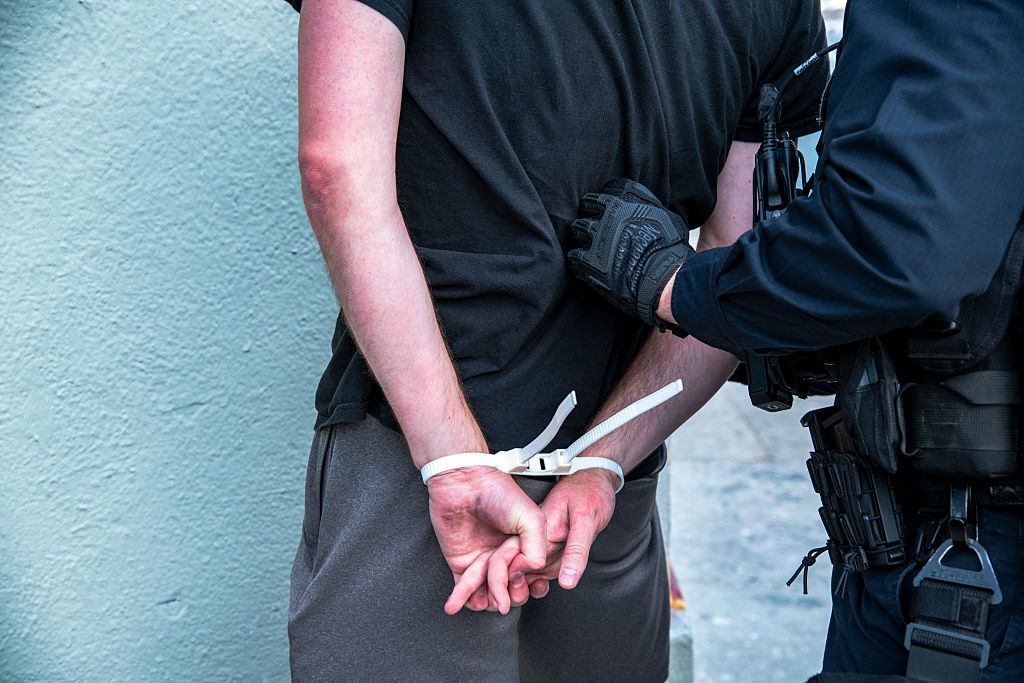
The outcome of the Prairieland case may determine how easily the administration can quash opposition and criminalize dissent. (Lauren Puente / Middle East Images / AFP via Getty Images)

Some in the Trump administration may now regret calling Renée Good and Alex Pretti “domestic terrorists.” The hasty application of this label by Kristi Noem, J. D. Vance, and other hard-liners generated justifiable outrage and helped mobilize opposition to Donald Trump’s terror campaign against immigrants. Meanwhile, however, a far less-publicized case threatens to provide an enduring legal framework by which virtually anybody involved in activism against Immigration and Customs Enforcement (ICE), or Trump’s agenda more broadly, can be labeled a “domestic terrorist” and treated accordingly.

Next week, a Fort Worth jury will consider the case of an accused “North Texas Antifa Cell” indicted on a variety of charges related to domestic terrorism for anti-ICE activism. (The trial was supposed to begin this week, but the judge declared a mistrial during jury selection yesterday over a defense lawyer wearing a shirt featuring the faces of Martin Luther King Jr and other civil rights movement figures.) The outcome of this case may determine how easily the administration can quash opposition and criminalize dissent through specious accusations of terrorism.

The Demonstration

On July 4, 2025, a small group of activists gathered outside Prairieland Detention Center in Alvarado, Texas, for a noise demonstration. “Noise demonstrations are a common form of protest that occur at jails, prisons, and other facilities that incarcerate people,” explains journalist Sabr Qalam. “The goal of these actions is to make enough noise so that people on the inside are able to hear the support from their community on the outside.”

“We make noise to remind the people inside that they are not forgotten,” remarked Rhode Island organizer Sophia Wright, at a New Year’s Eve demonstration against an ICE facility in Central Falls. Noise demonstrations are usually festive affairs. In activist circles, they are considered safe, family-friendly fun, even if the people outside the jail are having most of it. A few years ago, I watched the windows at Cook County Jail fill up with incarcerated spectators as a local punk band performed outside, only to quickly empty. (The band could have used more practice.) The demonstration in Alvarado seemed, at first, to be much of the same.

Some defendants brought guns and body armor. It is a common practice in red states like Texas, where open-carry gun culture runs deep, violence against queer and gender-nonconforming people is common, and left-wing demonstrations are often met by armed counterprotesters. At Prairieland, most of the guns were kept away from the actual demonstration, and most demonstrators were unarmed, but that didn’t make a difference in the state’s theory of the case.

As the evening progressed, a handful of revelers made noise and shot fireworks, and a duo peeled off and scrawled anti-ICE slogans on a few cars and a small shed. Meagan Morris had agreed to drive some protesters to what everyone believed to be an ordinary noise demonstration. Once there, she sat in her car playing Nintendo Switch, waiting to drive them home.

What happened next is contested. According to a series of indictments handed down by Trump’s Department of Justice (DOJ) and the State of Texas, an Alvarado police officer responding to the demonstration was ambushed and shot in the neck. But like Jonathan Ross in Minneapolis, the ICE agent who killed Good, the officer was released from the hospital almost immediately. And what were his injuries? “As to victim medical records,” wrote assistant United States attorney Shawn Smith, “the government does not have any medical records.”

Whether a person was shot — and who shot first — remains unclear, as the official story keeps changing. For instance, initial filings described multiple shooters, embedded within the demonstration itself, unloading dozens of rounds at close range. Amended filings claimed a single shooter discharged eleven rounds from far away.

The Defendants

Presently, only one person is charged with shooting anyone. Trump’s DOJ, however, has advanced a theory that the entire noise demo was orchestrated to lure cops and federal agents into plain sight and shoot them. In other words, they are all “domestic terrorists.”

Nine alleged participants in this plot were detained in the immediate vicinity of Prairieland. In the following days, local activists report, the FBI carried out a series of aggressive raids on friends and families of the accused, using flash-bang grenades, ransacking homes, and, in one case, detaining a child with a bag over their head.

At least one activist was intimidated into opening up their Signal account for police. The DOJ began using heavy-handed intimidation tactics against virtually everyone in the political orbit of the arrestees, which led to additional charges. Fresh indictments included multiple people who weren’t at Prairieland or had never even set foot in Alvarado but were nonetheless charged with “providing material support to terrorists,” among other serious felonies.

Dario Sanchez, a Dallas schoolteacher, was arrested for allegedly removing a defendant from a group chat. “It’s been a nightmare made real,” Sanchez remarks, “seeing the prosecution jump from lie to lie, and seeing even some people on the Left accept this paper-thin narrative from the Trump administration.”

The number of defendants has now reached nineteen. Defendants are being housed in squalid jail cells, denied basic medical care, and routinely strip-searched. Multiple trans women have been misgendered in court documents, denied hormones, and held in facilities for men. Most defendants are being held on multimillion-dollar bonds, far in excess of what anyone can afford. Sanchez, who is currently out on bond, has been harassed and repeatedly rearrested. Defendants arrested throughout the summer were held without being indicted until September, isolated from their families and communities. Several have been held in solitary confinement.

To date, seven defendants have pleaded guilty to “providing material support to terrorists.” The decision to plead out is likely attributable to torturous pretrial detention conditions and the threat of many decades behind bars. These defendants still face upward of fifteen years in federal prison, however, and their pleas have implicated themselves — opening the possibility of state-level charges — while also implicating the remaining accused in a conspiracy that almost certainly did not exist. Today the remaining defendants are facing the staggering prospect of concurrent federal and state trials, which require separate counsel and double the possibility of spending decades in prison for attending a protest.

The Specter of “Antifa”

Trump’s DOJ has advanced the theory that all nineteen defendants are members of something called the “North Texas Antifa Cell.” The capitalization of the common noun cell indicates the title of a formal organization, but no evidence of such a thing exists.

It is tempting to laugh off the Right’s obsession with “Antifa.” In September, President Trump designated it as a domestic terrorist organization. Observers were quick to point out that this is not a formal category — unlike the designation of foreign terrorist organizations (FTOs), which allows for onerous restrictions on finances, travel, and property ownership — and that “Antifa” is not an organization at all but an amorphous political identity.

Still, the Prairieland case demonstrates how Trump’s DOJ is experimenting with using the “Antifa” label as a catchall designation to criminalize activists writ large. And as Ken Klippenstein has explained, Trump’s subsequent national security directive, entitled “NSPM-7: Countering Domestic Terrorism and Organized Political Violence,” dedicates unprecedented state resources to fighting “Antifa,” whether it exists or not. “President Trump directs the Justice Department, the FBI, and other national security agencies and departments to fight his version of political violence in America,” Klippenstein reports, “retooling a network of Joint Terrorism Task Forces to focus on ‘leftist’ political violence in America. This vast counterterrorism army, made up of federal, state, and local agents would, as Trump aide Stephen Miller said, form the central hub of that effort.’”

As this machine revs up, Prairieland represents a test case for the repression of tomorrow. Whether someone identifies with “Antifa” or not is of little importance; there isn’t much evidence that any of the Prairieland defendants even called themselves that. Instead, it is a term that can be imposed on loose aggregates of activists to bind them together into imaginary conspiracies.

“Antifa is a militant enterprise made up of networks of individuals and small groups primarily ascribed to a revolutionary anarchist or autonomous Marxist ideology,” writes the DOJ in an indictment of nine Prairieland defendants. The term enterprise here is crucial. Most commonly deployed under the Racketeer Influenced and Corrupt Organizations (RICO) Act, which was designed to destroy the Mafia, this designation gives prosecutors a wider berth to charge any number of defendants for crimes that they may not have played any direct role in, because of mere association. This means prosecutors can cast a wide net, indicting a variety of actors in an activist ecosystem, including people otherwise breaking no laws.

Prosecutors can also demand the forfeiture of assets, as some Prairieland defendants are now facing. Treating diffuse networks of ideological fellow travelers as a criminal enterprise with centralized funding could constitute an ever-widening net ensnaring virtually any activist project, while providing the pretext for taking away whatever assets and property targeted individuals own.

The deployment of enterprise prosecutions against left-wing activists was first piloted by the State of Georgia, which launched a 2023 RICO case against the Stop Cop City movement. Prosecutors spun a narrative of conspiracy against a variety of activists, many of whom were seemingly chosen at random from the thousands who participated in that movement. Importantly, the Atlanta Solidarity Fund, a jail support organization providing bail to arrested activists, was also targeted. While the Stop Cop City RICO case has recently unraveled, this was largely due to prosecutorial incompetence rather than the legal unsoundness of using RICO in this way.

A Laboratory for Repression

The Prairieland case has emerged as the latest laboratory in which to test aggressive prosecutions against the administration’s enemies. “First time ever: the FBI arrested Antifa-aligned anarchist violent extremists and terrorism charges have been brought,” tweeted FBI director Kash Patel. “Under President Trump’s new authorities we’ve made 20+ arrests.” They won’t be the last.

The creative and highly theoretical claims by the state around Prairieland risk producing precedents. The theory that the whole demo was bait — for which the indictments themselves give no supporting evidence — is but one. The mere use of Signal is recast as evidence of criminal enterprise, while deleting someone from a group chat has become “material support for terrorism.” Fireworks are “explosives.” A home where friends congregate is a “staging area.” Dressing in black with a face covering is “designed . . . to aid and abet those members engaged in illegal acts.” The defendants are accused of possessing “insurrectionary materials called ‘zines,’” and defendant Daniel “Des” Rolando is charged with “corruptly concealing a document or record and conspiracy to conceal documents” for transporting a box of them.

The State of Texas, which has filed charges alongside the DOJ, defines Antifa as an enterprise in which members are “associated through ideology.” In other words, no real association can be proven. But if this precedent stands, nobody will be safe from guilt by association. There is no publicly available evidence supporting the state’s claim that everyone at Prairieland acted in concert to execute a planned ambush. But they might not even have to prove that. This is an experiment aimed at setting a precedent.

The best evidence for the innocence of the Prairieland defendants comes from the DOJ’s case against them. In an excerpt from the “Core Chat,” where the ambush was supposedly planned, defendants discussed whether to bring rifles at all. One worries that “rifles might make the situation more hot.” Another argues for bringing rifles, on the grounds that they will make the cops “back off.” Is this the planning of an armed ambush? Do any of the actions of the accused, besides being armed in Texas, suggest they had planned to go down in a hail of gunfire? And why go through all this trouble just to shoot an Alvarado cop?

Meanwhile, multiple defendants charged with being at the scene are depicted as reasonably believing they were planning and attending an ordinary noise demonstration. Most of the guns and armor were either stored in the defendants’ cars or in a wagon kept away from the noise demonstration, making it unlikely that the defendants planned to use them. Multiple defendants plausibly state that they don’t even know each other, much less conspire together. Everybody involved seems to be totally flummoxed by the state’s case.

Moreover, the FBI’s access to private Signal chats, where planning allegedly took place, has apparently yielded nothing that backs up its version of the case. The DOJ emphasizes multiple times that Signal messages can be deleted, perhaps to preemptively explain why their story has no basis in the available evidence.

All that’s left is the specter of “Antifa” and the dangerous ideology that supposedly holds it together. If the murders of Good and Pretti had not been caught on tape, we could expect as much to be said about them — and anyone they could have been connected to. The precedent established in Texas will not remain there but will reverberate throughout the country.

“I think people need to be aware,” concludes Sanchez, “that it’s not just the defendants on trial.”