Even Law Enforcement Officers Think This Has Gone Too Far

The impunity with which ICE and other DHS agents are carrying out violence and murders in cities like Minneapolis is so awful that now scores of law enforcement officials themselves are speaking out against it.
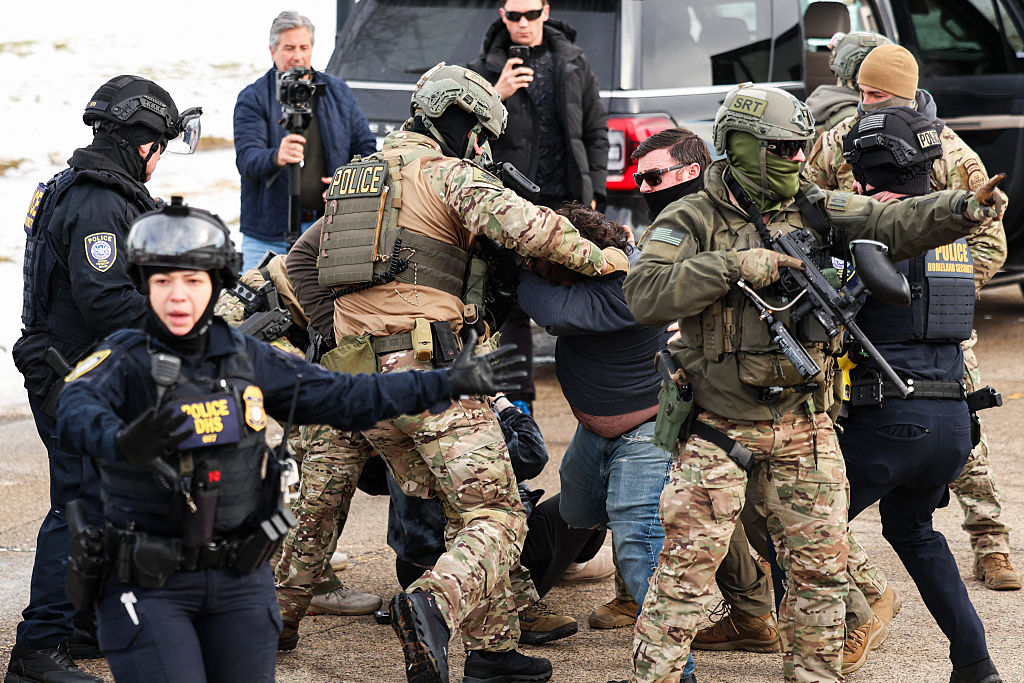
Some of the harshest criticisms of DHS agents’ tactics have come from former and current law enforcement officers. (Charly Triballeau / AFP via Getty Images)

In the wake of Immigration and Customs Enforcement (ICE) and other Department of Homeland Security (DHS) agents’ increasingly lawless and violent rampage through Minneapolis, those defending their abuses have claimed they are rooted in a respect for law enforcement. To second-guess ICE agent Jonathan Ross’s murder of Renee Good or the Border Patrol agents who murdered Alex Pretti, or to criticize federal agents’ behavior more generally, they argue, is tantamount to reviving the “defund the police” movement. And a fair and judicious review of the footage of Good’s killing specifically shows that Ross was perfectly justified in using deadly force.

All of this is pretty impossible to square with anyone who has used their own eyes to watch the videos of the killings of each. But it’s also hard to square with the fact that some of the harshest criticisms of not just Good’s and Pretti’s murders but DHS agents’ tactics over the past year more broadly have often come from former and current law enforcement officers, including former DHS personnel themselves.

Craig McQueen, a former assistant chief of police with the Miami Police Department, seemed astonished that Pretti would even be pepper sprayed for trying to help a woman who had been pushed over, let alone shot, calling him “basically a helpless man” at the time he was killed and declaring it “totally unjustified.”

In the wake of Pretti’s killing, numerous Trump officials and right-wing commentators have charged that merely the fact that he had a pistol on him at the time — for which Pretti had a concealed carry permit — made it justifiable for DHS agents to shoot him. Several actual former law enforcement officers disagreed.

A former Green Bay Police Department district captain called the shooting “unwarranted” and that you can’t shoot him just because it’s in his holster”; “otherwise, there’d be a lot of people [who] would get shot.”

Two former policemen, one of whom later worked as a training instructor, told the New York Times it was “disturbing” and questioned why Pretti was shot after the gun he was legally permitted to carry was taken. “It’s just utterly ridiculous to suggest that just because someone has a weapon on them, that that justifies the use of deadly force,” one of the officers told the paper.

Maybe this is to be expected. The killing of Pretti, prone, face down, surrounded by roughly half a dozen agents, was caught on film from so many angles and so clearly unjustified that hardly anyone can seriously defend it — which is probably why so many Republicans have, this time, not even tried to justify it, and the Trump administration has now done a public U-turn.

The administration’s aggressive and indiscriminate approach to deportations is a danger to US citizens. (Octavio Jones / AFP via Getty Images)

But voices from law enforcement were just as across-the-board critical of the Good murder, which many have insisted is filled with ambiguities and was even justified.

Shortly after she was killed, Minneapolis police chief Brian O’Hara was scathingly critical in a conversation with the New York Times’s Michael Barbaro about the decisions Ross made that led him to kill Good, whose murder he said “was predictable and preventable.”

“The No. 1 is you don’t place yourself in the path of the vehicle. That’s like Traffic Stop 101,” O’Hara said, before laying out the various things officers do to de-escalate and act professionally, like introducing themselves to a driver and explaining why they’re being stopped. “I didn’t see any of that,” he said.

O’Hara was also more broadly critical of DHS tactics in Minneapolis this year, complaining that local police were struggling to deal with constant 911 calls about ICE actions, including abandoned cars that agents at times left to roll uncontrollably down the road. ICE and other DHS agents, he said, had eroded any public trust his department had worked hard to win back after 2020.

It echoes the complaints shortly after from a group of Minnesota law enforcement leaders, led by Brooklyn Park police chief Mark Bruley, who alleged that their own off-duty officers were being racially profiled, treated aggressively, and even had guns drawn on them by federal agents. One local police chief called federal agents’ behavior “not just only wrong, but illegal.”

“It has to stop,” Burley said.

O’Hara was by no means alone in his assessment of Good’s killing. Going frame by frame through the original video, former ICE agent Eric Balliet — who spent twenty-five years in law enforcement and who investigated use-of-force misconduct for the agency until last year — likewise criticized Ross for getting in the way of the car and questioned whether he really had justification to shoot Good.

“The first thing you do is do not put yourself in the position where you are in danger. . . . If you have the choice not to be in front of a car that’s moving, don’t,” commented former US Capitol Police chief Tom Manger.

A retired St Paul police officer similarly called that decision “both tactically and legally unwise,” and said Ross’s actions made him wonder if ICE agents “possess even a rudimentary understanding of basic policing tactics or the legal principles governing them.”

ICE is advertising their own violent, illegal behavior as an intimidation tactic. (Kerem Yucel / AFP via Getty Images)

“It was really an unnecessary shooting,” a former Florida police officer told the Washington Post a few days after it happened, one of several former law enforcement officials who criticized Ross in statements to the paper for endangering himself, escalating the situation, and shooting into a moving vehicle. “If you’ve got time to shoot, you’ve got time to get out of the way, which we saw in this case. The guy was clearly able to avoid being impacted by the car.”

It’s not just former law enforcement but even current and former ICE and other DHS personnel who expressed disquiet about the shooting. The day of, an unnamed “senior” DHS official told NBC News that agents are trained not to do either of the things Ross did, namely, to get in front of a vehicle and to fire into it; a retired ICE agent likewise questioned Ross’s decision to put himself in danger. A day later, multiple current and former DHS officials questioned his conduct to CNN.

After days went by and the dust settled, one former ICE agent with twenty-five years of experience told Time that they were “embarrassed” and that “the majority of my colleagues feel the same way,” while a current ICE agent said that the video footage was “very problematic for” Ross’s claim of self-defense. Commenting on the incident, a former ICE chief of staff and Customs and Border Protection (CBP) counterterrorism official said that immigration enforcement had “drifted away from its core purpose” and had become “politicized, disconnected from local realities, and increasingly dangerous for everyone involved.”

“They murdered her, plain and simple. That is all there is to it,” the former deputy chief counsel for ICE’s Dallas field office told Mother Jones.

This frustration has now migrated beyond Minnesota. After ICE agents arrested a corrections officer in Maine who they falsely accused of being undocumented, the local county sheriff slammed the arrest as “bush-league policing” and accused ICE of having “moved the goal posts” and now treating anyone who’s not “a card-carrying US citizen” as if they’re “illegal.”

Before Minneapolis

Criticism of DHS agents from current and former law enforcement was already mounting before the murders in Minneapolis.

Back in October, Thomas Mills, the chief of police in the Chicago suburb of Broadview, bitterly criticized DHS’s tactics at the local ICE detention center in a sworn statement. Agents’ use of chemical weapons “has often been arbitrary and indiscriminate” and “unlike anything I have seen before,” he said, noting that agents’ appearance and behavior was counterproductive to what they were in theory trying to do. When agents in masks and camouflage tactical gear approached, Mills said, “the tone of the crowd of protesters changed” and “grew louder and began to press closer to the building,” calming down only once the agents retreated back into the building.

ICE agents knock on the door of a residence in Chicago. (Christopher Dilts / Bloomberg via Getty Images)

Commenting on a now-infamous September ICE raid on Chicago’s south side — in which federal agents indiscriminately kicked down doors, laid waste to the apartments inside, and dragged their occupants out and zip-tied them, children included — retired St Louis police lieutenant Ray Rice called it a “betrayal of constitutional norms.” The group Rice heads — the Ethical Society of Police, founded in 1972 by black police officers trying to push back against racism — put out a statement together with the National Association of Black Law Enforcement Officers that declared the raid “state violence.”

These weren’t the only law enforcement groups that had harsh words for DHS’s behavior. Only a few days before the raid, the International Association of Chiefs of Police warned that agents’ masks and refusal to identify themselves “can create confusion, fear, and mistrust.”

This was a common complaint from law enforcement officials. “I do have a problem with any current police officer who thinks dressing up like SEAL Team Six and putting a mask on to deal with the public is the right way to do police work. They should not be doing that. It’s intimidating,” former King County sheriff John Urquhart told a Seattle radio show at this same time, complaining that it was making the police’s job harder and eroding their trust with immigrant communities.

“This is all about intimidation” was the similar conclusion of the former second-highest-ranking official at the Drug Enforcement Administration. A former assistant director of the US Bureau of Alcohol, Tobacco, Firearms and Explosives likewise opined that he had “never known law enforcement . . . to wear masks.”

“My perception is that they know they are operating on the fringe of the law and ashamed of their actions,” commented a former military police officer who likewise questioned agents’ use of masks, calling their “questionable apprehensions/detentions” the actions of “cowards and bullies.”

“We don’t need, nor do we want secret police here,” wrote a retired three-decade-long former law enforcement officer, charging that the only officers who would cover their faces “are either mercenaries, cowards, those who simply look to intimidate the public, those that are perhaps ashamed of how the job is being done, and those who might consider abusing their authority.” Diane Goldstein, a retired lieutenant who spent twenty-one years on the force, described ICE’s behavior as “lawlessness” and an “authoritarian spectacle” and said their arrests “more closely resemble kidnappings.”

Former DHS personnel were just as scathing about their agencies’ operations before Good’s murder. Included in US District Court judge Sara Ellis’s November 2025 ruling barring agents’ use of force against protesters was expert testimony from Gil Kerlikowske, a forty-seven-year-long law enforcement veteran who was once both the Seattle chief of police and the commissioner of CBP. Kerlikowske concluded, similar to Mills, that agents were “deploying force that exceeds a legitimate law enforcement purpose,” often violating their own guidelines in the process, and that this was “highly ineffective and often counterproductive in calming unrest.”

A confrontation between protesters and federal law enforcement agents in Los Angeles.. (Taurat Hossain / Anadolu via Getty Images)

Balliet, the former ICE use-of-force investigator who reviewed the Good shooting for CBS, had been critical of ICE’s tactics before that murder. Last year, looking at the flood of videos of DHS agents mistreating protesters, he told the news outlet that “this isn’t policing and law enforcement as I practiced it for twenty-five years” and that “they are elevating the force to a degree that is excessive,” with “oversight and justification for the use of force” seemingly “absent across the board.” Commenting on a video late last year of an ICE agent manhandling a woman, Balliet said that in all the years he had “arrested dozens upon dozens of human traffickers, human smugglers, child molesters” through his career, he had “never dragged a suspect one-handed across a street.”

After an agent who was filmed violently assaulting the wife of a detainee was quickly returned to  the job with no punishment, a former ICE chief of staff under Joe Biden called it part of a “larger systemic issue of how law enforcement is being hyper-politicized.” Barack Obama’s ICE director charged that “the ultimate objective [of the operations] is not legitimate law enforcement, it is to scare people to death,” and that “it has never been done in this way before.” A former ICE deportation officer has said that during her time there, agents didn’t wear masks or pick people up at random, and always carried credentials and identified themselves, but that now it seems “the gloves are off and they’re doing what they want.”

No Longer Just the Left

Arguably the most striking thing about these statements is that many of them are exactly the same as the kinds of things that critics dismissed as left-wing radicals and activists often say about these operations: that agents are “cowards and bullies,” that they are behaving as a “secret police” and aiming to intimidate, that it is “state violence,” “illegal,” and involves blatant, outrageous racial profiling, and that the shootings of both Good and Pretti were completely avoidable, the result of the agents’ own recklessness, and simply straight-up murder.

The fact that the rhetoric longtime law enforcement officials are using to describe what DHS is doing sounds indistinguishable from the Left should tell us something. The unacceptable and increasingly violent and lawless behavior from ICE and other DHS officers isn’t simply a left-wing concern — it’s a concern and an outrage that is now basic common sense to anyone with a set of eyes and a semblance of humanity.