How Gig Capitalism Came to Thrive in Nordic Labor Markets
Platform companies haven’t overthrown Nordic labor institutions. But they have navigated around them, growing by exploiting the Nordic model’s uneven and conditional protections.
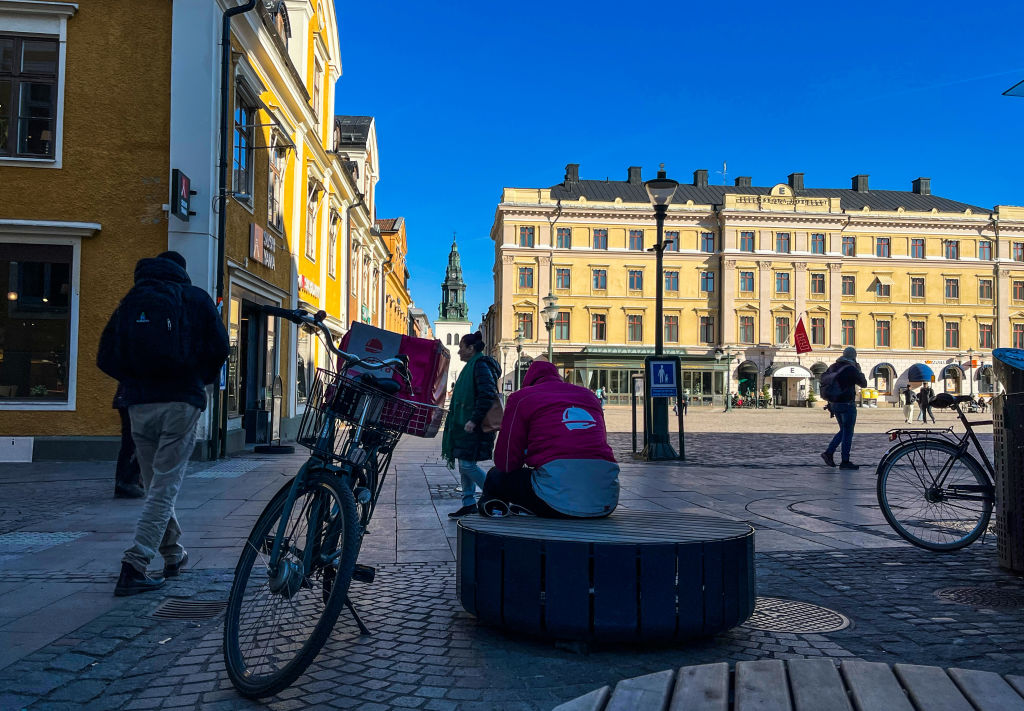
A Foodora food delivery rider is sitting on a bench in Stora Torget, Linkoping, on March 8, 2024. (Pradeep Dambarage / NurPhoto via Getty Images)
For decades, the Nordic countries have occupied a special place in the global political imagination. Denmark, Finland, Norway, and Sweden are routinely held up as proof that capitalism can be tamed: high wages, strong unions, and universal welfare states. In this story, the Nordic model appears to be a place where the gig economy would struggle to gain a foothold. Yet Uber, Wolt, Foodora, Bolt, and similar platform companies have not only entered the Nordic countries — they have reshaped entire industries.
This is the Nordic paradox. In societies with well-established regulations and robust unions, certain forms of precarious labor have nonetheless flourished. The explanation is not that the Nordic model has simply collapsed. Rather, gig companies have succeeded because the model has always been uneven, selective, and politically contingent. Gig capitalism did not attack the system head-on but grew in its blind spots, industries where unions have long been weak and working conditions precarious. Understanding how this happened tells us something important not only about the Nordics, but about the limits of social democracy under platform capitalism.
Reclassifying Employment
The Nordic labor market model differs fundamentally from Anglo-American systems. Minimum wages and working conditions are not primarily set by law but by collective bargaining between strong unions and employers’ organizations. The state plays a secondary role, intervening mainly to support collective bargaining and provide universal welfare.
This system has historically produced stable employment, low inequality, and high levels of worker power. However, the Nordic model has never covered all workers equally. It relies on high union density and sector-wide collective agreements. Where unions are weak or fragmented, protections risk thinning out. Long before the arrival of apps, certain sectors — transport, logistics, food delivery, and private cleaning — already stood on the fringes of the Nordic model. Hence, gig companies did not invent these margins. They exploited them.
The central mechanism enabling gig platforms’ success in the Nordics is deceptively simple: classifying workers as self-employed contractors. In Nordic labor regulation, employment status is central. Employees have the right to unionize, bargain collectively, and they benefit from extensive labor protections. Independent contractors generally do not. By insisting that drivers and couriers are “partners,” “contractors,” or “entrepreneurs” — despite the platforms functioning as employers and exerting significant control over working conditions and pay through their algorithms — platforms bypass the core regulatory institutions of the Nordic labor market.
Crucially, Nordic labor regulation does not automatically prevent such misclassification. Employment status is typically determined case by case, often through lengthy court proceedings. This created a window of opportunity: platforms could expand rapidly while legal, political, and union responses lagged behind. In effect, platform companies were able to operate inside Nordic economies while remaining outside Nordic labor institutions.
Leveraging the Gray Zone
The taxi industry illustrates how gig companies combined legal evasion with political pressure. When Uber entered the Nordic countries in 2013–14, it encountered very different regulatory regimes. In the early 1990s, Sweden deregulated its taxi market, removing caps on licenses and adopting a free price-setting model. This opened the sector to competition, making Sweden fertile ground for Uber’s expansion, even though early attempts to bypass licensing rules led to drivers being prosecuted. Denmark, Finland, and Norway still maintained regulated taxi markets, with means-tested licenses, requirements to use certified meters, and obligations to belong to dispatch centers. Uber did not comply with these regulations, launching services with unlicensed drivers. This was a deliberate political strategy.
By operating in legal gray zones, platforms forced governments to choose between enforcement and accommodation. In Finland and Norway, center-right governments chose accommodation. Taxi markets were deregulated, license caps removed, and platform-based business models legalized in the name of competition and innovation. Denmark chose a different avenue. While it partially deregulated, it retained key requirements — including dispatch-center affiliation and taximeters — that prompted Uber to exit the Danish market in 2017. It reemerged in 2025 in a different form, partnering with a Danish taxi company rather than using its own drivers. The lesson is straightforward: where regulation held, the platform retreated but adapted; where it was dismantled, the platform entrenched the gig model.
Unlike taxis, food delivery in the Nordic countries was largely unregulated. Platforms could enter freely, set prices, and organize work as they saw fit. As a result, companies like Foodora, Wolt, and Uber Eats faced virtually no barriers to establishing their preferred employment models.
Public debate focused instead on working conditions: low and unpredictable pay, traffic hazards, and algorithmic control. Labor inspectorates and tax authorities argued that platforms functioned as employers in practice. But legal clarification has been slow and uneven. At the same time, some platforms selectively adapted to Nordic institutions. Foodora employed couriers in Norway and Sweden and signed collective agreements, earning praise as evidence that the Nordic model works.
Yet this adaptation was always partial and strategic. Alongside employed couriers, platforms increasingly relied on freelancers, subcontractors, and third-party arrangements — workers excluded from collective agreements. The result was an internally segmented workforce: a minority with protections, a majority without. Adaptation, in other words, coexisted with evasion.
Gig Capitalism’s Nordic Success
A common argument is that gig work struggles where workers have access to good jobs. The Nordic experience complicates this view. Gig platforms in the Nordics rely heavily on migrant labor — often workers facing discrimination, language barriers, or the nonrecognition of qualifications. For many, platform work is not a flexible side hustle but one of the few viable ways to earn an income.
This exposes a central contradiction of Nordic capitalism. While welfare states raise reservation wages for many workers, access to secure employment remains stratified. Platform companies have built their business models on those excluded from the system’s core benefits. In this sense, gig work did not emerge despite the Nordic model but alongside it.
For much of the 2010s, Nordic governments adopted a wait-and-see approach to platform work. Gig companies were framed as technological innovations rather than labor market actors. When regulation came, it often focused on markets rather than labor relations. Only recently have governments begun to address misclassification, proposing legal changes to strengthen the definition of employment. These efforts remain incomplete, contested, and slow — while platforms are already deeply embedded.
Gig capitalism’s Nordic success was not inevitable. It was enabled by concrete policy choices: deregulating taxi markets, tolerating legal ambiguity, and prioritizing competition over worker protection. The rise of gig work in the Nordic countries is not an anomaly. It reveals that the Nordic labor market model, often treated as universal, is in fact segmented and conditional. Strong protections exist where unions are powerful and collective agreements cover entire sectors. Where they do not, platform capitalism finds ample room to grow.
Gig companies did not overthrow the Nordic model but navigated around it — classifying workers out of existence, recruiting from marginalized segments of the labor force, and leveraging political willingness to reshape markets in their favor. The question, then, is not whether the Nordic countries can regulate gig work. They clearly can. The real question is political: whom the Nordic model is designed to protect — and whom it is willing to leave behind.