US Labor Unions Can Take a Page From Sweden’s Meidner Plan
In the US, union pension funds collectively manage roughly $8 trillion in worker savings. Sweden’s Meidner Plan suggests how labor can wield that economic power effectively: by using pension funds to establish worker ownership over private companies.
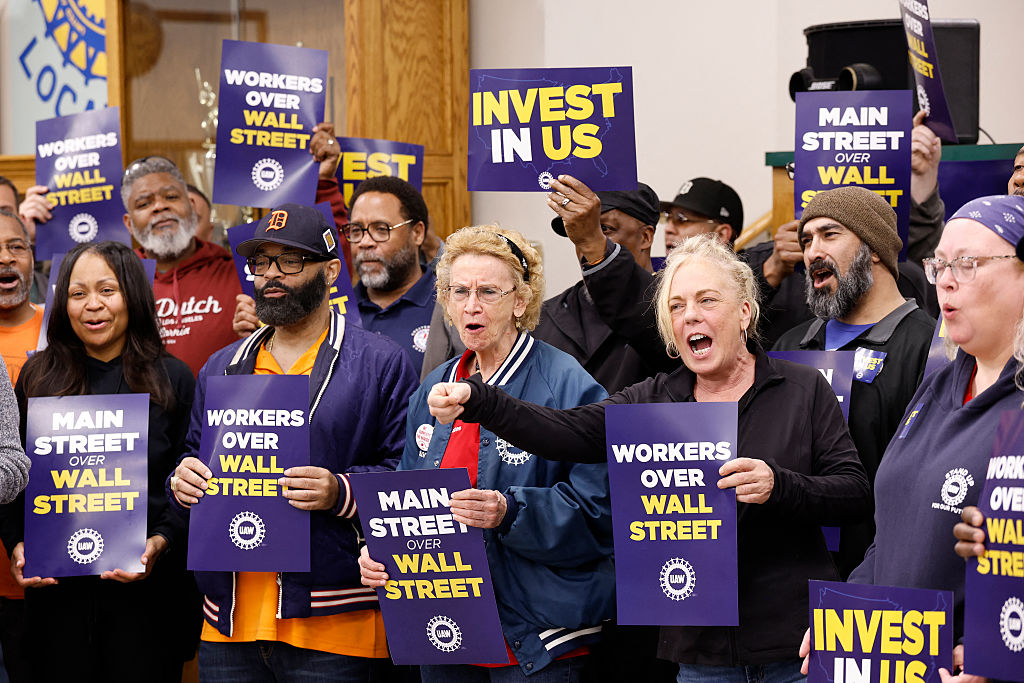
Private sector and public sector union members’ pension funds collectively manage roughly $8 trillion in worker savings. That’s nearly 15 percent of Wall Street. (Jeff Kowalsky / AFP via Getty Images)
It may come as a surprise that a substantial portion of America’s economy is worker- and union-owned — technically. Private sector and public sector union members’ pension funds collectively manage roughly $8 trillion in worker savings. That’s nearly 15 percent of Wall Street. But those funds — comprising the monthly contributions of millions of workers and enabled (in part) by union organizing and collective bargaining — are often invested in (and by) firms that harm workers.
The labor movement has long tried to harness the economic power tied up in its vast stores of capital: labor’s “last best weapon.” Proposals abound: divesting from nonunion companies, intensifying pro-labor shareholder activism, and acquiring bigger stakes in union-driven or worker-friendly asset managers (like the AFL-CIO Housing Investment Trust) that finance union-labor projects. But none have been attempted at the scale needed to reap their promised rewards. And all push up against the narrow definition of “fiduciary” that prevents pension fund trustees from considering much more than their fund’s rate of return.
Still, none of that should stop the labor movement from being ambitious and imaginative. It’s time to dust off an often-overlooked chapter of not-too-distant labor history, “one of the most promising roads not taken.” That’s the Meidner Plan, a proposal to put Sweden on a path to achieving real workplace democracy through collective worker control over the country’s largest corporations. The plan has a simple lesson for those interested in mobilizing labor’s capital: ownership matters.
The Meidner Plan Then
Rudolf Meidner was born in the German Empire in 1914. A Jewish leftist, he fled Nazi Germany in 1933, landing in Sweden, where he completed a PhD in economics. In collaboration with Swedish economist Gösta Rehn, Meidner was a chief architect of Sweden’s postwar economic model: the solidaristic wage policy. Their goal was to build Sweden’s economy around four ostensibly incompatible objectives: full employment, low inflation, high growth, and income equality.
The key pillar of the solidaristic wage policy was wage compression. “Equal work should be equally paid, regardless of the profitability of the firm, the size or location of the workplace,” Meidner maintained. Wages were set through centralized bargaining. By taking wages out of competition across Sweden’s industries, the model was innovation-forcing: no longer were low wages a viable path to profitability for the country’s least productive firms. Thus, wage compression not only reduced income inequality but also reoriented Sweden’s economy toward productive, knowledge-intensive sectors.
But there was, in Meidner’s words, a “dilemma.” Wage compression meant Sweden’s most productive firms received a wage discount — they paid employees less than they would have if wages were set by market forces. That resulted in enormous profits. An influential 1960s study found just fifteen Swedish families had a controlling stake in nearly all of the country’s fifty largest companies. Sweden’s uniquely strong labor movement, robust welfare state, and interventionist government had tamed income inequality by exacerbating wealth inequality. As Meidner put it: “Solidarity in the politics of wages had led to a lack of solidarity in the politics of profits.”
But Meidner had a plan. Formulated in the early 1970s, the Meidner Plan had three ambitions: to equalize wealth, shore up the solidaristic wage policy, and enhance employees’ control over their workplaces.
The plan was relatively simple. Sweden would establish so-called wage-earner funds in each major industry, run by workers through their unions. Each year, the government would require large companies to distribute a portion of their profits to the wage-earner funds. The funds wouldn’t receive cash; rather, companies would give them voting shares — that is, an ownership stake.
Initially, local worker representatives would exercise voting rights vis-à-vis their own employers. Once wage-earner funds acquired a sufficient share of a company’s equity capital, voting rights would be transferred to boards appointed by Sweden’s national unions. Meidner estimated that if companies were required to discharge 20 percent of gross profits as shares to wage earner funds each year, the entire Swedish economy would be majority worker-owned within just a few decades. Because funds’ ownership stakes would grow with firms’ profits, the more profitable a firm, the more quickly it would become worker-owned. At Volvo, for instance, it was projected that employees would attain working control in just five years and reach majority ownership within twenty.
The Meidner Plan was received enthusiastically by the Swedish union confederation, the Landsorganisationen (“LO”), which adopted it unanimously in 1976 (and upon doing so burst into a spontaneous rendition of “The Internationale”). Though intense employer resistance and political headwinds stymied the proposal, a watered-down version of the Meidner Plan was enacted in 1984 and lasted until a Conservative government came to power in 1992. Even in that short time, “the scaled-down wage earner funds had accumulated 7% of the Swedish stock market.”
The Meidner Plan Now
The Meidner Plan may sound radical — and its broader economic and political effects certainly would be — but at base, it’s a combination of two institutions that are entirely unexceptional in the United States: profit-sharing and collective funds. Meidner himself called the United States the “Promised Land of profit-sharing schemes,” noting in 1993 that 300,000 American firms and nine million American workers participated in some form of savings plan, stock bonus plan, or employee stock ownership plan (ESOP). Today fourteen million workers are covered by ESOPs, and roughly one in eight employees owns stock in their employer. The wage-earner model is like a collective stock ownership plan, albeit at an economy-wide scale and required by law.
A Meidner Plan in the United States remains very far off (although there’s evidence worker ownership is popular among Americans). But Meidner’s core thesis is more relevant than ever: “All experience shows that influence and control is not enough. Ownership plays a decisive role.”
That brings us back to pensions. That ownership ought to be labor’s key strategic objective isn’t an intuitive proposition. After all, “unions would have to invest in, rather than shun, the stocks of major nonunion firms.” Ownership cuts against an ascendant strain of progressive thought: that divestment is the most powerful financial strategy for social progress. It may be true that pension funds (and other institutional investors) ought to pull out of companies (and countries) engaged in morally reprehensible or environmentally deleterious practices. But at least in the labor context, divestment “reduce[s], not enhance[s], the impact of unions on management.”
An alternative approach, shareholder activism, seeks to leverage labor’s existing stake. It’s worked before. In 1954, amid a proxy fight embroiling Montgomery Ward, the Teamsters leveraged their voting shares to convince management to agree to collective bargaining. Unions used pension funds to pressure the bankers, insurance companies, and debtholders of the J. P. Stevens Company to force the company to end its vicious anti-union campaign. But the potency of labor shareholder activism is inherently constrained, as is all shareholder activism, by labor’s lack of ownership; company boards have sophisticated defense mechanisms to mitigate minority shareholders’ power.
Concertedly pursuing worker ownership, Meidner tells us, is the path to ameliorating wealth inequality. If pension funds, directed democratically by worker-beneficiaries, could invest with Meidner’s ambition as a touchstone — gradual attainment of worker control over individual firms — labor’s last best weapon might realize its promise.