Wall Street–Backed Lawmakers Want to Help Banks Gouge You
State lawmakers across the US have moved to shield residents from sky-high interest rates charged by out-of-state banks. Two GOP congressmen, both heavily financed by Wall Street, are pushing federal legislation to override those state protections.
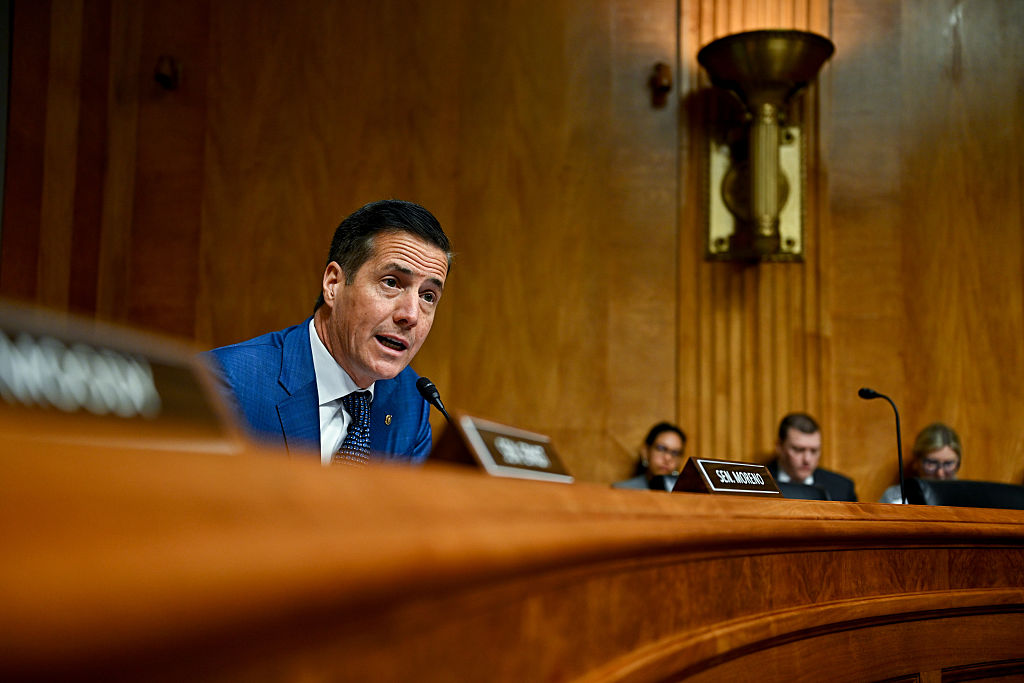
Two Republican members of Congress who have received nearly $5 million in financial sector donations, including Sen. Bernie Moreno (pictured), are pushing federal legislation that would override state caps on interest rates. (Graeme Sloan / Bloomberg via Getty Images)
State lawmakers across the country have moved to shield residents from sky-high interest rates charged by out-of-state banks — in some cases as high as 199 percent on credit cards and loans. Now two Republican members of Congress who have received nearly $5 million in financial sector donations are pushing federal legislation that would override those state protections, allowing lenders to charge potentially exorbitant rates for their services.
The bill, introduced by Sen. Bernie Moreno (R-OH) and Rep. Warren Davidson (R-OH) on Feb. 12, would effectively codify a controversial lending loophole dubbed the “rent-a-bank” scheme. Under that model, lenders partner with banks headquartered in states with weak or nonexistent interest rate limits, allowing them to claim those states’ laws apply even when operating and issuing loans in states with more stringent consumer protections.
Many banks are based in states such as Delaware and South Dakota, which impose no caps on interest rates. Some other states, meanwhile, only prohibit “unconscionable” rates — a vague legal standard that generally bars charges “so one-sided that it shocks the conscience.”
The Republicans’ legislation comes amid rising credit card interest rates, with credit card debt becoming one of the nation’s top household expenses, costing consumers roughly $120 billion each year in interest rates and fees.
Millions in Donations
Since first taking office in 2016, Davidson has received more than $1.6 million from the finance, insurance, and real estate industries that are heavily reliant on interest rates, according to campaign finance watchdog OpenSecrets.
Throughout 2025, during the lead-up to the bill’s introduction, Davidson also accepted campaign donations from political action committees (PACs) representing industries that likely stand to benefit from the bill. These contributions included:
- $6,000 from a PAC representing credit unions,
- $5,000 from a PAC affiliated with Wells Fargo,
- $2,500 from Goldman Sachs’ PAC,
- $2,500 from the American Bankers Association’s PAC,
- $2,500 from Bank of America’s PAC,
- $2,000 from Citigroup’s PAC,
- $1,000 from Visa’s PAC.
Meanwhile, Moreno, first elected to the Senate in 2024, has received more than $3.2 million in campaign donations from the same industries. In 2025, he has also accepted campaign donations from several financial industry PACs, including:
- $5,000 from Visa’s PAC,
- $3,300 from an Ohio-based credit union’s PAC,
- $3,000 from Goldman Sachs’ PAC,
- $2,500 from the American Bankers Association’s PAC.
The proposed legislation arrives as states have increasingly moved to curb high-cost lending by targeting rent-a-bank arrangements. In 2023, Colorado enacted a law limiting the interest rates out-of-state lenders can charge on certain short-term loans under $1,000.
Three industry groups representing banks and financial services firms sued to block the measure, arguing federal banking rules should override state interest rate caps. But in 2025, the US Court of Appeals for the Tenth Circuit upheld Colorado’s law, affirming states’ authority to enforce their own rate limits against nonbank lenders.
Supporters of the new federal bill have explicitly framed it as a response to that ruling, saying the measure would restore “uniform national [lending] standards.”
The National Association of Industrial Bankers, the American Financial Services Association, and the American Fintech Council — three lobbying groups that sued to block Colorado’s interest rate cap law — issued statements praising the bill alongside its sponsors in a press release from Moreno’s office.
The American Financial Services Association donated $5,000 to Moreno in December 2024, and a broader coalition of lobbying groups — some of which donated to Davidson and Moreno — sent the lawmakers a letter supporting the bill and praising their efforts
“Thank you for your leadership in introducing the American Lending Fairness Act of 2026, which addresses these harms, restores competitive parity, and protects consumers’ access to responsible credit,” the groups wrote.
Analysts say the legislation would significantly limit states’ ability to enforce their own interest rate caps, potentially opening the door to a new wave of high-interest loans that officials have struggled to curb.