How Argentina Banned Its Opposition

Cristina Fernández de Kirchner has been imprisoned and barred from public office for life. As Argentina heads toward its 2027 elections, her case shows what democratic erosion looks like when it comes in judicial robes.
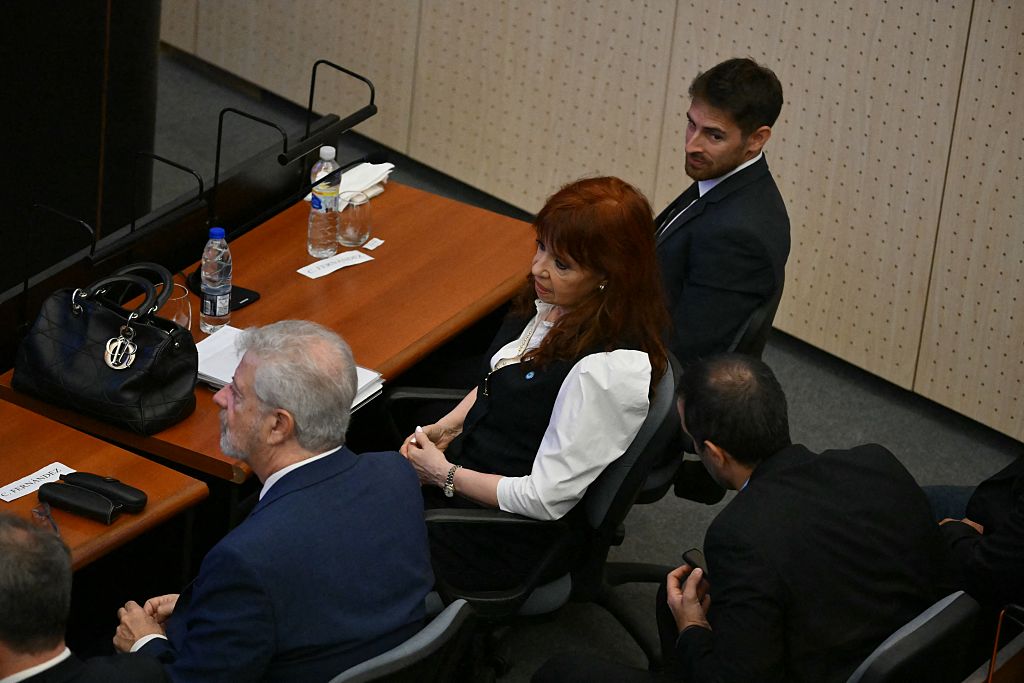
Former Argentine President Cristina Fernández de Kirchner sits next to her lawyer at the Comodoro Py courthouse in Buenos Aires on March 17, 2026.

Former Argentine President Cristina Fernández de Kirchner sits next to her lawyer at the Comodoro Py courthouse in Buenos Aires, Argentina, on March 17, 2026. (Luis Robayo / AFP via Getty Images)


Imagine the person you had already decided to vote for in the next election — the leader your side trusts most, the one whose name you would put on a ballot without a second thought. Not a fringe figure. Not someone caught enriching himself or credibly accused of ordering a killing on a street corner. Imagine waking to the news that they will not be on that ballot at all, because a court has decided that the ordinary business of governing — a contract signed, a subsidy approved, a program launched, a budget enacted — was in fact a crime and has sent them to prison for it and barred them from public life for good.

Hold that person in your mind, whoever they are. For half the country it is a Democrat; for the other half a Republican. That is precisely the point. Every leader who has actually governed leaves behind a record of contestable decisions — the substance of governing is nothing but contestable decisions — and any of them can later be reread by a motivated prosecutor and an obliging court, not as policy but as felony. The machinery does not care who you voted for. It needs only a target and a tribunal.

Most citizens, whatever their politics, would know at once what they were looking at. Not the rule of law but its inversion: the courts turned into the instrument for removing the opponent the ballot box would not. They would understand that a republic in which the state can jail and disqualify the front-runner by criminalizing the acts of government has stopped being a democracy in any sense that matters — and that the elections held afterward, however clean the count, are hollow at the core.

For Argentines, none of this requires imagination. It is simply the news.

Banished From Office for Life

That politician is Cristina Fernández de Kirchner. Twice elected president and later elected vice president, she has never lost a national election. Today she is the head of the Partido Justicialista and remains the most formidable figure Argentine politics has produced this century. Her political stature has been likened to Eva Perón’s.

Since June 2025, however, Kirchner has been a prisoner. Because she is over seventy, she serves her sentence under house arrest in an apartment on 1111 San José street in Buenos Aires. An electronic ankle bracelet tracks her movements. Her visitors are restricted by court order. Even her access to her own rooftop has become a matter for federal litigation. This month, an appeals court again refused to loosen those conditions. Her sentence — six years in prison and permanent disqualification from public office — is final. She will not appear on the ballot in 2027. She will not appear on any ballot again.

The case that produced this, known as Vialidad, concerned the administration of public roadworks contracts in the southern province of Santa Cruz. It is worth being specific about what the conviction rests on, because the details comprise the argument. The expert report propping up the fraud allegation examined only five of fifty-one road projects. The tribunal itself conceded it had no direct proof of criminal conduct and had built its case on inference.

The Supreme Court that made the conviction has been whittled down to three judges. Even Raúl Zaffaroni, a former Supreme Court justice and hardly a fringe voice, has observed that no serious country entrusts its highest court to a panel of three. Several of the judges who handled the case at various stages maintain well-documented social ties with Mauricio Macri, the conservative president under whom the prosecution took shape. Kirchner was the perfect enemy for Macri and the Argentinian right: a woman, a Peronist, and a champion of wealth distribution.

From Tanks to Courts

It is worth remembering too that the courtroom was not the first venue tried. In September 2022, as the prosecution reached its climax, a man pushed through the crowd outside Kirchner’s home, raised a pistol to her face, and pulled the trigger twice. The gun did not fire.

Years on, the question of who, if anyone, directed him remains unanswered. One of the country’s largest newspapers captured the sequence in a much-discussed headline of the period: the bullet that did not go off, and the judgment that would. The bullet failed. The judgment did not.

Argentines have a word for what is being done to Kirchner, and it is not one they coined for the occasion: “proscripción” — proscription. After the 1955 coup that overthrew Juan Domingo Perón, Peronism — the movement of the country’s organized working class, and for most of that period its electoral majority — was banned outright from national elections for eighteen years. Its leader lived in exile; its candidates were struck from ballots; its very name was, for a time, illegal to print.

The generals and their civilian allies understood something their descendants understand still: when a movement rooted among workers and the poor keeps winning, the simplest way to govern against the majority is to prevent the majority from choosing. What has changed since 1955 is only the instrument. Where they once relied on tanks and decrees, they now use indictments and three-judge courts.

Argentine Lawfare

This is what the shorthand “lawfare” names — not a conspiracy theory but a recognizable, recurrent pattern with its own grammar, one that has run through the region this century. Fernando Lugo removed in Paraguay by a two-day impeachment. Dilma Rousseff removed in Brazil over budgetary accounting. Luiz Inácio Lula da Silva jailed and barred from office before ultimately being vindicated. Rafael Correa convicted in Ecuador and driven into exile. Evo Morales disqualified in Bolivia. The details differ; the choreography does not: a compliant judiciary, a concentrated media that reaches its verdict before the courts do, a foreign policy establishment that blesses the result, and always — always — a target who governed for the wrong people.

Argentines will go to the polls in 2027 in a country where the leader of the largest opposition party sits under guard in her apartment, barred from the ballot. The votes will almost certainly be counted honestly. That is exactly what makes the situation so instructive and so grim: you can hollow out a democracy without ever touching the count simply by deciding in advance who is allowed to run.

So, return to the thought experiment, because it is not really a hypothetical — it is a translation of what is already happening. If you would recognize the jailing and disqualification of the candidate you meant to vote for as a democratic crisis, then you already understand what is happening in Buenos Aires.