The Class Politics of Austerity

A new book by economist Clara Mattei explains why calls for governments to balance budgets and live within their means are often a thinly veiled justification for an assault on the poor.
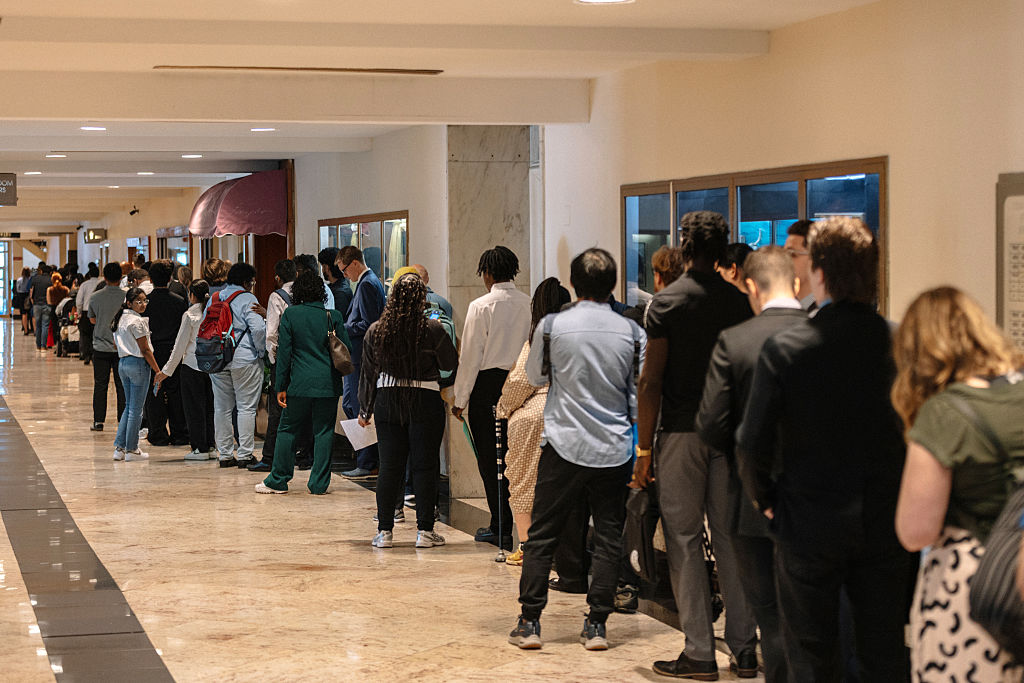
Job seekers wait in line to enter a career fair in Chicago, Illinois, on August 7, 2025. Recurring applications for unemployment benefits surged to the highest since November 2021, adding to recent signs of a weakening labor market. (Jim Vondruska / Bloomberg via Getty Images)

In 2021, the United States was confronted with a challenge that it hadn’t seen in decades: inflation. Working-class Americans were assaulted by rising costs of living, likely leading to Donald Trump’s second term in the White House. But even as American workers were struggling to afford basic necessities, blame for inflation was pinned on them.

Harvard economist and close friend of Jeffrey Epstein, Larry Summers, blamed the bout of inflation on government stimulus checks. A rare instance of the American government providing non-means-tested universal financial support and “excessive” consumer spending were decried by the mainstream as the fundamental cause of rising prices. The solution proposed by the Federal Reserve was to raise interest rates to clamp down on wages and undermine a low-unemployment labor market favorable to workers.

The economist Isabella Weber was one of the few who challenged this narrative, identifying corporations that actually set prices as the real culprits behind inflation. But she was ridiculed by mainstream economists until evidence of her position became so overwhelming that it had to be acknowledged.

In Escape from Capitalism: An Intervention, Clara Mattei dispels the anti-worker ideology that permeated mainstream economists’ analysis of Joe Biden–era inflation. Rather than treating macroeconomic challenges as technical problems with technical fixes, Mattei shows that economics under capitalism is fundamentally political in nature. While central bank technocrats present raising interest rates as a technical solution to inflation, the real effect is to raise unemployment and increase employers’ bargaining power over workers. The power of unelected technocrats to strengthen capitalist power reveals the class character and antidemocratic foundations of the capitalist economy.

The Anti-Worker Politics of Austerity

Mattei extends her criticism of monetary policy to the fiscal realm as well. Neoliberalism often insists on the need for austerity, i.e., policy measures that reduce government spending. Budget deficits are seen as a moral failing where spending on social benefits for so-called welfare queens becomes excessive. The solution economists pose is to slash social benefits for health care, housing, and education to balance budgets. But austerity even fails on its own terms of ensuring budgetary responsibility and macroeconomic stability. Austerity measures have consistently failed to either reduce debt or increase growth.

So why do economists continue to insist on austerity? A thoroughly political drive to suppress worker power underlies the policy proposals of technocrats.

When the state cuts social spending, it increases worker dependence on their employers. Instead of receiving health care, childcare, and social security from the state, workers are forced to access all of these on the market by paying for them through their wages. Capitalists exercise enormous leverage over workers through their ability to cut access to basic needs at any moment. Being fired means not being able to pay for food, rent, and medication. Without unemployment insurance, fired workers are immediately thrust into financial insecurity as they’re unable to pay for mounting bills. Thus, austerity tremendously increases employers’ political power. Workers become far more hesitant to organize unions to fight for better wages and working conditions because opposing bosses becomes a risky life-or-death endeavor.

Even as neoliberals espouse the need to cut social spending, they take no notice of increased spending on bloated military budgets, anti-immigrant witch hunts, and support for private businesses. As Mattei succinctly puts it: “Austerity is not about spending less but about spending in favor of the economic and financial elite and to the detriment of the majority of the population.” While governments continue to financially support oligarchs, they refuse to tax the wealthiest.

As Trump’s One Big Beautiful Bill recently demonstrated, social welfare cuts directly fund tax breaks for the rich instead of reducing national debt. Behind pro-austerity economists’ claim that collectively shared pain is necessary for a better economy, the reality is that austerity is one of capitalists’ weapons in their class war against workers.

Democracy Against Capitalism

While liberal democracy and capitalism are often seen as inherently complementary, Mattei shows that they are fundamentally at odds. Universal suffrage in electoral democracy is often posed as the undeniable proof that citizens have control over their governments. If political leaders deviate from the will of the masses, people can supposedly simply elect a new government that represents their interests. In this view, fighting against capital’s dominance is as simple as electing an anti-capitalist government.

But, as Mattei argues, any party or government in power is ultimately constrained by the “economic necessities” of capitalism. Political leaders who want to prioritize increasing wages or expanding social welfare require a growing economy. Under capitalism, this means that private capitalists who control economic resources need to invest to create jobs and the tax base for social policies. And in order to be willing to invest, capitalists must believe they can achieve a “reasonable” profit rate.

Thus, even the most pro-worker government has to ensure profitable economic conditions for capitalists. If they ignore this imperative, capitalists do not invest, workers are laid off, and the economy sputters out. In this scenario, they’d be swiftly voted out of office and replaced. Governments of all political persuasions are structurally required to represent the general interests of the capitalist class. Although they do not necessarily take direct orders from individual capitalists, state managers must defend capital’s interest in profitability to keep their economies humming along.

Because profitability is seen as the foundation for “good governance” under capitalism, economists have consistently taken antidemocratic positions. To prevent greater democratic control of the economy, economists have always tried to keep economic policy decisions out of the public’s hands. Mattei cites a number of illuminating examples. In the 1920s, Italian economists supported Mussolini’s dictatorship with the claim that the people didn’t know what was in their interest.

Academic economics publications argue that democracies are less economically efficient because they are more resistant to austerity. The most egregious example is the enormous power of unelected central bank officials. Central banks ostensibly need to be unelected so they can stay “above” politics, but the truth is that they are deeply entrenched in pro-capitalist policies. Their antidemocratic nature helps them further this endeavor.

Escape from Capitalism is excellent at explaining capitalism’s injustices, but offers far less int he way of concrete solutions. Despite the book’s title, Mattei does not tell us much about how to escape capitalism. Mattei’s discussion of anti-capitalist politics is mostly isolated to the last few pages of the book, with citations to collectivist movements in Brazil, Mexico, and Kenya. Although admirable, it’s entirely implausible that any of these movements could pose a systemic challenge to global capitalism.

Nonetheless, Mattei can hardly be faulted for not finding the solution to global capitalism in a 160-page book. With Escape from Capitalism, Mattei has done a great service to the Left by providing an accessible introduction to anti-capitalist and socialist ideas. She dispels the myth that capitalism and the economy are immutable features of social life whose dictates we must passively accept. As Mattei implores us to understand, “the economy is us.” And if we are the economy, then we ultimately have the power to transform it.