How Economists Depoliticized the Economy
Economist Clara Mattei explains how her profession has provided elites with a justification for austerity and exploitation.
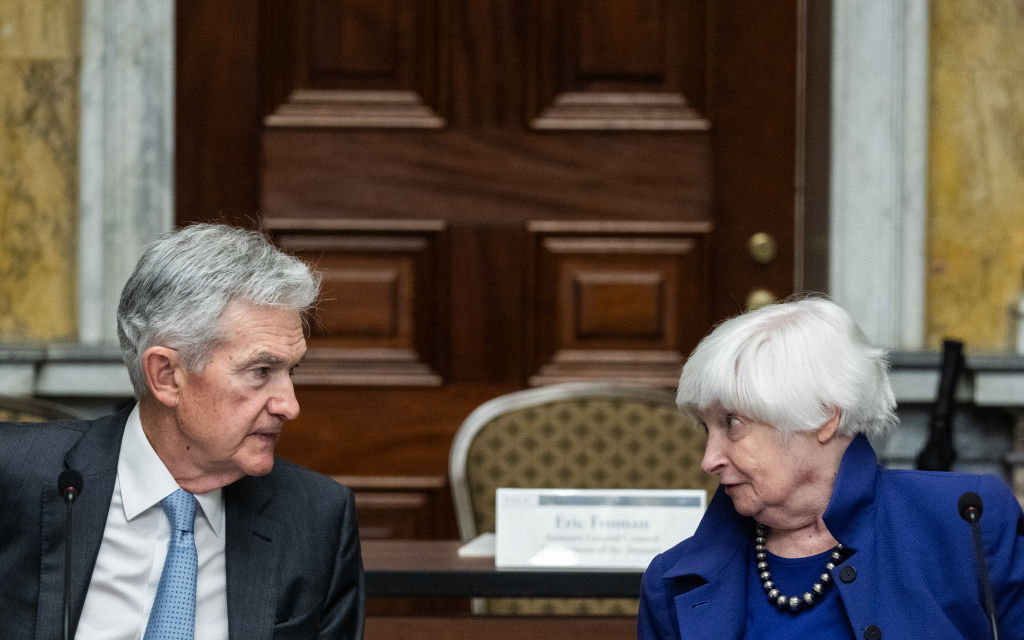
Since its inception, the economics profession has provided elites with a justification for austerity. But this is very often a thinly veiled defense of the interests of the rich. (Andrew Caballero-Reynolds / AFP via Getty Images)
It’s the autumn of 1920, and we are in Brussels. Politicians and economists from across Europe sit at worktables, gathered for the first international economic conference in history. Despite the formal tones and elegant attire, the tension in the air is palpable. Their statements reveal a sense of encirclement, even anguish, over what they consider an unacceptable disorder, a social chaos that is pushing the capitalist economy to the edge of the abyss.
“The manual workers,” declares the English financier Robert H. Brand,
were encouraged to expect, and do expect, some new way of life, some great betterment of their lot. These changes, they believe, at any rate in my country, can be achieved if the system of private industry is replaced by some sort of Government or common ownership. They do not realise the hard truth that . . . a better life can, owing to the losses of the war, be now reached only through labour and suffering.
The conference was organized by the newly created League of Nations in the immediate wake of World War I with a crucial objective: to rebuild an economic order that had collapsed. Across Europe, nations were facing record inflation, food shortages, and mass strikes. Ordinary workers who had suffered during the war were now challenging the moneyed elite and demanding a complete overhaul of the economic system.
Amid the turmoil of that convulsive moment, politicians and economists fervently advocated a “hard truth”: citizens’ behavior had to be shaped and controlled according to the principles of economic science. People had to work harder, consume less, and expect little or nothing from the government. It was essential for citizens to renounce any form of labor action or assertion of their economic rights that hindered the flow of capitalist production. Lord Robert Chalmers, former permanent secretary to the British Treasury and one of the representatives of the English delegation, stated it plainly: “Work hard, live hard, save hard.”
This motto translated into clear policies: cuts to government budgets, primarily those that funded social services like health insurance and unemployment benefits, along with wage cuts and higher taxes on basic goods.
As they constructed this hard policy package of painful austerity, the technocrats gathered in Brussels were well aware that their plan was far from popular. Inducing citizens to bend to the scientific economic order was easier said than done. The Italian delegate Alberto Beneduce, a professor of economic statistics, had no doubts about the tactic to use: it was necessary to “act on public opinion, on the psychological state of the masses, so that they would no more impede but help to reestablish the budget of the state.” Beneduce voiced these concerns during the plenary discussion on September 20, 1920.
The date is significant: in those days and weeks in Italy, class struggle had reached its peak. Factory occupations were spreading like wildfire. Throughout the Italian peninsula, for over a month, workers in more than sixty cities had taken direct control of production in all sectors, from mines to dockyards, railways to textile factories. The newspaper of the establishment, the Corriere della sera, captured the vibrant beginnings of the occupation in Milan:
The factories yesterday evening presented a singular spectacle. One reached them through crowds of women and children, coming and going with dinners for strikers. . . . Entrances were strictly guarded by groups of workers. Not the ghost of an official or a police officer in sight. The strikers were complete masters of the field.
An emblematic photograph taken in September immortalizes this moment of labor empowerment: a group of workers of the factory council — the organ of workers’ self-governance— are seated at the desk of Giovanni Agnelli, owner of Fiat, the greatest automobile company in Italy. In the Italian countryside, peasants had taken control of agricultural land and begun managing it with democratic assemblies.
The “psychological state of the masses” leaned into a postcapitalist society in which private ownership of the means of production and power relations between employers and employees would be replaced by a fairer structure. The deadly shock of the Great War had unleashed a new awareness of the simple fact that workers were central to the production of value and wealth. Led by Antonio Gramsci and other labor organizers and intellectuals, the factory councils were new institutions embodying the aspiration of democratic participation in production and distribution. Their efforts were empowering people to consciously exercise economic and political freedom in the “new society of free and equal producers.”
Mounting inflation fueled the flames of discontent. As food prices soared, workers called out the private investors profiting from their misery and even began questioning the justice of an economy that was working for only very few. The experts knew that monetary instability was not purely an economic puzzle for economic science to solve. It was inherently a political problem. Revered British economist John Maynard Keynes candidly acknowledged the challenge posed to the existing system: “A continuance of inflationism and high prices will not only depress the exchanges but by their effect on prices will strike at the whole basis of contract, of security, and of the capitalist system generally.”
From the height of their privilege, economic experts discussed inflation as a matter of imbalance between demand and supply in the economy, ultimately boiling down to peoples’ moral deficiency. Having fought for and obtained higher wages, workers were unable to control themselves and indulged in extravagant behavior, evidenced by “conspicuous increases in unnecessary consumption of alcoholic beverages, sweets, chocolate, and biscuits,” as economics professor Luigi Einaudi sneered. With similar disdain, Maffeo Pantaleoni, pioneer of today’s mainstream economics, blamed inflation on workers who “live like pigs in their homes in order to waste the greatest part of their income on wine at the tavern.”
A few years later, these experts would support the rise to power of the founding father of fascism, Benito Mussolini. Mussolini guaranteed a sufficient dose of economic austerity, characterized by wage reductions, cuts in social spending, the privatization of public services, and increased interest rates. His economic rectitude garnered applause from economic experts worldwide, including liberals and nationalists alike.
Contemporary economists have not renounced the habit of blaming workers. The inclination endures, and a century later the targeted culprits are still those in working-class families.
Let’s hop to Washington, DC, in the spring of 2022. Another wave of monetary inflation shakes the global economy. The governing board experts of the Federal Reserve System (the Fed) meet behind closed doors to raise interest rates. They will raise them aggressively for over two years, with tremendous influence over the decisions of central banks worldwide.
Federal Reserve chairman Jerome Powell and his colleagues have refined their technical language, but the antagonism toward the working classes is no less acute. Powell proclaims that to “restore price stability,” economic experts must use their tools “forcefully,” and this “will also bring some pain.” The pain is for the culprits of inflation, namely those who are consuming too much and working too little.
As Powell explains, we are in an “unhealthy” or “tight” labor market, where there are more job openings than there are available people, making it difficult for employers to find employable workers. The goal of raising interest rates is precisely to “have less upward pressure on wages” thanks to the disciplining effect of unemployment. Similarly, US Treasury secretary Janet Yellen wrote in a memo to then Fed chairman Alan Greenspan back in 1996 that unemployment “serves as a worker-discipline device because the prospect of a costly unemployment spell produces sufficient fear of job loss to motivate workers to perform well without constant, costly supervision.”
On September 12, 2023, in his speech at the annual Property Summit of the Australian Financial Review, the Australian billionaire and think tank founder Tim Gurner used less subtle words to express comparable thoughts:
I think the problem that we’ve had is that people have decided they really didn’t want to work so much anymore through COVID, and that has a massive issue on productivity. . . . Unemployment has to jump 40, 50 percent in my view. We need to see pain in the economy. We need to remind people that they work for the employer, not the other way around. . . . We have got to kill that attitude, and that has to come through hurting the economy, which is what the whole global, you know, the world is trying to do. Governments around the world are trying to increase unemployment to get that to some sort of normality, and we’re seeing it. . . . We are starting to see less arrogance in the employment market.
Most of us listen to economists and financial leaders with a mix of distraction and resignation. Economic decisions such as interest rate hikes feel like distant scenarios, too technical to directly concern us and over which we can do very little anyway. But is it really so? Or is this ability to “depoliticize” the economy — that is, the ability to deny our participation in economic decision-making — precisely the key to the success of a system that ties our hands and silences our voices? The language economic experts use compels us to think that we don’t have the knowledge or authority to partake in fundamental economic decisions that affect our lives. However, when we examine their actions closely, we see that they are engaged in a deeply political project: preserving our economic system — which they see as the only one possible.
Like the economists of a century ago, modern economists use language that hides an existential concern for a system that is actually neither eternal nor natural. Fear of social disorder shaking the capitalist economy is an unsurprising emotional response if you think your livelihood depends on capitalism.
Obviously, in our society, the vast majority of social relationships are mediated by money. Inflation is frightening precisely because it destabilizes the currency, the foundation on which our entire market economy stands. Not only that, but inflation creates alarm, as Keynes saw, and may erode popular consent for the system. We are outraged to discover that the cost of groceries has doubled or that rising costs of electricity or gasoline might drain our savings. Inflation fuels social discontent, yes, but it can also spark the realization that our economy is not the best possible system in the best possible world.
In 1919, inflation drove citizens in Europe to loot stores, strike, and organize to take control of production. In the post-pandemic economy of the United States, inflation encouraged a push for new unionizations and for unions to demand higher wages. It led employees to question their employers’ authority over them through the so-called no-work and quiet quitting movements as well as the “Great Resignation.” In 2022 alone, nearly fifty million Americans — a third of all US workers — said “enough” to exploitation by voluntarily leaving their jobs.
Now, as they did a century ago, technocrats look with anxiety at a possible change in the social order and point their fingers at the primary enemy, the workers. But we must not let these false accusations make us feel powerless. Why should we accept an economic system that enriches the extremely wealthy while ordinary people suffer?
The Fight
The decisions of economic institutions, from the Fed to the Treasury in the United States to the International Monetary Fund, are not neutral, scientific, or necessarily moral. They have long failed to serve the common good. The idea that the current economic form of our society, what we call capitalism, is something spontaneous, inevitable, and as eternal as gravity is a hoax.
The naturalization of capitalism and our habit of delegating many fundamental decisions to experts render us powerless and strengthen our passive consent to a society that oppresses the majority. Nearly all professional economists, as well as television networks, social media, and newspapers, perpetuate narratives that mask the functioning of our economic system instead of explaining it. The fact is that the inequities of the system are exploding. In the United States, the so-called middle class keeps shrinking while the disparity in wealth grows: the top 0.1 percent owns more than five times the wealth of the bottom 50 percent, and three people have more wealth than 150 million Americans combined. And the problem is not limited to this country.
In Britain, the richest 1 percent hold more wealth than 70 percent of the population combined. Since 2014, the number of children living in poverty has grown to one in three, while in the same period the number of billionaires has sextupled. Globally, the superrich saw extraordinary gains in 2022 and 2023: for every $1 of new wealth earned by a person in the bottom 90 percent, each billionaire gained roughly $1.7 million.
Despite claims of job creation and the dominant message that business success helps all of us, the reality is that ultimately market gains, or profit, are contrary to the well-being of citizens — as one rises, the other decreases. Our current economic system is coercive, and this is the crucial political reality that mainstream economics hides. Even if we feel something is wrong when we get up in the morning to go to a job that means nothing to us or when we struggle to find time to rest, such an instinctive realization is suffocated by the societal messages that this is the way it should be. The dissonance between our lived experience of daily economic life — that of alienation and struggle — and our acceptance of it, as if there were no alternative, is something constructed, predominantly by economic models that reinforce our surrender to an economic system that I call the “capital order.” This term refers to, first, the concentration of decision-making power in the hands of private investors; and second, the invisible subjugation of the majority, who are forced to work for someone else’s profit.
For decades, “experts” have been spreading this numbing story with academic theories spun from the elite circles of the most prestigious universities in the world. By hiding the true nature of the prevailing economic system, they atrophy our minds, blocking any possibility of transformative action. But it is possible to escape from capitalism.
Today’s dominant theories are the result of academic and political battles that have lasted hundreds of years, with the aim of expelling the economic paradigm of the founding fathers of political economy. Adam Smith, David Ricardo, and Karl Marx studied capitalism through the lens of class and class conflict. Over the last century, this lens has been replaced by a gaze that substitutes classes with individuals and conflict with harmony. In this rosy world, the engine of growth is not the worker but the entrepreneur who heroically saves and invests.
While Smith, Ricardo, and Marx theorized labor as the source of profit and interpreted its exploitation as the structural trap of capitalism, neoclassical economists posited labor relations as equal exchanges between individuals, imagining a path to prosperity for all those who play their cards right in the game of the free market.
The rise of neoclassical economics at the beginning of the twentieth century portrayed economic theory as objective. “Pure economics” emerged as the new label for what until then had been known as “political economy.” This astute rebranding reimagined an economy that was somehow beyond power relations. Economists became the gatekeepers of infallible models on par with those used by the hard sciences — like, say, quantum mechanics — and too sophisticated for most citizens to understand. This coincided with the rise of allegedly politically independent economic institutions such as central banks, which began removing key policy decisions from democratic scrutiny.
The tidying of the economic discourse placed any suggestion of a more human, more commonsensical political project out of bounds. Even well-meaning progressives limit themselves to pointing the finger at exceptional corporate greed or the out-of-control rise of the financial sector. These critiques go nowhere because they ignore the problems within the basic structure. Neoclassical economists have peddled the market society as one in which everyone, if rational and virtuous enough, can thrive. They claim that social hierarchies are reflections of individual merit, meaning that those who aren’t at the top don’t deserve to be. It is an argument that supports those in power very well.
According to this perspective, the profits of saver-entrepreneurs are the result of their virtuous behavior, enabling them to sign workers’ paychecks, which sounds good. The message is so persuasive that today almost everyone has internalized it: if we try hard enough, each of us can become a rich investor. Those who cannot make it can blame only themselves.
Mainstream economic theories have draped obvious absurdities in scientific rigor: those who do not have sufficient resources to make ends meet, because they are unemployed or work for low wages, don’t have money to set aside to become a saver-investor.
Do we really live in the best and only possible economic reality? During the economic boom of the post–World War II period, a golden age of capitalism, this perspective might have seemed vaguely plausible, at least for those living in Europe and the United States. However, in the current moment, when the majority of the global population suffers from profound economic and social injustices and the planet is on the brink of ecological collapse, this pseudoscientific best-of-all-possible-worlds idea can’t be right. There is a more powerful, humane approach to understanding society.
We must redemocratize the economy so that citizens can reclaim the most important choices that regulate the very foundations of their lives. That is a better way forward than anything capitalism has or can offer. What is the first step in this direction? It is a radical change of perspective. There is nothing more political than the lens through which we view the world. Only if we learn to look at the world differently can we act differently.
My fundamental intuition is that there are no economic problems that are not inevitably also political problems; contrary to what technocrats typically suggest, our economy is neither a force of nature nor an external object that we can manipulate as if it were a machine. On the contrary, the economy is us: flesh-and-blood people. This means that “capital” as a “commodity,” as money to invest, as wealth expressed in gross domestic product, exists thanks to specific social relations, and in particular thanks to the fact that most people have no alternative but to sell their ability to work for a wage and inevitably be paid less than the value they produce. This is the capital order, the backbone to our society that we do not criticize or even discuss. It is only through the lens of class that we can escape this trap and understand the functioning of our economic system and the policies implemented to govern it.
History reveals that, far from being eternal, our economy is fundamentally fragile and based on political decisions that enforce specific social relations. When the central bankers of this world raise interest rates knowing that the practice will cause an economic recession, they do so out of at least one particular concern: if people no longer accept their condition as low-paid wage laborers without secure employment, our economic system would collapse. They are right.
The economy is profoundly political at multiple levels. The capitalist economic system that oppresses us is political; the economic policies aiming to safeguard and manage it are political; and the economic discipline that provides a lens through which we see the world is political.
When we hear the term “political,” we mostly associate it with the squabbles between parties and the trivial personalisms of our political class. When I use the term, however, I am asserting something more fundamental: both that the economic world is currently antidemocratic and that it is one in which we can have collective agency. We need not be bound by any supposedly natural and scientific laws dictating that most people must suffer. The economic dimension of our lives is pervasive — it defines who we are as individuals and as a society. But it is also a dimension that we have created. We thus have the power to transform our socioeconomic order into one that does not make us subservient to the interests of the few winners of our current system.
All the problems afflicting our era — from the rise of ultranationalist parties to perpetual wars, hatred for migrants, the environmental catastrophe that is especially hitting the Global South, and the mental health crisis, especially among younger people — can be explained by an economic system that oppresses the majority both nationally and globally. When people decide to stop engaging in electoral processes or to vote for parties that present themselves as against the liberal establishment, they are expressing deep dissatisfaction, or even despair, with an economic order that has failed them. These symptoms of our sickly economic order have led to the rise of political figures like President Donald Trump in the United States and President Javier Milei in Argentina, who sell themselves as alternatives to the system. But they are false alternatives.
The spectacle of strongman personalities distracts us from the fact that the policies of these politicians are in perfect continuity with capitalism and its austerity policies. At a conservative gathering in 2025, for instance, Milei gifted Trump’s then right-hand man Elon Musk with a chainsaw in symbolic support of Musk’s proposals to slash nearly all federal funding for the working class, including Medicaid, food stamps, and public schools, especially education programs for low-income communities. These governments’ violent leanings are only accelerating capitalism’s destructive tendencies toward humanity. Yet people’s calls to change the establishment tell me that there is ample space for ambitious, courageous thinking that envisions radically different principles to govern our society.
I’m writing without the detached manner typical of economists. This does not mean abandoning the scientific rigor of investigation. On the contrary, I accept my role as an academic researcher gathering evidence. I accept the unavoidable social positioning of the intellectual, which, as Antonio Gramsci reminds us, is organic to the class struggle. No one who produces knowledge is exempt from the influence of their socioeconomic status: my life, and my place in the world, informs my work. Unlike most economists, therefore, I am aware that I don’t exist above the economy, simply observing it; like all other citizens, I live within it. I thus try to overcome the limits of my point of view by considering other peoples’ historical and contemporary struggles to build a stronger and bigger picture of the economic world we live in. Having done so, I go beyond mere criticism of neoliberalism to propose an anti-capitalist view that I hope will shake readers into participating in real social transformation.
As I write, many are fighting for a different society, believing in it with such dedication that they risk their lives. My contribution is from a safe position, but I understand the need for daring. My great-uncle and great-aunt continue to be sources of inspiration. My grandfather Camillo’s siblings fought fascist oppression. His sister Teresa Mattei, with the battle name Chicci, was the youngest woman to sit in the 1946 Italian Constituent Assembly after the fall of Mussolini’s regime. It was thanks to her that the words “de facto” were included in Article 3 of the Italian Constitution:
It is the duty of the Republic to remove the obstacles of an economic and social order, which, by limiting de facto the freedom and equality of citizens, prevent the full development of the human person and the effective participation of all workers in the political, economic, and social organization of the country. [My italics]
A free spirit, Teresa did not succumb to the violence of the SS Nazi guards when, during the Resistance, they took advantage of her body while she carried messages to her partigiani comrades and did not hesitate to distance herself from the Communist Party when it betrayed its ideals.
Her brother, Gianfranco Mattei, a twenty-seven-year-old chemistry professor and member of the anti-fascist resistance, was captured on February 1, 1944, while building bombs to be used in the fight against the Nazi occupation. After a few days of continuous torture, Gianfranco hanged himself with his belt rather than betray his comrades. The last words of my great-uncle, written on the back of a check secretly handed to his cellmate, were for his parents: “Be strong, knowing that I have been strong too.”