A New Day for NYC Taxi Drivers Under Zohran Mamdani?
New York taxi drivers have long been mercilessly squeezed by the city, culminating in their 2021 hunger strike joined by Zohran Mamdani. Announcing a new taxi commissioner yesterday, Mayor Mamdani promised a break with that past.
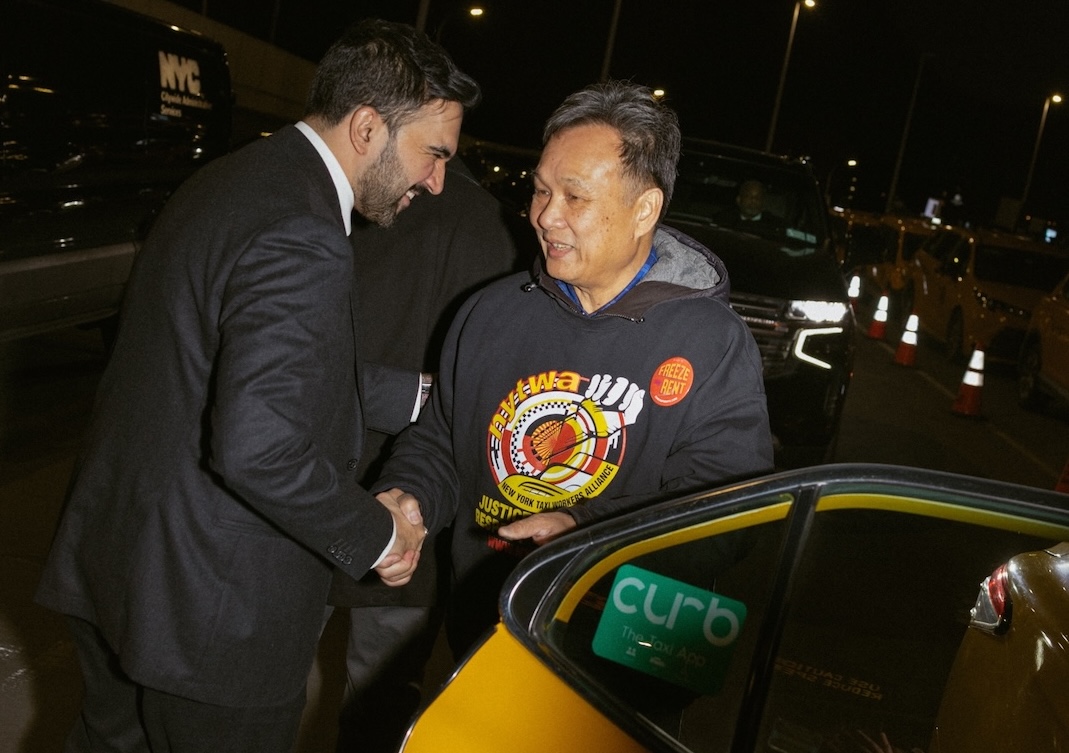
Zohran Mamdani joined long-exploited New York City taxi drivers in a hunger strike in 2021. Yesterday he announced his pick for taxi commissioner, who promised to “center working people in all of our decision-making.” (Courtesy of Kara McCurdy)
On the ride from Jackson Heights to LaGuardia Airport yesterday evening, I explained to my taxi driver why I was headed to the airport’s taxi lot. Mayor Zohran Mamdani was announcing his nominee to lead the Taxi and Limousine Commission (TLC): Midori Valdivia, a forty-two-year-old former TLC deputy commissioner of finance and Metropolitan Transportation Authority (MTA) board member. Known as a transportation wonk, Valdivia spent six years as an analyst and adviser at the Port Authority and, during her tenure at the TLC, led a push to expand wheelchair-accessible vehicles.
“There’s no way,” the driver said when I raised the possibility that the mayor’s pick could be good for drivers. “Nobody ever looks out for taxi drivers. The TLC office is very rude. They treat us like slaves.”
It was a familiar assessment. For decades, drivers’ encounters with the TLC have largely meant fines, hearings, suspensions, and rules that many say feel designed less to regulate the industry than to discipline those doing the work of driving. When I mentioned that Mamdani had taken part in a hunger strike outside city hall in 2021 alongside taxi drivers that had won $475 million in relief for heavily indebted taxi-medallion owners, he shrugged. “We’ll see.”
At the LaGuardia lot itself, the mood was more hopeful. Drivers still carried a long list of grievances, but they were standing beside the mayor, Valdivia, and Deputy Mayor of Economic Justice Julie Su during the press conference. New York Taxi Workers Alliance (NYTWA) members appeared intent on pressing an administration that had already shown itself responsive to their needs.
Among them was Richard Chow, a hunger striker whose brother was one of nine indebted drivers who committed suicide in 2018. Mamdani name-checked Chow in his election night speech and arrived at his January 1 inauguration in Chow’s cab.
“I’m very proud of him, from the bottom of my heart,” Chow told me of the new mayor. “Because he supported me and supported our drivers: the union, the working-class people.”
“He’s putting some work in already,” said Kuber Sancho-Persad, a hunger striker whose father passed away shortly after his medallion was confiscated, mentioning the mayor’s push to increase the number of restrooms available to drivers.
The hunger strike forced the city to confront a medallion lending system that had pushed drivers into foreclosure, bankruptcy, and suicide. But it did not end the daily grind. When I asked Chow, now in his seventies, whether he still drives seven days a week, he answered without hesitation: “Yes.”
Jean-François, who has driven for forty years and also took part in the hunger strike, described spending hours before getting a single fare. On a recent day, he’d waited from 7:50 a.m. until noon for his first passenger.
“There was nothing,” he said.
One reason was visible just beyond the taxi lot. Uber and Lyft drivers can pick up passengers curbside at many airport exits, while yellow cabs are restricted to a single location per terminal.
As we waited for the mayor to arrive, drivers began listing other problems. One explained how an NYPD traffic ticket can later reappear as a TLC violation. “You cannot give the punishment for one offense twice,” he said. Others raised concerns about lax enforcement against unlicensed drivers. Another worried that TLC vehicle mandates requiring larger cars could push drivers back into debt.
Then there was retirement.
“I’ve been driving for forty years,” Jean-François said. “After you retire, at least you should get something.” He has no pension. “All of us,” he said, gesturing to the crowd, “nothing.”
There are a host of external threats. New York’s yellow taxis have yet to fully recover from the COVID pandemic that shut down service in 2020. According to the taxi commission, there were 4.1 million yellow taxi rides in November 2025, a significant decline compared to 6.8 million for the same month in 2019. (Uber and Lyft have seen a more robust recovery from their own downturns.) Waymo, a subsidiary of Alphabet, which owns Google, is piloting driverless vehicles in city limits thanks to a testing permit approved by then mayor Eric Adams; Governor Kathy Hochul has said she will introduce a law to allow “a limited deployment” of driverless vehicles outside New York City. Since at least 2019, Waymo has spent more than $3 million on lobbying city and state leaders.
Departing TLC head David Do raised fares in 2022, and the commission has required gig companies to increase driver pay in recent years. But many drivers see the TLC as less of an advocate for them than an enforcer over them, with drivers’ anger absorbed and penalized rather than taken to heart. That history loomed over the announcement at LaGuardia, even as the administration promised something different.
Standing at a podium in the corner of the lot, Mamdani framed Valdivia’s nomination as part of that break.
“From city hall, we will deliver meaningful change in the lives of the working people too often forgotten by our politics, and in the day-to-day existences of the taxi drivers who deserve a forceful champion at the TLC,” said Mamdani, speaking at a podium in a corner of the taxi lot. “That champion is Midori Valdivia.”
“A priority of mine will be to center working people in all of our decision-making,” Valdivia told me. If confirmed by the city council, she would oversee more than two hundred thousand licensed drivers completing roughly one million trips a day. “That means drivers will have not just a seat at the table, but they will be a core part of how we think about TLC regulations. What does it mean to build better working conditions for drivers? There are so many small items that are additional burdens drivers shouldn’t have to deal with. That’s also part of building dignity.”
Speaking with me after the press conference, Mamdani linked the TLC to a broader enforcement agenda across city agencies.
“Whether you’re speaking about TLC or you’re speaking about Department of Consumer and Worker Protection [DCWP], you are speaking about agencies that, at their best, can be the first line of defense for these workers, and at their worst can be yet another example of a city government that’s overlooking them,” Mamdani said. “Just today, DCWP announced findings that DoorDash had potentially stolen more than $500 million in tips.”
He also pointed to unfinished business from the medallion relief program. Some drivers, he noted, had been left out.
“There are more drivers who have medallion loans through other lenders that the city still needs to work to bring into the fold,” Mamdani said.

Organizing Beyond Yellow Cabs
The crowd at LaGuardia wasn’t limited to taxi drivers. Members of Los Deliveristas Unidos, an organization of app-based delivery drivers, were present as well, fresh off a legislative win in their fight against unjust deactivations. Their presence underscored how regulatory agencies like the TLC have become a central battleground for workers facing platform-driven precarity.
Asked how the TLC could assist these workers, Valdivia emphasized corporate accountability.
“People overlook the fact that driving is one of the most dangerous professions in the United States,” Valdivia told me. “You see that with the deliveristas, and you saw that with pizza companies back in the 1990s. Back then, they told drivers to deliver in under thirty minutes; that created such unsafe conditions that they are no longer allowed to do it.”
Deputy Mayor Julie Su echoed that approach, pointing again to the DCWP’s findings on tip theft.
“That’s another way of cheating workers,” Su told me. “And minimum wage protections are not ceilings; they’re the floor. All the ways that these companies are trying to basically violate labor laws, but do it under the guise of saying ‘It’s just technology’? We are coming after those practices.”
Su also emphasized enforcement and organizing.
“We strongly believe workers should have a real voice on the job,” she said. “They should be allowed to come together collectively and help determine the conditions in which they live and work. But specifically for these companies, there are laws in place. New York drivers have fought hard and won really significant laws, and they only matter if they’re actually enforced.”
NYTWA executive director Bhairavi Desai, whose members formed the backbone of the hunger strike, put the stakes plainly.
“This job has been a bridge to poverty rather than a pathway to a stable middle-class life,” she said. Drivers shoulder long hours, violence, and health risks while app companies and garages accumulate wealth. “A strong TLC — one that champions its licensees and stands up to corporate greed — can right a generational wrong.”
“No one should have to work full-time year-round and still live in poverty,” Su said. “No workers should have to wonder if they’re going to come home healthy and safe, or whether they’re going to be able to retire one day and enjoy life.”
Watching Closely
Nothing about the way drivers engaged at LaGuardia was new. Taxi drivers have always argued: with mayors, with regulators, with reporters, with each other. But the terrain on which those arguments are now landing is different. They are pressing an administration that owes part of its political ascent to their struggle. That does not guarantee results, but it does mean drivers are no longer arguing with an institution that can pretend not to hear them.
The driver who dropped me off at the lot wasn’t wrong to doubt. When I relayed his skepticism to the mayor, he nodded.
“As someone who was on a fifteen-day hunger strike with so many of these New York Taxi Workers Alliance members, I remember back then the chant was, ‘TLC Lies, Drivers Die,’” said Mamdani. “That’s what the TLC stood for for so many of them. And now to have Midori as the nominee to run the TLC — it’s the potential for a new era in that relationship.”