As President of Brazil, Lula Could Usher in a New Global Nonalignment Movement
Brazil’s president-elect, Lula da Silva, appears eager to challenge Western dominance. But instead of siding with China against the US in a new cold war, he’s likely to pursue a sovereign third path in the vein of the 20th century’s Non-Aligned Movement.
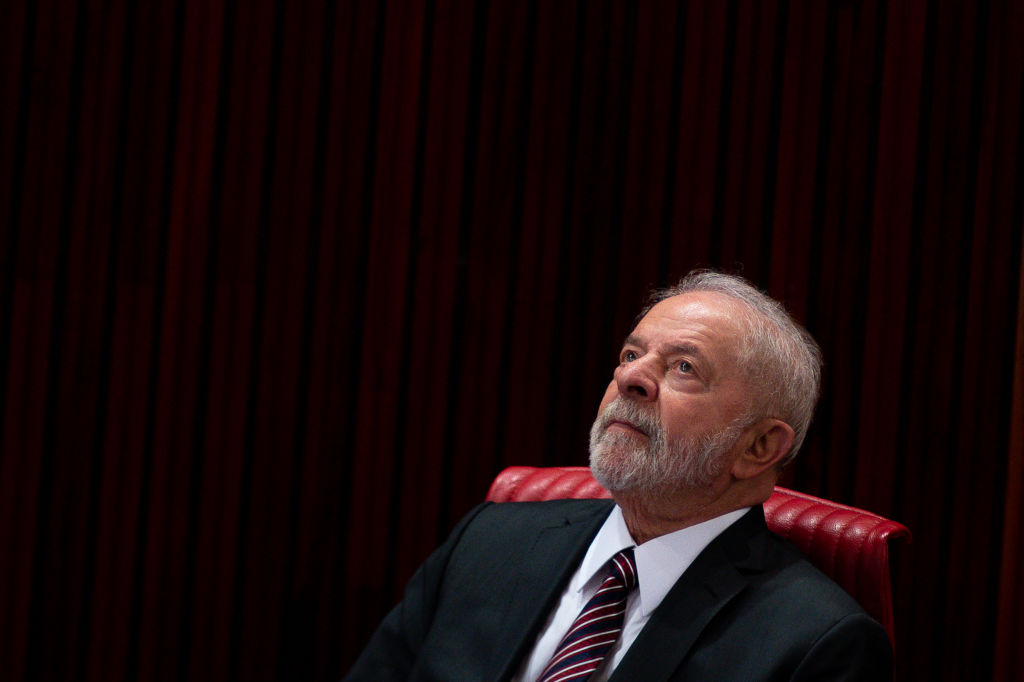
Luiz Inácio Lula da Silva, Brazil’s president-elect, during the certification of the 2022 Brazilian presidential election at the Superior Electoral Court in Brasilia, Brazil, on December 12, 2022. (Andressa Anholete / Bloomberg via Getty Images)
Lula da Silva’s victory in this year’s Brazilian presidential election marks a significant political shift not only in Brazil, which spent the past three years under the leadership of the far-right Bolsonaro administration, but on the global geopolitical stage.
In 2009, as then president of Brazil, Lula took a leading role in the foundation of BRICS, a group of emerging economies (Brazil, Russia, India, China, and South Africa) challenging the dominance of Western capital. When he returns to office, Lula’s economic and foreign policy approaches are likely once again to challenge the United States’ global political-economic dominance.
But we can expect some nuance to Lula’s approach, too. He appears uninterested in entangling Brazil and BRICS in the standoff between the United States and China, currently shaping up in the form of a trade war. Instead, Lula is likely to pursue a sovereign third path in the vein of the twentieth century’s Non-Aligned Movement, a group of nations that pledged fealty to neither the United States nor the Soviet Union during the Cold War.