Empire’s Workshop Under a Flailing Empire
Latin America is not the United States’ “backyard.” It’s the training ground, historian Greg Grandin argues, for periods of imperial retrenchment and regroupment. But it’s also a region where radical movements have consistently refused to be crushed by US imperial power.
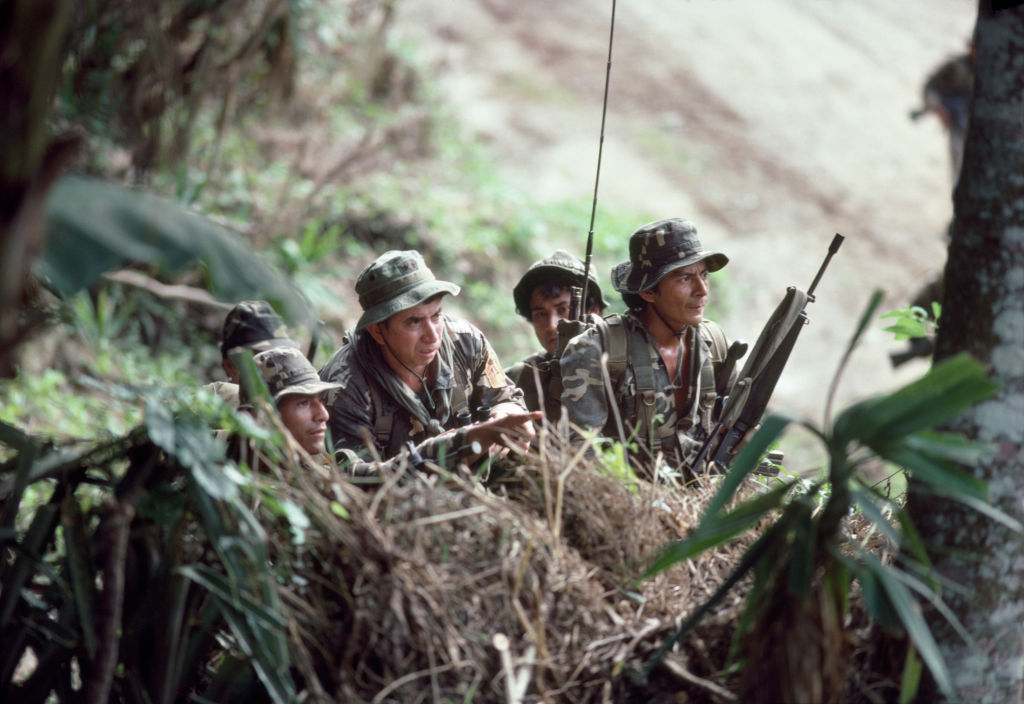
Lieutenant Colonel Domingo Monterrosa and several of his soldiers of the US-trained and funded Atlacatl Battalion, responsible for the El Mozote massacre in 1981 in El Salvador, which remains the largest single massacre in recent Latin American history. (Robert Nickelsberg/Getty Images)
Fifteen years since its original publication, historian Greg Grandin has revised and reissued his now classic 2006 book, Empire’s Workshop. Having dedicated the intervening years to studying US imperial power through the prism of figures from Herman Melville and Andrew Jackson to Henry Ford and Kissinger, Grandin’s razor-sharp insight into the structural contradictions of the US imperialist project make this work required reading for today’s Left.
Grandin reveals Latin America as a laboratory of both US military expansion and soft power. Rather than the United States’ “backyard,” as the region has so often been referred to, he contends that Latin America has served empire as a “training ground, where the United States could regroup during periods of retrenchment, where ascendant governing coalitions could work out new tactics and new worldviews.”
Writing in the early years of the Iraq War, Grandin traced the origins of the neoconservative project to Ronald Reagan’s counterrevolutionary crusade in Central America. There, the New Right worked to re-moralize and remilitarize “both American diplomacy and capitalism,” restoring to the Republican right the moral purpose and idealist grandeur that was once the purview of liberal internationalists like FDR and JFK.