The Left Should Have Nothing to Do With Carl Schmitt
The Nazi legal theorist Carl Schmitt opposed liberalism in favor of an authoritarian politics based on singling out the enemies of the state. His ideas are incompatible with democracy, equality, and socialism.
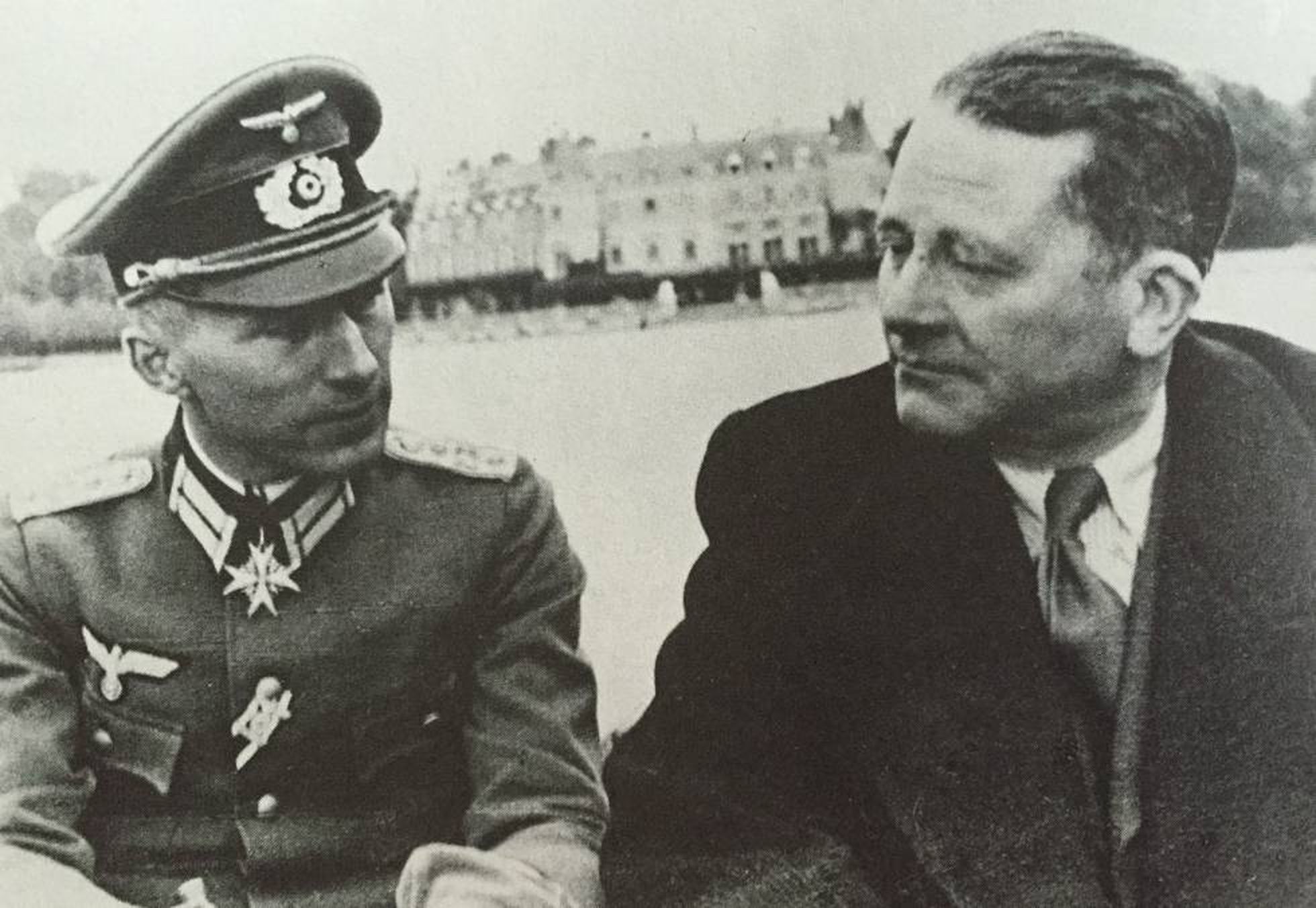
Weimar reactionary Carl Schmitt (R) together with writer Ernst Jünger (L) in Rambouillet, France, 1941.
Among polite company, Carl Schmitt, the ultrareactionary political philosopher, jurist, and unrepentant Nazi from 1933 until his death in 1985, was long regarded with the contempt he deserved. Whilst Schmitt’s defenders have sometimes portrayed his Nazism as a regretful but largely opportunistic and short-lived episode in a long and complicated career, his own repudiation of Nazism was always qualified.
By August 1945, three months after Germany’s surrender, Schmitt was at work drafting a legal opinion in defense of Nazi businessmen against the accusation that they had helped to prepare their nation for a war of aggression. Though he was unequivocal in his condemnation of the genocide committed by the Nazis — crimes of “rawness and bestiality” exceeding the “normal human capacity of conception” — he insisted that the capitalists supportive of the regime were innocent.
Under detention by American soldiers, Schmitt would water down his condemnation of the Nazi genocide, arguing that the Third Reich’s crimes were not any worse than the allies’ firebombing of Nuremberg. From his jail cell, he complained that he had “not yet once spoken with an American, but only with German Jews,” and imagined his own imprisonment as cosmic retribution for God’s decision to allow “hundreds of thousands” of Jews to be killed. Free from captivity, Schmitt would live the rest of his life in relative obscurity, visited often by conservative intellectuals and jurists and supported by a pension provided by industrialists thankful for his loyalty.