An Infinite State of Exception in Nayib Bukele’s El Salvador
Both Donald Trump and El Salvador’s Nayib Bukele style themselves successful businessmen with an affinity for social media, cryptocurrency, and criminalizing poor Salvadorans. And each stands to gain from the relationship with the other.
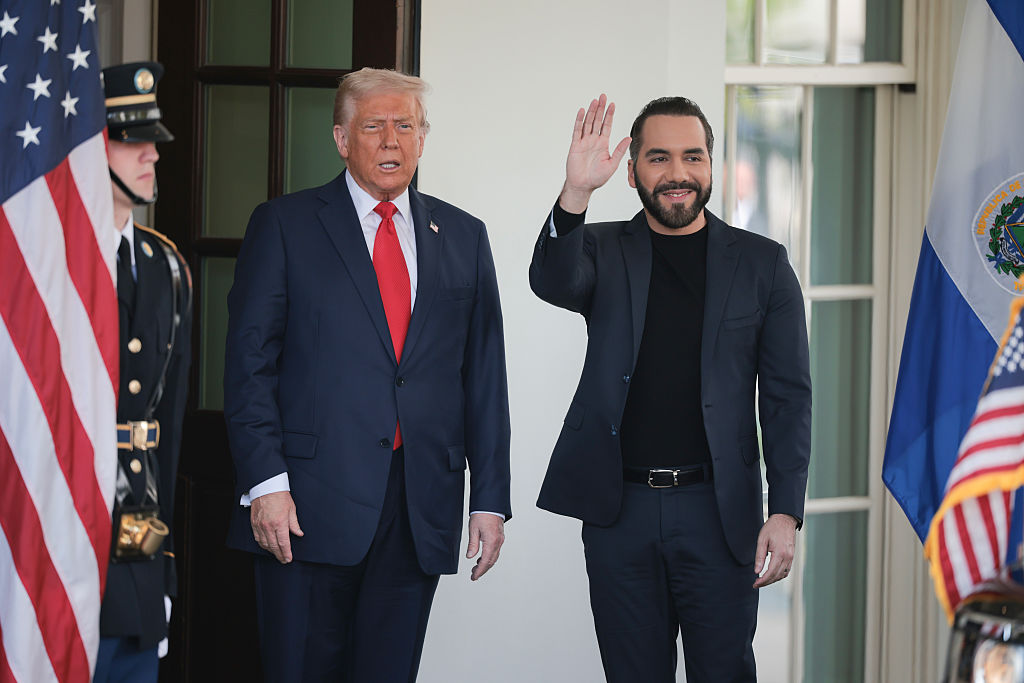
President Nayib Bukele has built an authoritarian regime in El Salvador. Donald Trump’s support is key to that regime. (Kayla Bartkowski / Getty Images)
The small Central American nation of El Salvador has of late assumed an outsize role in the western hemisphere. With a vengeful and reckless Donald Trump back at the imperial helm, Nayib Bukele, an elder-millennial advertising executive and crypto enthusiast, has fostered a productive alignment with Trump’s punitive politics.
El Salvador’s relationship with the United States has long been defined by an asymmetrical integration into both US-led accumulation patterns and security regimes, from the Cold War to the “war on drugs” and “war on terror.” In the 1980s, El Salvador’s military dictatorship was propped up by massive outlays of military and economic aid to sustain a scorched-earth counterinsurgency campaign against a powerful leftist insurgency. Following the negotiated transition to liberal democracy in the 1990s, successive right-wing governments stewarded the country through neoliberal restructuring and a new, subordinate insertion in the global division of labor as a purveyor of cheap labor for export via outsourced, underpaid garment workers for US brands, and as a source of criminalized migrant laborers in the lowest segments of the deindustrialized US economy.
In the early aughts, these administrations used US aid to pioneer “mano dura” or iron fist security programs against the incipient street gangs that flourished among the abundant reserves of disaffected youth excluded from the postwar development model. These illicit groups had been deported from their US origins thanks to the same zero-tolerance policing paradigms that helped forge them to begin with, among refugees from the United States’ counterinsurgency wars who found themselves among a growing racialized relative surplus population in US urban centers and prisons.
In 2003, El Salvador deployed troops to join the US invasion of Iraq. In 2004, it was the first country to sign the Central America-Dominican Republic Free Trade Agreement (CAFTA-DR). In 2005, it became the host of the US-funded International Law Enforcement Academy (ILEA), and in 2006, El Salvador adopted anti-terror legislation modeled on the US Patriot Act.
The Trump-Bukele nexus lends a new political dimension of mutual reinforcement and escalation to the traditional dependency relationship. Both leaders style themselves as successful businessmen and view the presidency as a patrimonial project. They share an affinity for social media, cryptocurrency, and criminalizing poor Salvadorans. And while to unequal degrees, each stands to gain from the relationship, which stages Bukele as a zealous counterpart in Trump’s regional war against transnational criminal-cum-terrorist gangs.
Elected in 2019, Bukele cultivated close ties with the first Trump administration, signing an agreement in September of that year to make El Salvador a so-called “Safe Third Country” to receive migrants seeking asylum in the United States. Relations were strained with the Biden administration, which targeted Bukele cabinet members with sanctions over corruption allegations, and congressional Democrats imposed limited restrictions on military aid amid growing outcry over human rights violations. Nevertheless, the administration soon muted its rebukes of Bukele’s antidemocratic consolidation for fear of encouraging further deals between El Salvador and China.
In August 2018, the leftist administration of the Farabundo Martí National Liberation Front (FMLN) broke off relations with Taiwan in favor of the People’s Republic of China. It was Bukele, however, who reaped the benefits of that deal. Bukele traveled to China shortly after his election to sign agreements that included donations of major infrastructure projects, which would become flagship attractions in his campaign to rebrand and redevelop the Salvadoran coast and capital city center for international tourism.
By the time Trump returned to the White House, an emboldened Bukele had indefinitely suspended key civil rights, fired a third of the judiciary, replaced the entire constitutional court and attorney general, jerrymandered opposition parties out of the legislature, been sworn in for an unconstitutional second term, and set about amassing a massive family real estate fortune. With Trump’s blessing, Bukele’s party went on to reform the constitution to allow for indefinite reelection, extend the presidential term from five to six years, and reschedule the 2029 presidential elections for the 2027 midterms, apparently anticipating erosion of his resilient public image and hoping to boost his party’s less popular downballot candidates.
Salvadorans in both countries have been casualties of the renewed amity between Washington and San Salvador, but Trump’s second term pivot from MS-13 as a favored scapegoat to Venezuela’s Tren de Aragua has put new racialized migrant populations — including heads of state — in the crosshairs. As a result, in March 2025, the United States rendered 238 Venezuelan nationals to El Salvador, where they were incarcerated without charge in the infamous Terrorism Confinement Center (CECOT) megaprison, together with dozens of Salvadoran migrants. Among the latter was Kilmar Abrego García, a Maryland resident mistakenly deported and eventually returned to the United States. The Trump administration has since sought his expulsion to Uganda, Eswatini, and Costa Rica.
In addition to renting his prisons to the Department of Homeland Security, Bukele opened his airfields to US attack planes, which began flying lethal missions out of Comalapa in October. Salvadoran airports are no strangers to covert US operations, having hosted illegal CIA Contra supply runs to Nicaragua throughout the 1980s. This time, however, is perhaps the first that a country has hosted US aircraft engaged in military strikes in the region.
Before those same forces bombed Caracas and kidnapped President Nicolás Maduro in January 2026, the migrants were released to Venezuela as part of a US-brokered prisoner exchange. Court filings subsequently confirmed that the Trump administration paid El Salvador US$4.7 million to detain the men on behalf of the United States. The arrangement included a US commitment to drop federal charges against nine leaders of the MS-13 gang facing prosecution in the United States and return them to El Salvador, in an apparent bid to prevent airing their testimony regarding Bukele’s corrupt pacts with the criminal group, which has served as a key political foil for both heads of state.
Testimonies from the freed migrants confirmed the accounts of sexual violence, beatings, and torture relayed for years by Salvadoran survivors of Bukele’s state of exception, which since March 2022 has suspended constitutional guarantees, including due process, in the name of fighting street crime. Some 90,000 people have been arrested in the intervening years, lending El Salvador the world’s highest incarceration rate and more than tripling the country’s prison population.
Excepting minors, not one of the inmates detained in Bukele’s “war on gangs” has yet seen trial; the legislature has extended the limit to pretrial detention for up to five years, leaving prisoners in an effective state of forced disappearance. At least 470 deaths in state custody have been confirmed by rights groups to date: one-third with signs of violence, one-third from medical neglect, the rest of as-yet-unknown causes. The true toll is certainly far higher.
Detainees in El Salvador have been denied visits from counsel or family since early in Bukele’s first term. The CECOT, however, has become a tourist destination for far-right politicians, influencers, and journalists. These invited guests livestream their guided tours and stage selfies before a curated human backdrop of shorn, scowling prisoners, whose visible gang tattoos mark them as longtime inmates, imprisoned well before Bukele’s tenure.
Tens of thousands of those detained in Bukele’s mass arrests have no gang ties whatsoever; in addition to criminalizing the poor, the state of exception has also proved an efficient instrument to target opposition activists, human rights defenders, and communities in the path of government-backed private developers. Salvadoran prisons hold dozens of political prisoners, and many more have been driven into exile, as a new foreign agents law shutters legacy nonprofit and civic associations across the country.
Affective affinities aside, US support is key to Bukele’s authoritarian project. El Salvador’s economy remains structurally dependent upon the United States in almost every sense: the United States is El Salvador’s number-one trading partner; since 2001, the US dollar reigns as national currency, and the Salvadoran diaspora in the United States represents nearly 25 percent of El Salvador’s population, without accounting for those born in the United States to Salvadoran parents; remittances from those influential workers now represent 25 percent of GDP.
Thus far, Trump has rewarded Bukele for his service. Salvadoran exports were hit with a 10 percent tariff, but while his administration has sought to cancel the temporary protected status (TPS) that shields hundreds of thousands of migrants from Afghanistan, Cameroon, Haiti, Honduras, Nepal, Nicaragua, and Venezuela from deportation, the nearly 200,000 Salvadorans with TPS have so far been spared. Trump’s State Department also rewarded Bukele by upgrading the country’s travel advisory, even as US citizens are swept up in Bukele’s mass arrests. A $1.4 billion International Monetary Fund deal for the country — negotiations for which were suspended under the Biden administration — was finally approved in February.
Nevertheless, alliance with the Trump administration carries political hazards. Salvadorans in the United States have been subjected to the terror unleashed by Trump’s raids in diaspora strongholds like Los Angeles and Washington, DC, yet El Salvador has not advocated for its emigrants. Instead, Bukele has fed the dehumanizing discourse, reproducing Trump’s racist smear campaign against migrants like Abrego. Trump is, furthermore, a fickle friend, and unlike Mexico to the north, El Salvador has little strategic leverage on its side, economic or otherwise.
Bukele already faces domestic challenges. The deal to lease sovereign territory to unlawfully imprison Venezuelan migrants was not well-received at home; notably, Bukele’s communications on the matter were conducted in English for a foreign audience. While he trumpets his domestic support, which has been buoyed by relief from street-level gang activities in the wake of the 2022 crackdown, measures like Bitcoin adoption and the overturning of the country’s historic ban on metals mining have been deeply unpopular, slowly eating into his ratings.
Meanwhile, Bukele’s rent-based accumulation strategy is driving land grabs, evictions, and displacement across the Pacific coastline and urban center. The cost of living has skyrocketed, rising alongside poverty rates and public debt, which now stands near 100 percent of GDP, even as foreign direct investment has declined. As the reserves of consent threaten to dwindle, Bukele is shoring up the means of coercion.
Bukele’s carceral state has been forged by decades of imperialist intervention and extraction to house an enemy born within empire’s own entrails. These technologies of violence are successively redeployed on both sides of the border. Indeed, Trump appears to have drawn inspiration from Bukele’s spectacular aesthetics of cruelty, livestreaming immigration raids, metabolizing state violence into bite-size “content,” and inviting far-right influencers into the White House press pool, while devotees like Elon Musk call for replicating Bukele’s purge of the judiciary.
New and grotesque forms of repression and domination are fashioned with each ricochet of the imperial boomerang. As US gunboat diplomacy returns to the Caribbean and federal security forces are deployed to occupy major US cities, the state of exception multiplies, folding back on itself infinitely like a funhouse mirror, from San Salvador to Washington, from Gaza to Minneapolis, and back and back again.