Dem-Backed ICE Body Cams Are a Giveaway to Weapons Makers
To reduce ICE misconduct, Democratic legislators propose that its agents be required to wear body cameras. Evidence of body camera efficacy is remarkably thin, but weapons technology companies are set to make millions from the “reform.”
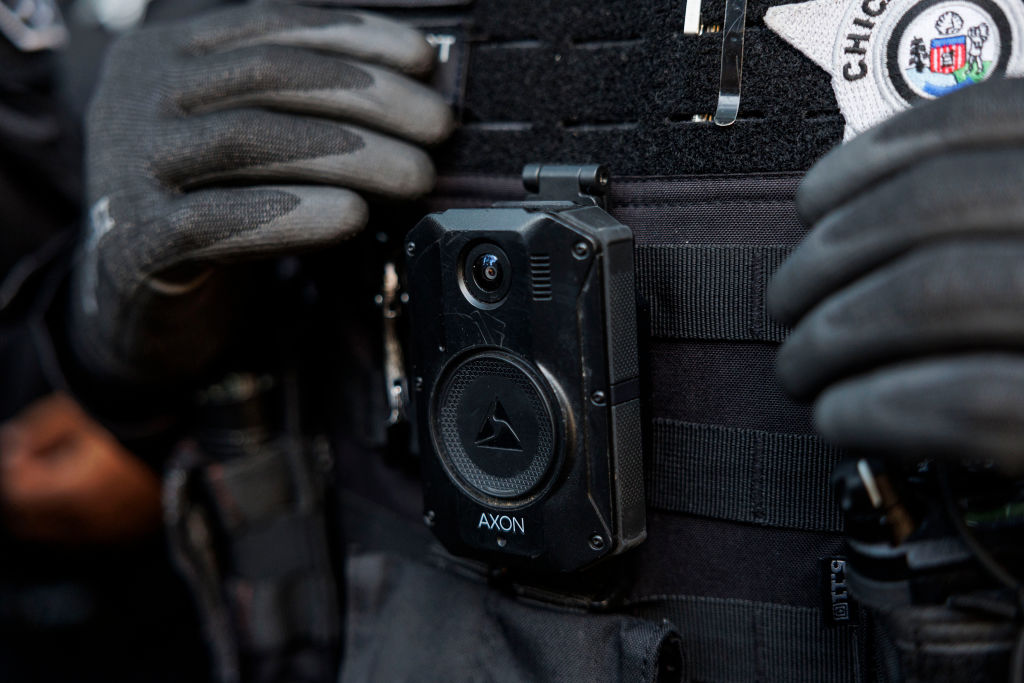
With the crucial support of congressional Democrats, and under the guise of reform, a weapons technology company is set to make millions in federal contracts for body cameras to be worn by ICE agents. (Armando L. Sanchez / Chicago Tribune / Tribune News Service via Getty Images)
Amid President Donald Trump’s violent immigration crackdown in Minneapolis, industry-backed Democrats just helped congressional Republicans turn proposed Immigration and Customs Enforcement (ICE) reforms into a $20 million windfall for the body camera industry.
Federal disclosures reviewed by the Lever show that Axon Enterprise, Inc., a weapons company and the country’s largest manufacturer of body-worn cameras, has lobbied aggressively since July on the $64 billion Department of Homeland Security spending bill that lawmakers passed on Thursday. The company’s CEO, a regular campaign contributor to Republicans, also donated directly to key Democratic lawmakers who pushed for the body camera measures.
Now, the company is well-positioned to reap the benefits of the $20 million allocated by the legislation for body cameras as part of ICE’s extended $10 billion budget, on top of the $75 billion in additional funding the agency received from the One Big Beautiful bill last year.
Axon has faced lawsuits for monopolizing the police body camera market and raising prices on local government contracts. Its profits have soared despite recent studies casting doubt on body cameras’ ability to curb law enforcement misconduct.
The homeland security spending bill has faced public opposition as unrest grows nationwide over ICE’s tactics. But instead of organizing against the bill, Democratic negotiators have highlighted the body camera provision as a central way that the legislation — despite granting ICE billions of dollars — provides new oversight to the agency.
“For weeks, Democrats have pushed House Republicans to adopt strong guardrails and accountability measures, including . . . a body camera mandate and mask ban,” said House Minority Leader Hakeem Jeffries (D-NY) on the state of the homeland security bill in advance of the vote this week. The mask ban, among a handful of other reforms pushed for by Democrats, did not make it into the final bill.
With the help of seven Democrats, Republicans were able to pass the expanded ICE budget on Thursday, separate from the funding package for other federal departments needed to avert a government shutdown at the end of the month.
One of those Democrats, Texas Rep. Henry Cuellar, who sits on the House Appropriations Committee and helped negotiate the deal with Republicans, received a thousand-dollar check from Axon’s CEO, Rick Smith, in 2024. Last year, Trump pardoned Cuellar from federal bribery, money laundering, and conspiracy charges filed against him.
Although the vast majority of the Democratic caucus voted against the new ICE funding, Jeffries reportedly did not attempt to whip votes against the bill — a legislative maneuver in which members of a party are instructed to vote with the party leadership’s official position. The homeland security funding, along with the rest of the government spending package, now heads to the US Senate, where its prospects are uncertain.
In the lead-up to the House vote, Democrats called for ICE reforms to quell the growing political firestorm over the legislation after an immigration agent killed legal observer Renee Good in Minneapolis. Party leadership stopped short, however, of demanding a significant agency funding cut, as some progressive lawmakers have urged.
Instead, Democrats rallied around a more modest proposal to mandate body cameras for every ICE agent. Democrats on the Appropriations Committee touted the provision as an accountability measure. Senator Ruben Gallego (D-AZ), the top recipient of campaign cash from Axon executives, including the company’s CEO, reintroduced legislation to do so last week. Gallego cosponsored the bill alongside fellow Arizona Democrat, Sen. Mark Kelly. Axon is headquartered in Scottsdale, Arizona.
In response, Republicans offered a concession to Democrats in the spending bill: $20 million allocated for ICE to purchase and implement body cameras for its officers, which are already currently deployed piecemeal across the agency.
“We’re going to give them the money for it,” Rep. Mark Amodei (R-NV) told Politico, referencing the body camera requirement for ICE agents.
Some of the seven Democrats who broke from the rest of the party to support the spending bill cited the body camera provision as a reason for their support.
Yet the provision is likely little more than a giveaway to Axon, which spends hundreds of thousands of dollars lobbying each year to have the government buy its technology, including drones, Tasers, and AI for law enforcement.
Axon spent at least $1.4 million on lobbying in the last half of 2025, including on the Department of Homeland Security spending bill “for body worn cameras” and other technology, according to recent federal disclosures. Axon’s nearest competitor, Motorola Solutions, also lobbied on the homeland security appropriations bill.
Beyond the body camera funding, experts say the homeland security bill as a whole delivers a massive windfall for ICE’s many for-profit vendors, who have hit the jackpot as the agency’s resources have surged.
“Every dime of detention funding is really just a giveaway for contractors,” Jesse Franzblau, director of policy at the National Immigrant Justice Center, told the Lever.
Substantial Footage, Questionable Uses
Body-worn cameras have long been touted as a solution to address police violence by providing greater transparency to the public and accountability for officers’ potential wrongdoing. Yet while the technology has proved an easy talking point for politicians who want to appease a public concerned about police misconduct, its effects are not always straightforward.
Body cameras collect huge reams of video data, becoming in effect surveillance tools that can be used in court in the same way as surveillance cameras. Axon and other manufacturers are now advertising artificial intelligence products that write police reports based on audio from the cameras. Body cameras also come at a high cost — contracts for the technology can amount to millions, even for a mid-sized police department — adding to already sky-high taxpayer-funded police budgets.
Evidence is mixed on whether or not they improve policing practices on the whole. One literature review from 2020 concluded that there was no firm evidence that camera adoption altered officer behavior, but that the wide range of findings suggested that “there may be conditions in which [body-worn cameras] can be effective.”
In 2022, President Joe Biden signed an executive order requiring body cameras for all federal law enforcement, an order that Trump rescinded upon taking office. While some federal agencies — including the Drug Enforcement Administration — have since quietly stopped wearing the cameras, other agencies have continued to deploy them.
In ICE’s case, an updated body-worn camera policy released in February under the Trump administration largely preserved the Biden-era policy. The agency’s use of the cameras, the policy reads, “shall be dependent on availability of appropriated funding resources.” The agency signed a $5 million contract with Axon for body cameras as recently as March.
Now, instead of mandating that ICE pull from its historic resources to buy body cameras, Congress is poised to give the agency millions more for the technology.
A Body Camera Monopoly
Though the homeland security funding bill does not specify a vendor for the body camera outlay, Axon — which has won tens of millions in Department of Homeland Security contracts — is likely a top candidate. The company is by far the biggest player in the body camera market, controlling as much as 85 percent of the market, according to some estimates.
In August 2023, several cities and towns whose police departments had contracted with Axon for body cameras and other products sued the vendor, alleging that it had an illegal monopoly in the industry, leading to years of product price hikes and wasteful spending.
Among other claims, the lawsuit argues that Axon’s 2018 purchase of Vievu, its largest competitor for body camera technology, cemented its dominant position, delivering contracts with police departments in New York City, Miami, and Phoenix.
That merger deal was later challenged by the Federal Trade Commission for reducing competition in the marketplace, forcing buyers, including localities, to rely on sole-source contracts from Axon. The legal challenge was struck down at the US Supreme Court due to a procedural dispute over how the case was filed; justices did not weigh in on the alleged antitrust violations.
After buying out competitors for its technology, Axon has leveraged its monopoly power over local government and police departments to increase its product prices, costing taxpayers millions of dollars, according to the ongoing lawsuit.
The average price of Axon’s body cameras has more than doubled over a six-year span, the complaint alleged, all while its margins quadrupled. According to the lawsuit, these prices would be lower in a competitive market.
Columbus, Ohio, is locked into a five-year, $19 million contract for Axon products, mostly body cameras. Ten years ago, before Axon consolidated the market, Columbus paid only $9 million for a slightly smaller order of body cameras from a competitor.
Oklahoma City currently pays $28 million to Axon for its police technology and body cameras, compared to the $600,000 it paid to a competitor in 2014.
Axon has also bundled its body cameras with other products it provides, such as tasers and underlying software services, making it difficult for local governments to shop for better body camera prices, according to the lawsuit.
While consolidating its grip on the industry, Axon has also amassed political influence in Washington, DC, where it’s been focused on winning federal contracts and lobbied extensively, spending at least $2.4 million last year. On the company’s last earnings call in November, an Axon executive said he had high expectations for its federal business in the coming year, calling the prospect “exciting.”