Edward Said’s Orientalism and Its Afterlives
Edward Said’s Orientalism instilled an anti-imperial sensibility into an entire generation of Western scholars. But even while it castigated the imperial project, its actual analysis didn’t give us the intellectual resources to overturn it.
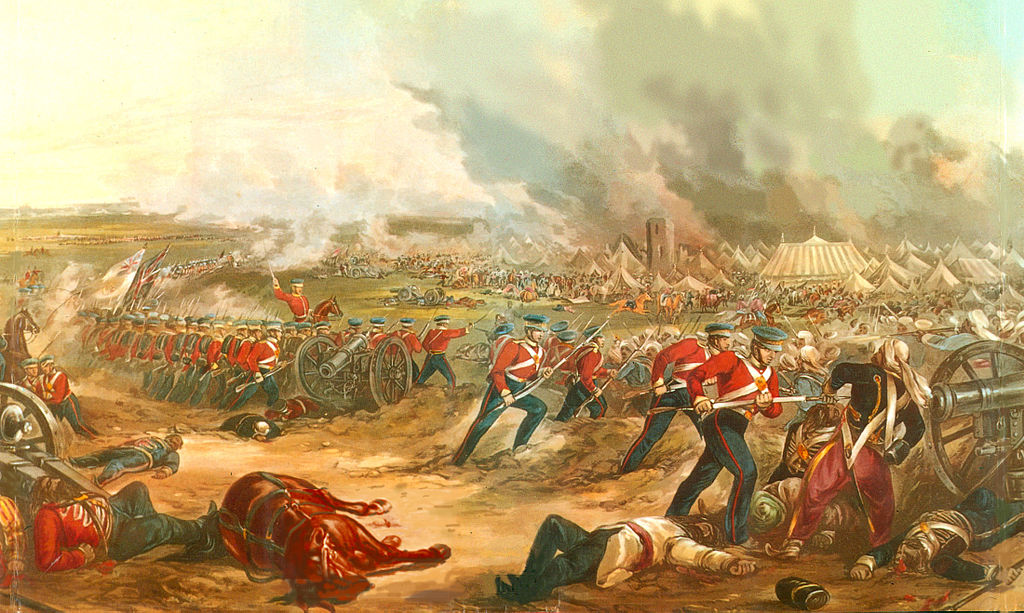
A painting by Henry Martens portraying the battle of Ferozeshah in the First Anglo-Sikh War, which resulted in defeat and partial subjugation of the Sikh empire to the British. (Wikimedia Commons)
Few works have had a greater influence on the current left than Edward Said’s Orientalism. In the first instance, it has become the lodestone for critical scholarship around the colonial experience and imperialism. But more expansively, in its status as a founding text of postcolonial studies, its imprint can be discerned across the moral sciences — in race studies, history, cultural theory, and even political economy. Indeed, it is hard to think of many books that have had a greater influence on critical scholarship over the past half century. There are some respects in which Said’s placement of colonialism at the center of the modern era has had a salutary effect, not just on scholarship, but also on politics. Even as the Left went into retreat in the neoliberal era, even as working-class parties either shrank in influence or were absorbed into the mainstream, the centrality of anti-imperialism surprisingly remained close to the center of left discourse — an achievement in no small part attributable to Said’s great book. And even as class politics is reemerging after its long hiatus, it is impossible to imagine a future in which the Left in the core countries will ever repeat its sometimes baleful disregard for imperial aggression and for the aspirations of laboring classes in the Global South. In this recalibration of the Left’s moral compass, Said’s Orientalism continues to play an important role.
Precisely because of its classic status, and its continuing influence, Orientalism deserves a careful reexamination. Its importance as a moral anchor for the anti-imperialist Left has to be balanced against some of the other, less auspicious aspects of its legacy. In particular, alongside its excoriation of Western colonialism and its deep investigation of colonialism’s ideological carapace, the book undeniably took several steps backward in the analysis of colonial expansion. It was this very weakness that proved to be so attractive to the emerging field of postcolonial studies in the 1980s, and that enabled its proponents to don the mantle of anti-imperial critique even as they were engaging in the very essentialism and exoticization of the East that was emblematic of colonial ideology. It is no small irony that Said, a deeply committed humanist, secularist, and cosmopolitan, is now associated with an intellectual trend that traduces those very values. This apparent paradox, I will argue, is, in fact, not so mysterious. It reflects real weaknesses in Orientalism’s basic arguments — weaknesses that were exposed very early by critics from the South but that were brushed aside by the New Left in its flight from materialism. As the Left gathers its intellectual resources once again and takes up the challenge of confronting imperial power, an engagement with Orientalism has to be high on its agenda.
Orientalism as Cause and Effect
There are two arguments in Orientalism about the relation between Western imperialism and its accompanying discourse. The first, and the one that has emerged as a kind of folk conception of the phenomenon, describes Orientalism as a rationalization for colonial rule. Said dates this Orientalism to the eighteenth century, with the rise of what is now called the Second British Empire, and continuing into the Cold War, when the United States displaced Britain as the global hegemon. It was during these centuries that Orientalism flourished as a body of knowledge that not only described and systematized how the East was understood but did so in a fashion that justified its domination by the West. Hence, if nationalists demanded the right to self-governance by Asians, or criticized the racism of colonial regimes, defenders schooled in Orientalism could retort