Why the Far Right Rules Modi’s India
Indian prime minister Narendra Modi’s Bharatiya Janata Party, the electoral arm of a Hindu nationalist movement, represents the largest and most organized far-right force on the planet. To understand its rise, we must look to India’s 20th-century history.
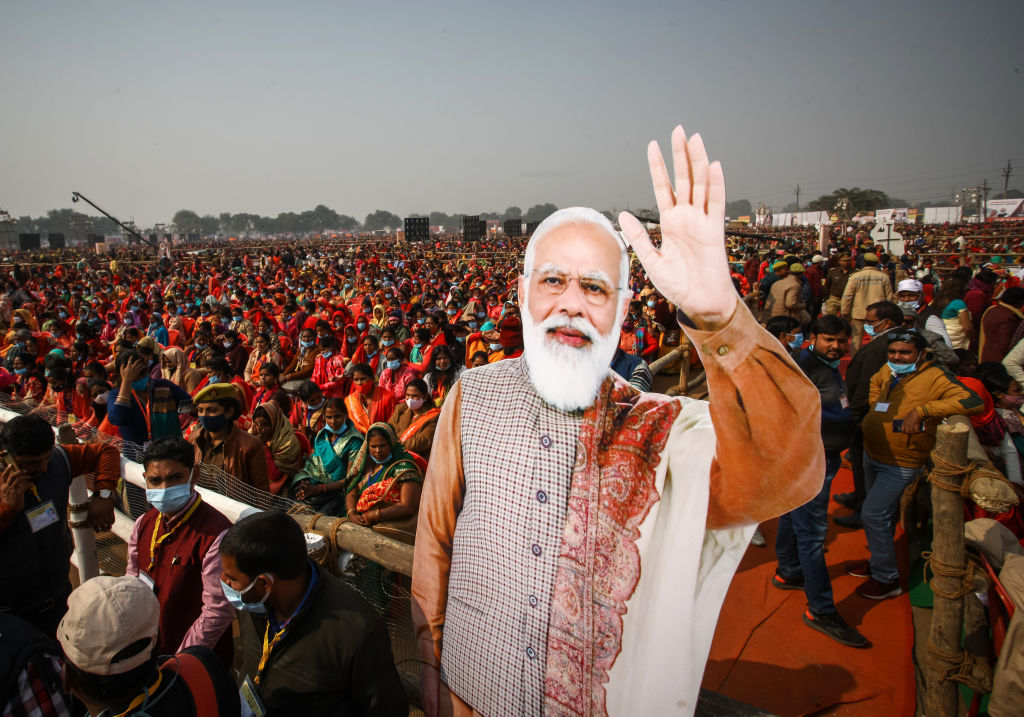
In Bharatiya Janata Party’s strongholds in Uttar Pradesh, women from various districts are seen near cutouts of Indian prime minister Narendra Modi at a rally on December 21, 2021. (Ritesh Shukla / Getty Images)
The rise of the far right is a global phenomenon. Perhaps nowhere is the far right stronger than in the second most populous country on Earth, India. There, the Bharatiya Janata Party, or BJP, under Prime Minister Narendra Modi, has held power since 2014.
The BJP, however, isn’t simply a party. The vision of the BJP and their cadre organization, the Hindu nationalist volunteer paramilitary Rashtriya Swayamsevak Sangh (RSS), is of a militaristhamic, nuclear-armed path to Indian greatness. It is also a vision in which Muslims have no history and therefore no right to belong in the present.
In an interview for Jacobin Radio’s podcast the Dig, Daniel Denvir discusses India’s pressing political problems with Achin Vanaik. They delve into the deep-rooted challenges predating partition and argue that the BJP’s ascent can only be understood in the context of neoliberalism’s rise and the decline of the Congress Party and its Nehru-Gandhi dynasty. This interview has been edited for clarity and length.