The Your Party Conference Was for the Few, Not the Many
The launch of a new party was meant to reenergize the British left. But Your Party’s founding conference showed a Left that had forgotten the outward-facing mass politics of the Corbyn-era Labour Party.
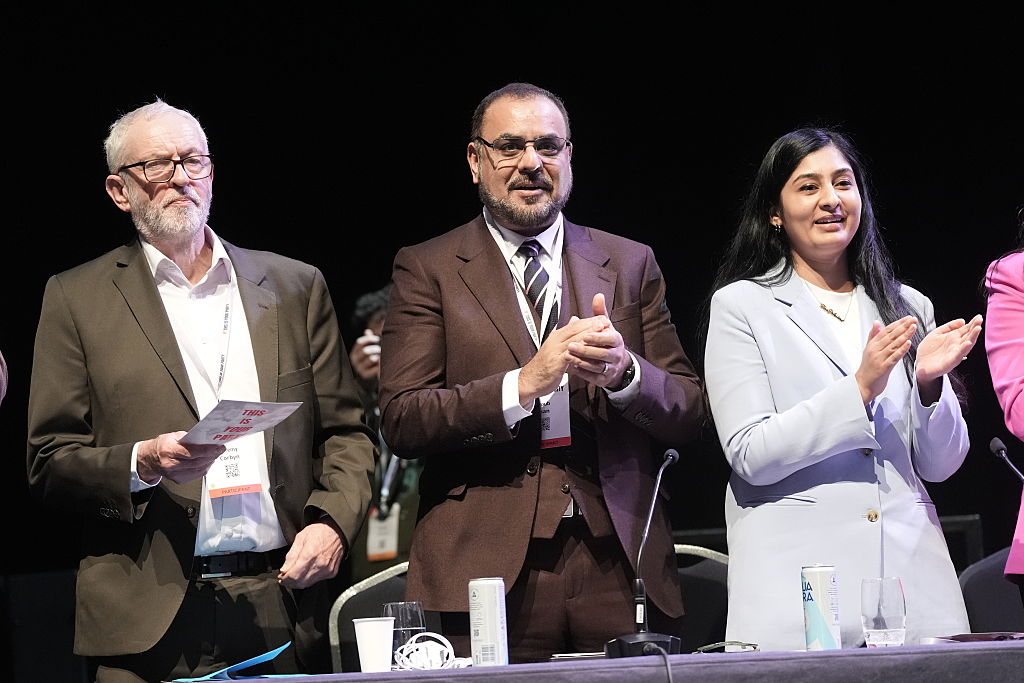
Jeremy Corbyn, Ayoub Khan, and Zarah Sultana on stage at the end of the Your Party conference at the ACC Liverpool. (Stefan Rousseau / PA Images via Getty Images)
In 2018, Jeremy Corbyn seemed like a prime-minister-in-waiting. Addressing the Labour Party conference at Liverpool’s ACC arena that September, he attacked Britain’s then-leader Theresa May for stalling in negotiations over the country’s exit from the European Union — urging her resignation in a speech delivered just days before his own alternative talks with EU chief negotiator Michel Barnier.
In place of May’s Conservative Party, Corbyn offered a Labour government capable of delivering a “socialism for the twenty-first century.” It was a vision based on the “commonsense” nationalization of Britain’s rail, water, and energy companies; a raft of measures to “rebuild and transform” communities left behind by austerity and neoliberalism; and a pro-peace foreign policy that would deliver the British recognition of a Palestinian state. He gleefully quoted a senior Conservative politician who lamented that Corbyn’s ideas had caught “the mood of our time.”
This past weekend, a woman who had watched that conference speech as a hopeful Labour delegate told me, upon exiting a different event at the same venue, that “if I didn’t get out, I was going to smash my head through the wall.” She was attending the founding conference of Your Party (YP) — the new outfit headed by Corbyn, fellow ex-Labour MP Zarah Sultana, and several independents who had won on pro-Palestine platforms in the 2024 general election, out-organizing Labour in formerly safe seats.
That the Your Party conference even happened was a testament to the determination of organizers. Throughout much of the summer and fall, it felt as if the party was over before it got started. It had been unilaterally launched by Sultana this July, as she looked increasingly sure to be expelled from Labour for declaring solidarity with activist group Palestine Action (absurdly labeled “terrorist” by the government). What followed, over several months, was an astonishing lesson in self-destruction. From 800,000 registered potential supporters — and polls suggesting a handsome vote share for the party — there followed vicious denunciations, lawsuits, briefings to the right-wing press, and bitter political maneuvers between the various players inside the emerging party.
Now it’s unclear what has been saved and can be made to work.
Fracturing Unity
Still on the eve of last weekend’s conference, shenanigans continued, with the factional strife between two main camps aligned to each of the party’s best-known MPs. On Friday night, as Sultana held a rally for her supporters, who said they and their ideas of “maximum member democracy” were being pushed aside, leaders of the Socialist Workers Party (SWP) were informed by e-mail that they had been expelled from Your Party and could no longer attend the conference. The stall of the SWP’s front organization, Stand Up to Racism (SUTR), was also ejected. This saw Sultana boycotting the Saturday of her own party’s founding conference, prompting the first headlines on the dawn of the British left’s new hope.
The expulsions added to the strange mood of the day’s proceedings. Standing in line for registration, a former member of Labour’s governing National Executive Committee (NEC) passionately argued in favor of the SWP’s presence in YP. He chided an official of a prominent left-wing labor union that he was “no better than [Keir] Starmer” for failing to sympathize with the expelled, accusing him of “small tent” politics, while surrounded by the literal small tents of various Trotskyist organizations peddling their wares.
An opening speech by local independent politician Lucy Williams urged delegates against a “Team Zarah or Team Jeremy” mentality, while Corbyn urged delegates to find the “common thread” of solidarity, approaching conference in an “outward-looking” way. The former Labour leader’s speech met with unusually muted reception from a crowd that is more dedicated than most to continuing the fight for the politics Corbyn is defined by.
Yet if this was hardly impassioned, much of the conference was bad-tempered. Indeed, it took slightly under two minutes, from the opening of proceedings, for a screaming delegate to be removed forcibly by conference security.
This heckling was a hallmark of proceedings. In relatively softball debates over whether YP should be explicitly socialist or just left-wing, whether it should center the working class or engage in the “broadest possible social alliances,” or what strands of political and social liberation comrades should constitutionally enshrine, many delegates took sides in a somewhat Manichean manner. Time and time again, the conference chair had to simply ask people not to wreck debates — trying to stop a constant flow of delegates who lined up to speak for one perspective, only to argue for another.
Capitalizing on Defeat
In voting terms, Sultana and her supporters clearly won the moment. On the urging of the Democratic Bloc (a faction that expressed disappointment that only eighty-eight of six hundred proposals were discussed) and the Democratic Socialists (who advocate a YP modeled on the Democratic Socialists of America), delegates voted to adopt collective leadership, a decision facetiously interpreted by the British press as members having “dropped” and “barred” both MPs. Party representatives were banned from accepting gifts or donations. This would appear to rule out local candidates gaining financial endorsements from trade unions — though no delegates even brought up this issue.
However, external assistance was granted in a different way, in a vote that allowed dual membership in YP for members of other political parties. For small organizations sidelined during the mass democratic participation that characterized Corbynism, this vote signals potential to capitalize on that movement’s defeat.
The SWP is the ultimate case in point. After over a decade of isolation on the British left — a radioactive image stemming from the SWP’s mishandling of a complaint over the sexual assault of a teenager at the hands of a senior member — the controversy surrounding its participation has given the party renewed visibility. Through its centralized decision-making, relative geographic spread, and experience in other projects, the SWP — which bans factions within its own ranks — can easily become the leading organized faction in YP, using its weight to steer large numbers of members.
Corbyn’s camp has only offered broad-stroke organizational visions over YP’s preferred direction. Often, its only interventions seem to be in media briefing, such as going through the Murdoch media to air concerns over Sultana’s encouragement of ultra-left groups. This lack of willing leadership is all the more baffling given that YP simply couldn’t exist without Corbyn’s figure and the ideas advanced during his time as Labour leader.
Dents in the Helmet
Following the conference, the public seemed highly unimpressed. At its inception, some polling showed YP in level competition with Labour and the Greens. In the week before the conference, possible voters numbered 12 percent. Now a recent poll suggests that this has dropped to 4 percent; another puts its prospective vote at 1 percent. Among some YP members, discussion is turning toward movement-building as a way to evade the probable reality that, as long as the Greens offer a humane social democratic message and a party that isn’t primarily about tearing itself to pieces, the moment of electoral capture is likely over.
This was the sense even among some delegates at YP’s founding conference. Speaking in the line for coffee, a care worker from East Lancashire told me that she would probably join the Greens after Christmas, given that “there wasn’t a lot of people I’d say are more like me here.” Throughout the entire YP founding process, both Corbyn’s and Sultana’s camps have taken for granted that sympathetic people uninitiated in left-wing microcultures would show unlimited patience for court factionalism. All efforts have been made to accommodate the already politically active. The missing ingredient is those thousands of ordinary people who rooted Corbynism in society, as a project that nearly won power.
In a conference report for Novara praising Sultana and the new “collective leadership” of YP, Steven Methven appears to welcome the death of Corbynism, which he defines as being “socialist principles carried by a single figure,” pushed by a political party, with an “inclusive, warm and optimistic message” that has “a tendency to placate rather than confront.” Such a reading could not be less political. Corbyn’s leadership of Labour might not have felt confrontational to leftist writers satisfied with punchier rhetoric, but it did not feel that way to the White House or, days into his leadership, the senior British military figures who warned of a potential coup to stop him entering 10 Downing Street.
Millions of people uninterested in sectarian activist politics found, in the experience of Corbynism, evidence that it really is possible to confront the powerful. Those years saw the first serious, organized attempt at progressive political rupture millions had ever been able to directly experience and contribute to. As the 2017 general election result showed, massive numbers of people operating with confidence, recognition, and discipline proved able to dislodge the certainties of a self-satisfied ruling class. The attempts to rebuild cultural and political life in many areas of the country — though unsupported by Labour’s apparatus and misunderstood by much of the far left — proved that there was an alternative to national collapse and the despair of reactionary politics.
The success of Corbynism required more, not less, of that dynamic. It is depressing to witness the jettisoning of such a powerful legacy of mass social politics in favor of constitutionalizing a small project with no hope of politically progressing. It can only have satisfied those with an active interest in political procedure, poaching members for already-existing parties, and a few decent diehards who will never give up.
Reflecting on the sectarianism of his own generation, the German playwright Bertolt Brecht was fond of joking that radicals all had dents in their helmets, and some of these were even made by the enemy. Considering the harsh future that all socialists and progressives in Britain almost certainly face, it is a shame that Your Party seems to have dented itself so much that the enemy may not even need to.