Wall Street Is Starting to Short AI
Wall Street traders have sharply increased how much they’re spending on credit default swaps tied to artificial intelligence. That means more and more investors are managing their risk by putting their money on the AI market’s eventual crash.
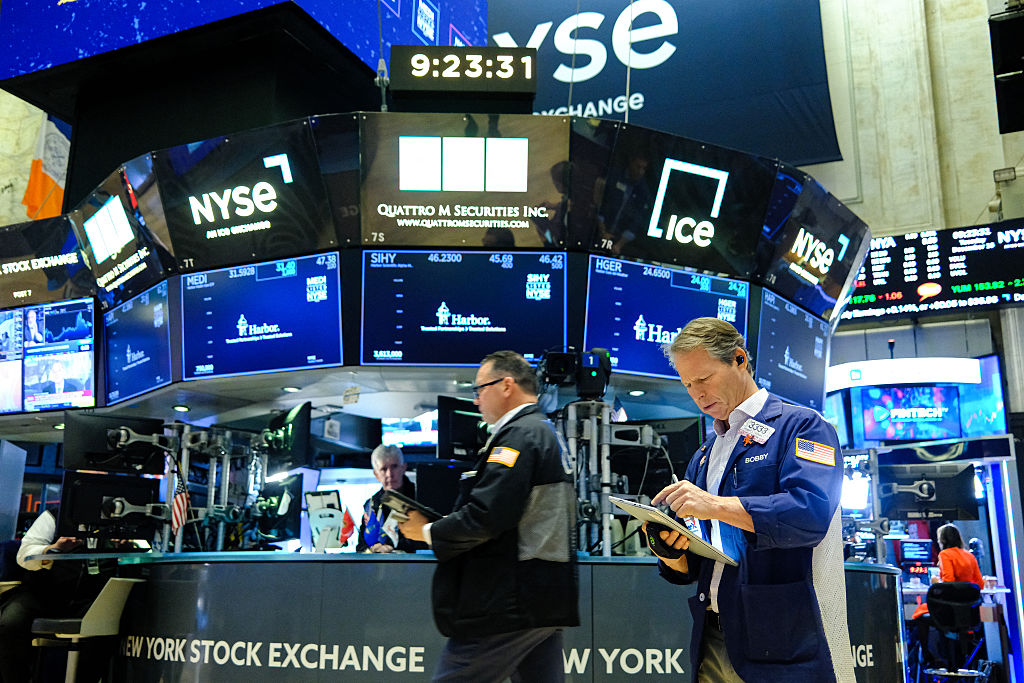
The volume of credit default swaps tied to US technology giants has risen 90 percent just since early September after being reportedly “thin to nonexistent” at the start of the year. (Charly Triballeau / AFP via Getty Images)
The secret is out about the potential artificial intelligence bubble — and Wall Street’s sharks smell blood in the water.
Wall Street traders have sharply increased how much they’re spending on “credit default swaps,” which, in case you weren’t paying attention during the movie The Big Short, are insurance derivatives that pay out when a company fails (a form of short).
Investors are shorting Big Tech companies, mainly Oracle and Meta, to “protect [themselves] and create a hedge,” one anonymous credit executive said. That means more and more investors are managing their risk by putting their money on the AI market’s eventual crash — just like in The Big Short.
In the lead-up to the 2008 financial crisis, firms like Goldman Sachs “made a fortune” playing both sides of the economic crash by selling mortgage-backed securities that its executives infamously identified as “shitty,” then also selling credit default swaps (shorts) against these investments as it became apparent they’d fail.
According to data reported by the Financial Times this week, the volume of credit default swaps tied to US technology giants has risen 90 percent just since early September after being reportedly “thin to nonexistent” at the start of the year.
“People are looking for insurance on their holdings,” one portfolio manager said to the Financial Times.
Oracle, a computing mainstay that survived the dot-com crash, has reportedly seen its credit default trading volumes triple this year, reaching levels not seen since 2009 — meaning the cost of insuring against Oracle’s failure is way up.
This comes even as Oracle inks blockbuster after blockbuster cloud-computing deal, adding hundreds of billions of dollars to revenue commitments.
So far, it’s not enough: Oracle is ramping up capital expenditures and adding to its debt to keep up with its sprawling AI infrastructure commitments, including $248 billion earmarked for data center land leases alone.
This month, the company reported higher-than-expected expenses and lower-than-expected revenues, leaving $108 billion worth of debt on its balance sheet. Growing bubble concerns and red flags raised by credit raters caused Oracle to recently shed $102 billion in value practically overnight as investors offloaded their shares.
Oracle declined the Lever’s request for comment.
Meanwhile, investors traded credit default swaps for Meta for the first time this fall, after Mark Zuckerberg’s company announced it was aiming to cover its AI buildout costs by selling roughly $57 billion worth of bonds.
Also feeling the pain from bubble panic is Nvidia, a $4.3 trillion computer chip designer that counts among its customers AI behemoths like Oracle, Meta, and Amazon. Nvidia’s critics accuse the company of exacerbating the AI bubble through “circular financing,” in which it makes enormous investments in its own customers — a strategy that hearkens back to the dot-com crisis.
While Nvidia has denied the risks of an AI bubble, its claims have been challenged by Michael Burry (the investor played by Christian Bale in The Big Short who predicted and then successfully shorted the 2008 financial crisis). Burry recently revealed that he owns “puts” (which bet that stock prices will fall) on both Nvidia and AI surveillance juggernaut Palantir.