Threatened With Jail for Offering Blankets to Migrants
Twenty-four aid workers in Greece are being tried on trumped-up smuggling charges after they gave blankets and water to migrants. Some have been in pretrial detention for months in a case highlighting the EU’s authoritarian clampdown on migrant rescue.
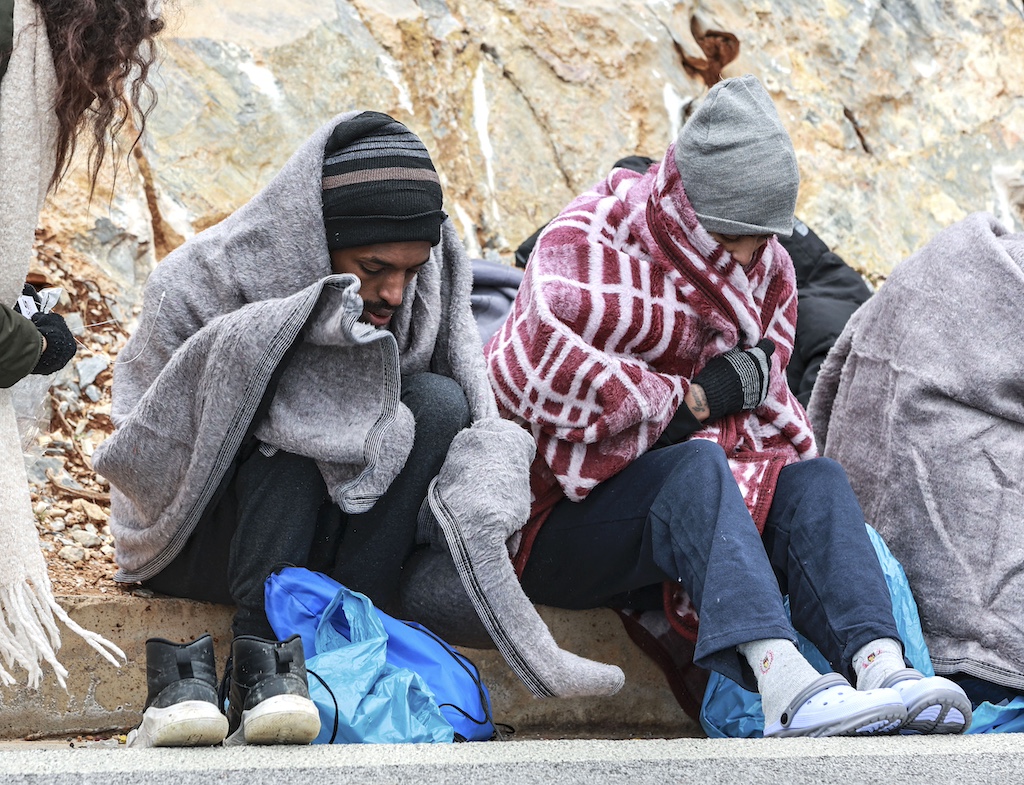
Aid workers said they offered blankets and water to people who had arrived on dinghies from Turkey and now face up to twenty years in prison. (Manolis Lagoutaris / AFP via Getty Images)
On December 4, the courthouse in Lesbos, Greece, began examining a smuggling case. On trial were twenty-four aid workers charged in connection with their work in 2016 and 2018 with Emergency Response Centre International (ERCI), a nongovernmental organization that had in that period conducted shoreline response in the waters off Lesbos. Aid workers have stated they offered blankets and water to people who had arrived on dinghies from Turkey and helped those who were at risk of drowning. They face up to twenty years in prison.
The charges have been decried as trumped-up and ludicrous by several human rights watchdogs and legal organizations. “These charges aim to portray those who help people on the move as criminals. And it’s part of a trend sweeping across Europe that’s criminalizing solidarity,” wrote Wies De Graeve, the executive director of Amnesty International Belgium’s Flemish branch.
But the criminalization of people on the move, and anyone who offers solidarity, has gone from a trend to the modus operandi in Greece and across Europe. This case is a stark example of how Europe’s response to asylum seekers has changed since 2016 — from people offering blankets on coastlines to criminalizing sea rescue and systematically pushing back those seeking safety.
The Lesbos case began with the arrest of Nassos Karakitsos, Seán Binder, and Sara Mardini in 2018. Karakitsos was the field director of ERCI, while Binder and Mardini worked on shore response. (Mardini herself arrived in Greece seeking asylum, and as the inflatable boat she was journeying on stalled out, she and her sister famously swam the dinghy to shore.)
Karakitsos, Binder, and Mardini were held in pretrial detention for over a hundred days. They, along with twenty-one others involved in the NGO, were hit with a laundry list of charges: forgery, espionage, facilitation of illegal entry, forming a criminal organization, money laundering, and fraud.
All the defendants maintain that their rescue work was not illegal, that they were in frequent communication and cooperation with the Hellenic Coast Guard and other authorities, and that the charges were meant to deter migrant solidarity. “What would you check first — their pulse or their passport? If, like me, you check their pulse first, you have committed the exact same crime that I supposedly am guilty of,” urged Binder, speaking about the case in the European Parliament in 2022.
The trial on Lesbos was split into one case for misdemeanors and another for felonies. The misdemeanor case began in 2023 but closed after two days when almost all of the charges were dropped due to procedural irregularities or referred back to a lower court. The trial that began last Thursday contains the felony charges of forming a criminal organization, facilitation of illegal entry, and money laundering.
“So far, the evidence presented at the trial has been in our favor, meaning that nothing substantial has been brought against us — nothing that would have criminal implications,” said Zacharias Kesses, an attorney on the case. It took a recess last Friday and will continue in January.
A decade has passed since the peak of Europe’s so-called refugee crisis of 2015, and whatever solidarity Europe once had toward people arriving on its shores has been hemmed in and handcuffed. There are no longer shoreline response organizations operating on Lesbos, or, in fact, on any of the Greek islands neighboring Turkey. Gone are the days when Greek grandmothers were photographed nursing babies arriving on their shores, and long gone is the sentiment that earned those grannies accolades from the Greek president and reported nominations for the Nobel Peace Prize.
What followed shortly after the surge in arrivals, rather, was a harsh crackdown. The NGOs and grassroots groups that scrambled to form a response where the state had not were quickly criminalized — with the most cases in Italy and Greece, but also in Germany, Malta, and Spain. Between 2015 and 2019, eighteen search and rescue vessels in the Mediterranean were put under investigation, often forcibly anchored in ports. By December 2019, at least sixty formal criminalization cases against individuals and organizations had been recorded, some for actions as simple as providing tea.
In theory, the EU has exceptions for aid workers — in 2020, the European Commission’s Pact on Migration and Asylum specified that prosecution of such search and rescue operations was illegal — but in practice, these cases have continued to ricochet through Greek and European courthouses.
On the island of Lesbos alone, several similar cases were brought, with what lawyers allege were almost identical charges. “The police officer [who brought the charges] is the same police officer who has already handled a very large case here in Mytilene, involving the Mare Liberum,” noted attorney Kesses. “It is a case that has been dismissed, as have two other cases. This is evidence that we will make available to the court. Truly, I believe that ultimately the charges will collapse.”
These same courthouses also more frequently try asylum seekers for smuggling — imprisoning people who arrived on boats seeking safety themselves, sometimes for decades. The same day the trial of the aid workers began in Lesbos, a series of hearings for asylum seekers charged with smuggling began on Crete. One young man from Sudan was sentenced to 335 years in prison for allegedly driving a boat of asylum seekers — he stated he had been threatened to drive the boat at gunpoint. Another defendant was sentenced to 1,360 years in prison.
This criminalization is coupled with ever-increasing and ever more high-tech border security, and a systematic practice of illegally pushing back migrants who attempt to enter the country, usually with beatings, tasers, and other forms of violence. (Greece denies it engages in such pushbacks, though the state has been convicted by the European Court of Human Rights for the practice.)
The case of the aid workers on Lesbos is no longer a harbinger of Europe’s web of anti-migration and anti-migrant policies. The trial, still dragging on seven years after the original charges were brought, is simply part and parcel of this wider trend.