The GOP Wants to Eliminate More Election Spending Limits

Co-filed by then-senator J. D. Vance, a GOP-backed lawsuit aims to erode some of the last remaining limits on unfettered election spending.
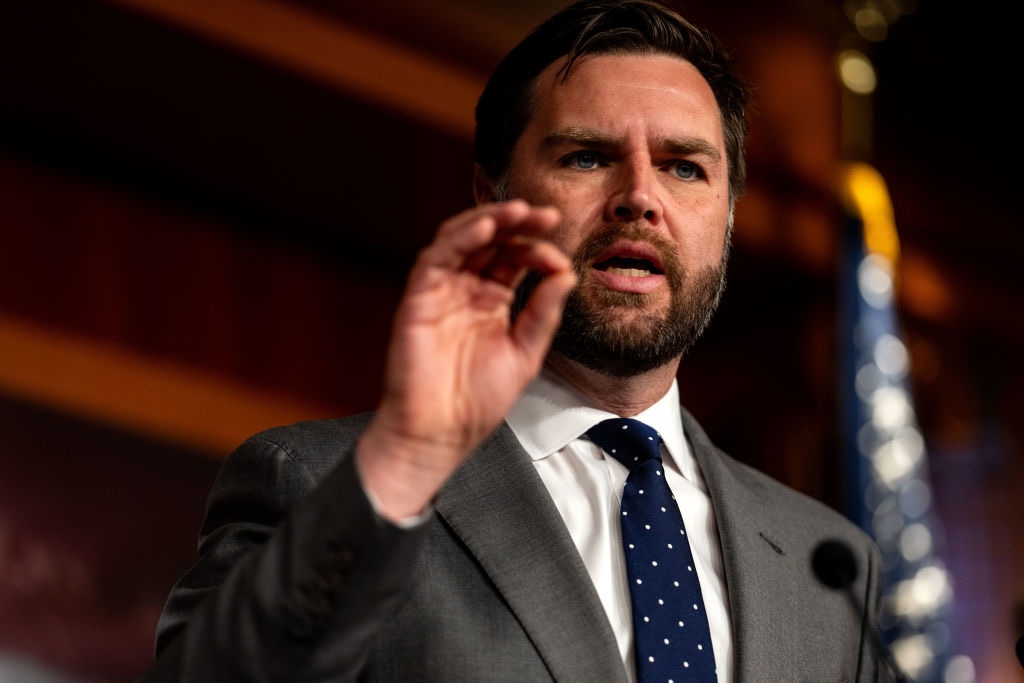
Even amid unprecedented levels of billionaire and corporate spending, the GOP and their corporate backers claim that big donors still aren’t being heard. (Kent Nishimura / Getty Images)

Amid unprecedented levels of billionaire and corporate political spending, the US Supreme Court will hear oral arguments on Tuesday in a GOP-backed effort to erode some of the last remaining limits on unfettered spending on elections.

A National Republican Senatorial Committee lawsuit, co-filed by then-senator J. D. Vance (R-OH), is asking the court to eliminate limits on political parties’ coordinated spending on candidates.

Coordinated spending limits prevent large-dollar donors from circumventing individual contribution maximums by giving to party committees, which then distribute funds to candidates. In 2001, the Supreme Court ruled against a Republican-led effort to eliminate Nixon-era limits on party-coordinated spending.

“There is little evidence to suggest that coordinated party spending limits adopted by Congress have frustrated the ability of political parties . . . to support their candidates,” Justice David Souter argued in the majority opinion.

In a new amicus brief filed to the Supreme Court, consumer interest group Public Citizen said a new ruling in the GOP leaders’ favor would turn party committees into “unlimited pools of money” and “potent sources of . . . [quid pro quo] corruption.”

A cohort of Senate Democrats filed a similar brief urging justices to block the suit, writing, “This Court should heed the lessons learned in the aftermath of Citizens United and decline the request to further distort our political process.”

Since the Supreme Court’s 2010 Citizens United ruling opened the gates to unlimited corporate spending and ushered in the super PAC era, political contributions have exploded. Between the 2008 and 2024 cycles, outside election spending rose from $574 million to $4.5 billion, a roughly 680 percent increase.

According to the GOP and their corporate backers, however, this deluge still isn’t enough for big donors to have their voices heard. They claim party-coordinated contribution limits violate their free speech rights.

The largest business interest group in the world, the US Chamber of Commerce, argued in a brief filed with the Supreme Court that the campaign finance limits in question “stifle” the operations of political parties, and thus, the economy.

“Precluding coordination by parties and their candidates undermines the availability and accuracy of electoral communication,” the chamber argued. “In this way, free association, free expression, and free enterprise are deeply intertwined.”